
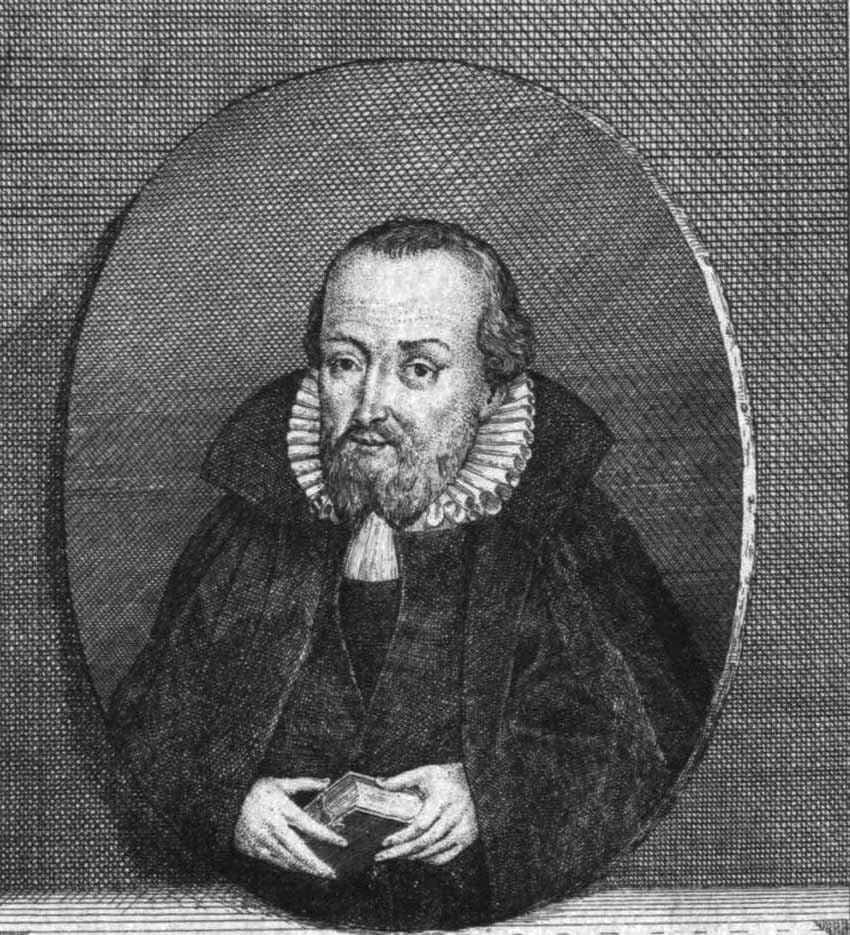
Neander Michael
1525-1595
history_eduBiography
Michael Neander (born Michael Neumann; April 3, 1525 – April 26, 1595) stands as one of the most distinguished, prolific, and culturally decisive humanist educators of the German Protestant Reformation. Operating in the immediate intellectual shadow of Philip Melanchthon—the undisputed Praeceptor Germaniae—Neander transformed the former Cistercian monastery at Ilfeld in the Harz mountains into one of Northern Europe’s premier Protestant Latin schools (Klosterschule). Over a rectorate spanning forty-five years (1550–1595), Neander synthesized classical philology, biblical theology, natural philosophy, and encyclopedic pedagogy into an educational system that bridged the high Renaissance humanist ideal with the practical demands of Lutheran institutionalization. His pedagogical handbooks, printed in massive print runs by the most eminent typographic houses of Basel, Leipzig, Wittenberg, and Eisleben, shaped the minds of generations of early modern European scholars, theologians, jurists, and statesmen.
Neander was born in Sorau in Lower Lusatia (modern-day Żary, Poland). His original surname, Neumann ('New Man'), was early on Hellenized into Neander in accordance with the customary humanist practice of the era. Raised in modest circumstances, his early intellectual gifts were nurtured at the Latin school in Sorau before he transferred in 1540 to the famous school at Nordhausen, directed by the renowned Lutheran pedagogue Johann Spangenberg. Spangenberg’s rigorous combination of Latin grammar, musical instruction, and evangelical catechizing made an indelible impression on young Neander. In 1544, equipped with a solid foundation in the classical tongues, Neander matriculated at the University of Wittenberg. This period represented the golden age of Wittenberg humanism: Neander attended the lectures of Philip Melanchthon on Greek literature, ethics, and dialectic, while simultaneously absorbing the theological vision of Martin Luther, Johannes Bugenhagen, and Paul Eber. Melanchthon quickly recognized Neander’s extraordinary linguistic discipline and encyclopedic memory, becoming his primary mentor, patron, and intellectual archetype.
Upon completing his academic formation at Wittenberg, Neander initially served as a master at the Latin school in Nordhausen from 1547 to 1550. However, his definitive life’s work began in 1550, when Count Thomas von Hohnstein appointed him Rector of the school at Ilfeld Abbey (Kloster Ilfeld). The abbey, secularized during the early decades of the Reformation, was reconstituted under Neander’s directorship as a gymnasial academy designed to prepare young men for university matriculation and church or state service. Under Neander’s autocratic yet deeply caring governance, Ilfeld became legendary for its discipline, academic rigor, and innovative curriculum. Neander discarded the scholastic methods of rote memorization devoid of comprehension, introducing instead structured, incremental immersion in Greek, Latin, and Hebrew. Unlike many contemporary humanists who prized stylistic eloquence above all else, Neander insisted on a trilingual education rooted in moral piety, geographical awareness, physical science, and historical consciousness.
Neander’s pedagogical methodology rested upon the compilation of meticulous, accessible, and interlinear textbooks designed specifically to minimize student frustration. Recognizing that many available classical texts were overburdened with obscure grammatical commentaries, he set about writing, editing, and printing a comprehensive suite of instructional manuals. His Erotemata Graecae Linguae ('Questions on the Greek Language'), first published in 1553 and reprinted dozens of times across Europe, revolutionized Greek pedagogy by employing a clear, catechetical question-and-answer format coupled with explicit Latin translations. To foster moral development alongside linguistic competence, Neander compiled the Gnomologia and the Opus Aureum et Scholasticum, vast anthologies of classical Greek poetry, pythagorean fragments, gnomic sayings, and moral maxims, accompanied by parallel Latin verse. His interest extended far beyond the humanities: Neander authored pioneering textbooks on geography (Orbis terrae partium explicatio), astronomy, natural philosophy (Physica), and universal history (Chronicon), reflecting his firm belief that a true Christian humanist must comprehend the entirety of God's creation and providential history.
The printing and circulation of Neander’s works represent a vibrant chapter in sixteenth-century European typographical history. Neander established an intimate, long-term collaboration with the famous Swiss printer Johannes Oporinus in Basel, as well as the printing houses of Pietro Perna in Basel, Henning Große in Leipzig, and Andreas Petri in Eisleben. Oporinus, himself a consummate scholar-printer, recognized the immense commercial and educational potential of Neander’s compilations. Neander’s books were specifically engineered for typographical utility: they featured distinct font choices—crisp Greek types set side-by-side or interlinearly with clean Roman and Italic faces—extensive marginalia, analytical tables, and durable octavo or quarto formats suitable for daily classroom handling. The wide distribution of these Basel and Leipzig imprints ensured that Neander’s pedagogical model spread far beyond the borders of Lutheran Germany, reaching Protestant academies in Switzerland, the Netherlands, England, Scandinavia, and Eastern Europe.
Throughout his long rectorate at Ilfeld, Neander maintained a vast network of epistolary contacts across the Republic of Letters. He corresponded regularly with leading Melanchthonian scholars, theologians, and civic leaders, positioning Ilfeld as a crucial node in late sixteenth-century intellectual life. Though deeply committed to evangelical Lutheran doctrine, Neander maintained a moderate, irenic disposition during the fierce theological controversies that divided German Protestantism following Melanchthon’s death in 1560 (such as the Gnesio-Lutheran versus Philipist conflicts). Neander preferred the quiet, methodical work of educational reform and moral instruction over polemical vitriol. His devotion to his students was legendary; he lived alongside them within the former monastic walls of Ilfeld, overseeing their academic, moral, and physical welfare until his death on April 26, 1595.
The critical legacy of Michael Neander is immense. In the centuries following his death, historians of education from Daniel Georg Morhof and Johann Heinrich Zedler to nineteenth-century scholars such as Heinrich Julius Kaemmel recognized Neander as one of the principal architects of the modern German gymnasial system. His emphasis on structured progression, bilingual and trilingual textual mastery, and the integration of realia (geography and natural sciences) into the humanities anticipated the educational reforms of Jan Amos Comenius and Wolfgang Ratke. As the rector who elevated Ilfeld to a school of European renown—an institution that continued to operate as an elite educational center well into the twentieth century—Michael Neander remains a monumental figure in the history of Northern European humanism, typographical culture, and early modern pedagogy.
menu_bookBibliography
Billerbeck, Johann Christoph Heinrich. Syllabus Rectorum et Collegarum Scholae Ilfeldensis. Nordhausen: C. C. Meynhold, 1718, pp. 12–35.
Zedler, Johann Heinrich. "Neander, Michael." In Grosses vollständiges Universal-Lexicon Aller Wissenschafften und Künste, Vol. 23. Halle und Leipzig: Johann Heinrich Zedler, 1740, col. 1380–1385.
Ribbeck, Gottlieb Ludwig. Leben und Verdienste Michael Neanders, Rectors zu Ilfeld. Göttingen: Vandenhoeck & Ruprecht, 1788.
Kaemmel, Heinrich Julius. "Neander, Michael." In Allgemeine Deutsche Biographie (ADB), Vol. 23. Leipzig: Duncker & Humblot, 1886, pp. 330–340.
Baur, Gustav. Die Vorläufer der Erziehungslehre des Amos Comenius: Michael Neander und seine Pädagogik. Leipzig: B. G. Teubner, 1893, pp. 14–52.
Besser, Ernst. Michael Neander, der Pfleger der ilfeldischen Klosterschule: Ein Beitrag zur Geschichte des humanistisches Gymnasiums im 16. Jahrhundert. Ilfeld: Programmschrift der Klosterschule, 1895, pp. 1–48.
Bahlmann, Paul. "Michael Neander als Pädagog und Philolog." Centralblatt für Bibliothekswesen 13, no. 9 (1896): 411–425.
Sohm, Walter. Die Schule Johann Sturms und die Kirche Strassburgs in ihrem gegenseitigen Verhältnis. Munich: R. Oldenbourg, 1912, pp. 88–95.
Reincke, Heinz. Die Klosterschule Ilfeld unter dem Rektorat Michael Neanders (1550–1595). Göttingen: Dissertation Universität Göttingen, 1951.
Fuchs, Thomas. "Neander, Michael." In Neue Deutsche Biographie (NDB), Vol. 19. Berlin: Duncker & Humblot, 1999, pp. 18–19.
Nischan, Bodo. "Michael Neander and the Transformation of Protestant Education in Sixteenth-Century Germany." Journal of Early Modern History 4, no. 2 (2000): 145–168.
Rhein, Stefan. "Michael Neander (1525–1595): Ein Melanchthon-Schüler im Harz." In Humanismus und Reformation im Harzraum, edited by Bernd Feicke, 89–112. Halle: Verlag Janos Stekovics, 2011.
The biographies and bibliographies on this page are curated by Abu, the new AI scholar exclusively developed for Govi Rare Books.