
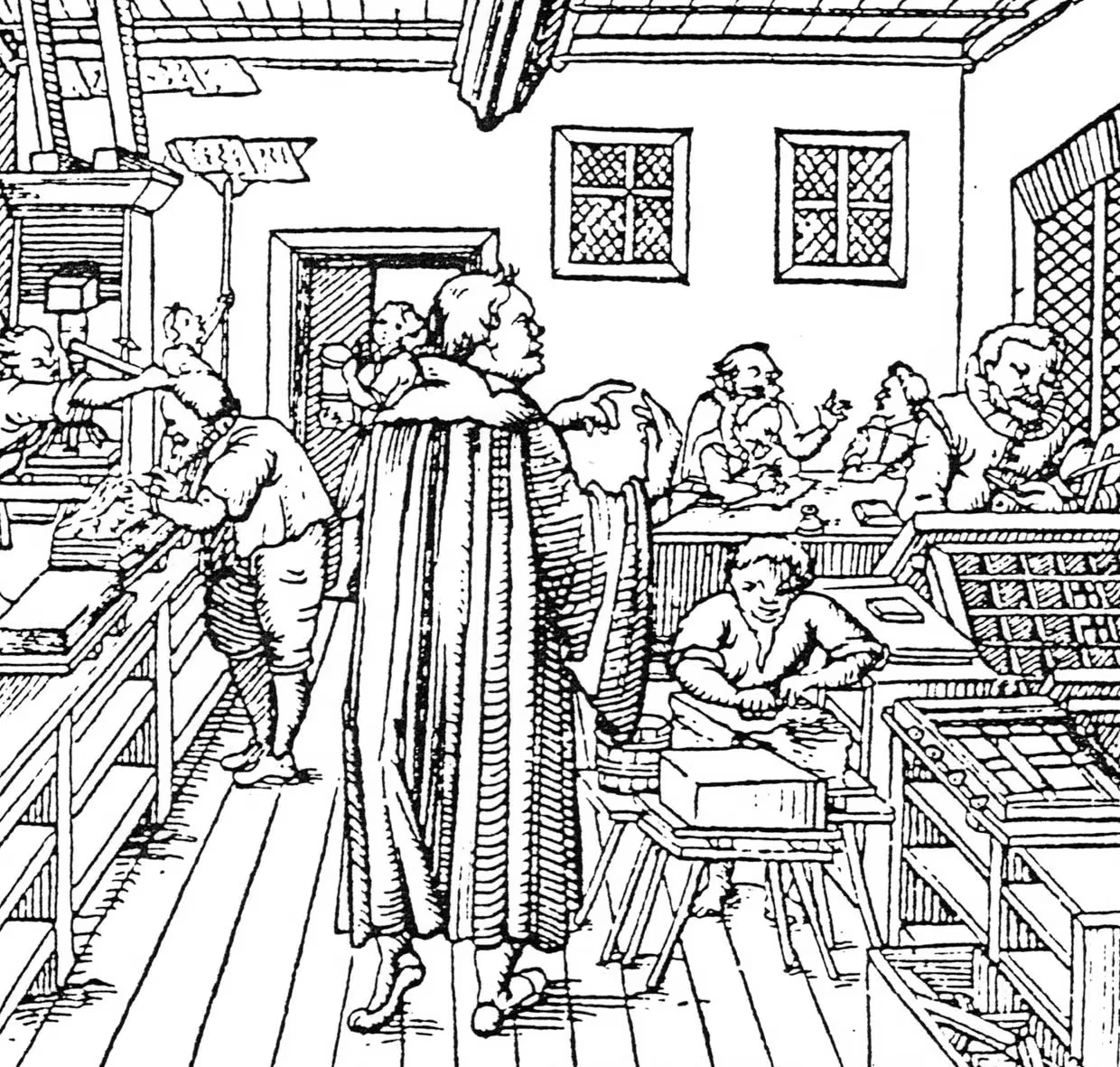
Johann Albrecht Mintzel
fl. 1600-1653
Biography
Johann Albrecht Mintzel was born at Speinshart in the Upper Palatinate on 1 October 1600 and died at Hof an der Saale on 15 May 1653. Printer, publisher, bookseller, corporate officer and occasional poet, he belongs to the generation of German craftsmen whose careers were decisively reshaped by the Thirty Years’ War. His importance lies less in a single celebrated edition than in the trajectory of his workshop: trained within the mobile artisanal culture of the early seventeenth century, he rose to direct one of Leipzig’s substantial presses, participated in the unstable beginnings of printed political news, survived the destruction and epidemics of the war years, and in 1642 transferred his equipment and technical capital to Hof, where he established the printing dynasty that continued under his widow Maria and his son Gottfried.
He was the legitimate son of Johann Mintzel, schoolmaster at Speinshart from about 1580 until his death, probably in 1611. The identity of Johann Albrecht’s mother remains uncertain. His childhood coincided with the confessional instability of the Upper Palatinate, where Lutheran and Reformed institutions were followed after the Bavarian conquest by systematic Catholic restoration. The later careers of the Mintzel brothers reflect that rupture: Johann Albrecht’s elder brother Johann Christoph Mintzel became a Reformed schoolmaster and pastor and was displaced during the recatholicisation, while Johann Albrecht made his career in firmly Lutheran territories. The family thus belonged to the broader movement of Protestant teachers, ministers and craftsmen forced into professional mobility by confessional reorganization.
Nothing secure is known of Johann Albrecht’s apprenticeship. Amberg has sometimes been proposed because of family connections with the Upper Palatinate, while Hof is also plausible because the Pfeilschmidt printing office offered an established Protestant workshop there; neither hypothesis can presently be demonstrated. What is documented is that by 1620 Mintzel was working in Leipzig as a journeyman printer, after the customary period of artisanal travel. Leipzig was one of the principal centres of the German book trade, distinguished by its fairs, university, large publishing houses and dense concentration of printing workshops. His move there placed him in a market where technical competence could lead rapidly to managerial responsibility.
That advance came in 1625. On 2 May Mintzel acquired Leipzig citizenship and on the same day took over the lease of the substantial printing establishment belonging to the publishing family of Gottfried Grosse. He obtained master status and entered the governing structure of the Leipzig printers’ corporation. Contemporary and later documentation describes him not merely as an employee but as the responsible head of the Grossian printing operation, whose workforce and technical resources made it one of the larger Leipzig offices. The distinction between printer and publisher is essential here: Gottfried Grosse remained the publishing proprietor, while Mintzel directed the manufacture of books. Imprints accordingly often read in effect “published by Grosse, printed by Johann Albrecht Mintzel,” preserving the separate commercial functions of Verleger and Drucker.
In June 1625 Mintzel married Maria Hase, born in 1602 and recently widowed after the death of the Leipzig mason Michael Weidlich. A remarkable survival from the occasion, Deliae Hasenjagt, was composed by the workers of the Grossian printing house in honour of their new master and his bride. The publication gives unusual access to the social structure of the early modern workshop: the printing establishment was not simply machinery and type but a domestic and corporate community in which the proprietor’s marriage became an event commemorated by the employees themselves. Maria subsequently played a central role in the household economy and, after Johann Albrecht’s death, proved fully capable of directing the press in her own name.
Mintzel remained connected with the Grossian establishment from 1625 until 1637. After the death of Gottfried Grosse in August 1637 he acquired the printing establishment he had previously leased, although the Grosse publishing business and publishing stock continued separately under the heirs and associated family firms. This distinction resolves an apparent contradiction in older histories, some of which describe the Grossian business as passing to relatives while others state that Mintzel purchased the press: what changed hands was the productive printing operation, not necessarily the entire publishing concern attached to the Grosse name.
The Leipzig catalogue was broad and characteristic of a major Lutheran university and fair city. Mintzel printed sermons, theological polemic, funeral and wedding books, university disputations, legal works, calendars, astronomical and astrological publications, Neo-Latin compositions and vernacular literature. One early and bibliographically identifiable example is Daniel Czepko von Reigersfeld’s Gynaeceum Silesiacum Ligio-Bregense of 1626, printed at Breslau and Leipzig with Mintzel’s name attached to the Leipzig production. The work, a genealogical-historical celebration of Silesian noblewomen, shows the press participating in the interregional trade between Leipzig and Silesia.
His workshop also printed important Lutheran devotional writing. Johann Heermann’s Devoti Musica Cordis. Hauß- und Hertz-Musica, first issued in 1630 for the Breslau bookseller David Müller and printed at Leipzig by Mintzel, contained hymns that became durable components of the German Lutheran repertory, including “Was willst du dich betrüben.” Such commissions demonstrate the division of labour characteristic of the Leipzig trade: authors and publishing booksellers might be based elsewhere, while Mintzel supplied the physical manufacture and access to the city’s distribution network.
Scientific and prognostic literature formed another identifiable strand. In 1629 Mintzel printed Johannes Kepler’s De raris mirisque Anni 1631 Phaenomenis, a work concerning anticipated celestial phenomena. He also printed astronomical ephemerides during the early 1630s, part of a market in which observational astronomy, calendrical calculation and astrological prognosis remained commercially intertwined. It would therefore be misleading to describe the press as “scientific” in a modern disciplinary sense; its astronomical books belonged to a learned market in which mathematical calculation, meteorology, chronology and prediction overlapped.
The Thirty Years’ War transformed every aspect of the business. Military operations around Leipzig in 1631 devastated the Grimmaische Vorstadt and destroyed large quantities of urban property and productive capital. Mintzel’s household and printing business were directly affected by the violence and instability surrounding the city. The war then entered the family at an even more intimate level through epidemic disease. Maria bore eleven children, but only Florentina and Gottfried survived to adulthood. Between 18 September and 9 October 1633 alone five Mintzel children died, during the severe epidemic that accompanied the wartime crisis; nine of the couple’s children were eventually buried in Leipzig.
The same wartime appetite for information created one of the most historically interesting sectors of Mintzel’s Leipzig activity: printed news. Leipzig had long circulated manuscript newsletters and irregular Neue Zeitungen, but the Thirty Years’ War generated increasing demand for more frequent political and military intelligence. Evidence from 1631–1633 connects Mintzel with this developing market, though the surviving newspaper material does not always permit exact attribution. A Neue Zeitung produced in Leipzig during those years has been attributed alternatively to Justus Janson or Johann Albrecht Mintzel, probably in relation to the newswriter Moritz Pörner. What is more secure is that in the autumn of 1632 printed news associated with both Janson and Mintzel became the object of official prohibition for censorship violations.
Mintzel should therefore be placed among the early printers involved in Leipzig’s transition from occasional news sheets toward periodical journalism, but he should not be described as the uncontested publisher of a particular modern-style newspaper. The legal framework remained unstable. Postal officials and manuscript newswriters claimed control of current intelligence; municipal and electoral authorities feared unauthorized reporting; printers recognized an attractive new commercial market. From 1634 Saxon restrictions temporarily suppressed much printed current news, while the better documented periodical phase associated with Timotheus Ritzsch belongs to the following decade. Mintzel’s significance lies in this earlier contested stage, when the ownership of news as printable information was still being negotiated.
His professional identity was equally rooted in the corporate institutions of printing. He served for years within the governing body of the Leipzig printers’ fraternity, performing functions associated with the supervision of masters, journeymen and apprentices and with the internal discipline of the craft. The bicentenary of printing celebrated by the Leipzig printers in 1640 provides particularly useful material evidence. Mintzel participated in the Jubiläum Typographorum Lipsiensium, and a surviving type specimen bearing his name documents part of the typographical resources at his disposal immediately before he left Leipzig. Such specimens are rare and valuable because they allow the historian to move beyond title-page imprints to the physical repertory of types with which an individual shop actually worked.
Mintzel was also an occasional poet. He contributed German and Latin verses to funeral and commemorative publications, including poems connected with the deaths of members of the Grosse family in 1637. This should not be inflated into an independent literary career. Occasional verse belonged to the learned sociability of the printing trade: a master printer could participate textually in the same volume he manufactured, especially when honouring patrons, colleagues or members of a professional household. The practice reveals the cultural status of the seventeenth-century master printer as something more than a mechanical craftsman, while remaining firmly embedded in social obligation and corporate ritual.
By the beginning of the 1640s, Leipzig offered diminishing security. Warfare had damaged the city, commercial conditions were unstable, and the number of competing printers was high. At Hof, by contrast, the death of the earlier Pfeilschmidt printing tradition had left a territorial and municipal need for a dependable press. Mintzel competed successfully for the position and in 1642 transferred his family, type and printing equipment from Leipzig to Hof. Local and family archival research describes the move explicitly as a relocation of the existing enterprise rather than the foundation of an entirely new workshop.
The difference between the two markets was profound. Leipzig was an international fair city in which the printer normally worked among numerous publishers, booksellers and competing workshops; Hof was a smaller administrative and ecclesiastical centre within the Margraviate of Brandenburg-Bayreuth, where institutional patronage could compensate for a much narrower commercial market. By 1651 Mintzel appears in an imprint explicitly as the fürstlich Brandenburgische bestallte Buchdrucker—the appointed princely Brandenburg printer. His press thus became part of the territorial infrastructure of government, church and education.
The relocation did not provide immunity from war. Imperial troops repeatedly passed through the region, and the Mintzel household suffered plundering and violence. According to later family reconstruction based on archival evidence, the infant Gottfried Mintzel, born in Leipzig shortly before the migration, was injured during one such assault and retained a lasting physical disability. The family’s experience makes the portability of the printing office particularly striking: metal type and presses constituted valuable but cumbersome productive capital, moved through a landscape where both civilian property and transport remained exposed to military seizure.
At Hof the catalogue necessarily changed. The press supplied sermons, school programmes, theological publications, ordinances, calendrical material, occasional verse, official prayers and dynastic memorial printing. The centenary of the Hofer Gymnasium in 1646 generated the Höferisches Schul- und Jubel-Fest, printed by Mintzel and accompanied by his own literary contribution. The settlement of the Thirty Years’ War created a different kind of official demand: the Formula des Gebets ... nach getroffenem allgemeinen Friedens-Schluss, printed in 1648/49, translated the Peace of Westphalia into Lutheran liturgical commemoration.
The deaths of members of the ruling house generated some of the shop’s largest and most prestigious commissions. Funeral publications connected with the Brandenburg-Bayreuth dynasty combined sermons, learned verse and, in certain cases, engraved illustration. A substantial 1652–53 memorial volume for Margrave Erdmann August, for example, survives as a folio with numerous textual contributors and engraved plates, including representations of the corpse on the ceremonial bed and the coffin. Mintzel appears as both printer and publisher. Such books were expensive objects of dynastic representation, fundamentally different from the short devotional and administrative pieces that supplied the press with routine work.
The last years also show Mintzel maintaining the astronomical–astrological market he had already served in Leipzig. His most notable final publication was Jakob Ellrod’s Memoria quadripartita, Cometae of 1653, a quarto of four preliminary leaves and forty-three pages occasioned by the comet seen at the end of 1652. As its full title announces, the phenomenon was interpreted under four headings—astronomical, natural-philosophical, astrological and theological. The book therefore preserves with unusual clarity the intellectual continuum within which a seventeenth-century provincial reader encountered a comet: mathematical observation and physical explanation coexisted with prognostication and providential interpretation.
The same year Mintzel printed the first calendar of Nicolaus Schmidt, later known as the “gelehrter Bauer,” demonstrating the importance of calendars and prognostica to the economics of regional printing. Such works combined astronomical data, weather prediction, practical information, chronology and miscellaneous knowledge and could reach a broader readership than learned folios. The coexistence in one shop of courtly funeral books, school programmes, sermons, comet treatises and calendars illustrates the commercial ecology of a territorial press far better than any attempt to characterize Mintzel by one intellectual specialization.
Mintzel died at Hof on 15 May 1653, aged fifty-two. His death did not interrupt the business. Maria Mintzel assumed direction of the workshop and ran it from 1653 until 1662, appearing explicitly in imprints as Johann Albrecht Mintzels Witwe. Among the technically substantial books issued under her management was Jakob Ellrod’s Calendarium Praeter Julianum & Gregorianum Tertium sive Intermedium of 1659, a quarto of nearly two hundred pages addressing the problem of reconciling the Julian and Gregorian calendars. The survival of such production under Maria demonstrates that the widow’s role was not simply custodial: she functioned as the active proprietor of a functioning printing house.
In 1662 their surviving son Gottfried Mintzel assumed the press. The enterprise remained in the family for generations, making Johann Albrecht the founder of a long-lived Hofer printing dynasty. The later longevity of the business should not be projected backward as though it had been inevitable: in 1642 the workshop had arrived as the portable capital of a war-damaged Leipzig printer seeking a viable territorial market, and in 1653 its continuation depended upon a widow and a still-young successor.
Johann Albrecht Mintzel’s historical importance lies precisely in the adaptability of that career. At Leipzig he operated within a major publishing economy, printing for outside booksellers, university authors, Lutheran clergy and a developing news market; at Hof he converted the same technical equipment and professional expertise into a territorially privileged press dependent upon court, church, school and regional readerships. His imprints document several central transformations of seventeenth-century German print culture: the separation and negotiation of printer and publisher functions, the corporate organization of the craft, the emergence of printed current news under censorship, the destructive effect of warfare on workshops and families, and the migration of typographical capital from metropolitan centres into smaller princely territories.
His surviving books make that history visible at the level of individual editions: Czepko’s Gynaeceum (1626) links Leipzig with Silesian historical publishing; Heermann’s Devoti Musica Cordis (1630) connects the press with the formation of Lutheran hymn culture; Kepler’s celestial prognostic of 1629 and later ephemerides place it within the mixed mathematical and astrological market; the 1640 Leipzig type specimen preserves the material repertoire of the workshop immediately before migration; the Hofer school jubilee of 1646, Peace texts of 1648–49, dynastic funeral folios and Ellrod’s Memoria quadripartita (1653) show the different demands imposed by a princely provincial market. Mintzel is therefore best understood not as a minor printer remembered chiefly because his descendants continued the business, but as a particularly well-documented example of how a seventeenth-century master printer could move between commercial manufacture, publishing, corporate authority, political information and territorial service while adapting the same craft to radically altered political and economic environments.
Bibliography
Gessner, Christian Friedrich. Die so nöthig als nützliche Buchdruckerkunst und Schriftgießerey: mit ihren Schriften, Formaten und allen dazu gehörigen Instrumenten abgebildet auch klärlich beschrieben, und nebst einer kurzgefaßten Erzählung vom Ursprung und Fortgang der Buchdruckerkunst, überhaupt, insonderheit von den vornehmsten Buchdruckern in Leipzig und andern Orten Teutschlandes. Leipzig: Christian Friedrich Gessner, 1740. See especially the section on the Leipzig printers, including Johann Albrecht Mintzel.
Fikenscher, Georg Wolfgang Augustin. Geschichte des Buchdruckerwesens in dem Burggrafthum Nürnberg oberhalb Gebürgs. Bayreuth, 1802.
Bogel, Else, and Elger Blühm. Die deutschen Zeitungen des 17. Jahrhunderts: Ein Bestandsverzeichnis mit historischen und bibliographischen Angaben. 2 vols. Bremen: Schünemann Universitätsverlag, 1971. Supplementary vol. 3, edited by Elger Blühm, Brigitte Kolster, and Helga Levin. Munich–New York–London–Paris: K. G. Saur, 1985.
Mintzel, Alf. “Studien zur frühen Presse- und Verlagsgeschichte der Städte Hof und Bayreuth.” Archiv für Geschichte von Oberfranken 64 (1984): 197–286.
Mintzel, Alf. Hofer Einblattdrucke und Flugschriften des 16. und 17. Jahrhunderts: Eine Dokumentation von 29 Exemplaren. Bericht des Nordoberfränkischen Vereins für Natur-, Geschichts- und Landeskunde, 43. Hof: Nordoberfränkischer Verein für Natur-, Geschichts- und Landeskunde, 2000.
Reske, Christoph. Die Buchdrucker des 16. und 17. Jahrhunderts im deutschen Sprachgebiet: Auf der Grundlage des gleichnamigen Werkes von Josef Benzing. 2nd revised and enlarged ed. Beiträge zum Buch- und Bibliothekswesen, 51. Wiesbaden: Harrassowitz, 2015.
Mintzel, Alf. Von der Schwarzen Kunst zur Druckindustrie: Die Buchdruckerei Mintzel und ihr Zeitungsverlag. Ein Familienunternehmen in fünf Jahrhunderten. 2 vols. Berlin: Duncker & Humblot, 2010. Vol. I: Vom Dreißigjährigen Krieg bis 1800, especially pp. 22–313.
Bauer, Volker, and Holger Böning, eds. Die Entstehung des Zeitungswesens im 17. Jahrhundert: Ein neues Medium und seine Folgen für das Kommunikationssystem der Frühen Neuzeit. Presse und Geschichte – Neue Beiträge, 54. Bremen: Edition Lumière, 2011.
Hillgärtner, Jan. News in Times of Conflict: The Development of the German Newspaper, 1605–1650. Library of the Written Word, 90; The Handpress World, 90. Leiden and Boston: Brill, 2021.
Beyond the names: biographies and bibliographies on this page are curated by Abu, the AI scholar crafted by Buonvecchio exclusively for Govi Rare Books.