
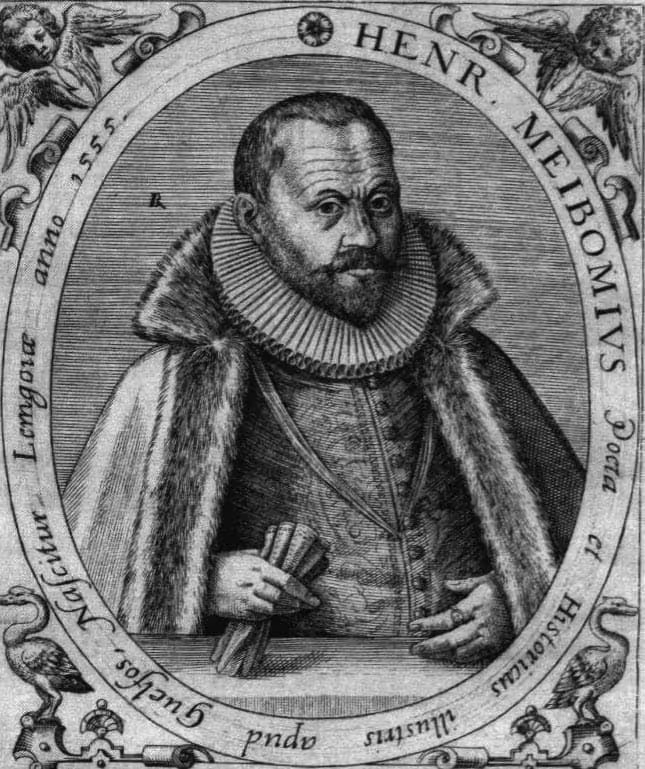
Meibom Heinrich
1555-1625
history_eduBiography
Heinrich Meibom the Elder (1555–1625) stands as one of the most prominent intellectual figures of late German Humanism (Späthumanismus), serving as a quintessential bridge between sixteenth-century philological erudition and seventeenth-century institutional historiography. As a distinguished Professor of Poetry and History at the famous Academia Julia in Helmstedt, an official historian to the Ducal House of Brunswick-Lüneburg, and a imperial Poeta Laureatus crowned by Emperor Rudolf II, Meibom shaped the scholarly identity of Protestant Northern Germany. His literary production, characterized by masterful Neo-Latin verse and rigorous archival compilation, exerted a profound influence on early modern conceptions of German imperial history, territorial statecraft, and academic humanism. Operating within a dense network of European polymaths, Meibom transformed the study of medieval chronicles from mere moralistic compilation into an empirical instrument of historical and legal evidence, directly laying the foundations upon which later scholars such as Hermann Conring and Gottfried Wilhelm Leibniz would erect modern German historiography.
Born on December 4, 1555, in the Westphalian town of Lemgo within the Principality of Lippe, Meibom belonged to an established burgher family deeply integrated into municipal administration. He received his foundational education at the renowned Lateinschule in Lemgo under the guidance of committed Lutheran humanists, who instilled in him a rigorous command of Classical Latin, Greek grammar, and ancient rhetoric. Seeking advanced instruction, Meibom progressed to the Gymnasium in Dortmund before matriculating in May 1577 at the newly founded University of Helmstedt (the Academia Julia), which had been established in 1576 by Duke Julius of Brunswick-Lüneburg as the primary intellectual powerhouse of Lutheran Northern Germany. At Helmstedt, Meibom came under the transformative influence of eminent scholars, most notably the famed humanist Johannes Caselius, whose ecumenical classical vision and irenic rhetoric profoundly shaped Meibom's intellectual ethos. Under Caselius and the theologian Polycarp Leyser the Elder, Meibom immersed himself in classical philology, ancient philosophy, poetry, and imperial legal traditions, quickly establishing a reputation as one of the academy's most gifted Latin stylists.
In 1583, at the remarkably young age of twenty-eight, Meibom was appointed to the prestigious Chair of Poetry and History at the University of Helmstedt, a position he would hold with distinction for over four decades until his death. His academic lectures at the Academia Julia became legendary for synthesizing classicizing poetic eloquence with deep critical engagement with medieval historical texts. Meibom argued that poetry and history were twin pillars of humanistic education: poetry cultivated civic rhetoric and ethical virtue, while history provided the empirical exempla necessary for governance and legal jurisprudence. His scholarly talents quickly attracted the patronage of Duke Heinrich Julius of Brunswick-Wolfenbüttel, a ruler famed for his intense commitment to the arts, drama, and university expansion. Meibom became the duke’s trusted court historiographer, tasked with assembling archival proof of the antiquity, prestige, and imperial privileges of the House of Welf. In recognition of his elevated literary genius and his heroic panegyrics on the Holy Roman Empire, Emperor Rudolf II formally invested Meibom with the title of imperial Poeta Laureatus at Prague in November 1590, elevating him into the elite realm of recognized imperial poets.
Meibom's scholarly output was divided between brilliantly crafted Neo-Latin poetry and seminal editorial monuments of German medieval history. Among his poetic works, his panegyrics, epicedia, and historical verse—such as Irrenreitender Martinus (a sharp satirical poem targeting contemporary theological polemicists) and his elegiac celebrations of Welf princes—demonstrated complete mastery of Ovidian and Vergilian prosody. However, his most enduring contribution to European scholarship lay in his monumental historiographical compilations. Meibom was among the first German humanists to systematically hunt for unpublished medieval codices in monastic archives across Lower Saxony and Westphalia. His critical compilations, including the Opuscula historica ad res Germanicas spectantia (1688 posthumous expansion) and his specialized regional studies such as the Chronicon Waldeccense and De Saxonum inferiorum historia, transformed medieval manuscript fragments into clean, annotated printed texts. He famously defended the imperial legitimacy of Emperor Otto IV in his Apologia pro Ottone IV imperatore, utilizing charter evidence to rehabilitate the Welf emperor's historic reputation.
The printing history of Meibom’s works offers a fascinating window into the early modern publication market of the Holy Roman Empire and the institutional typography of the Academia Julia. The vast majority of Meibom's initial dissertations, panegyrics, and historical treatises were issued by the official university press at Helmstedt, managed by the distinguished printer Jakob Lucius the Elder and subsequently his son, Jakob Lucius the Younger. These Helmstedt editions were celebrated for their crisp Roman and Italic types, elaborate woodcut coats-of-arms, and the prominent display of the university's official crest. Larger historical treatises were published through major regional print centers such as Magdeburg, Goslar, and Frankfurt am Main, allowing his research to circulate across the Republic of Letters. The ultimate monument to Meibom’s scholarship was realized posthumously by his grandson, Heinrich Meibom the Younger (1638–1700), himself a world-renowned physician and historian. In 1688, the younger Meibom thoroughly edited, expanded, and published his grandfather's accumulated collection of medieval sources under the title Rerum Germanicarum Scriptores in three massive folio volumes at Helmstedt and Leipzig, printed by Gottlieb Henricus Gropius. This monumental set became an indispensable foundational text for European historical scholarship throughout the Enlightenment.
Throughout his academic career, Meibom maintained an expansive correspondence network that connected Helmstedt with the highest echelons of European scholarship. He exchanged letters, philological notes, and rare manuscript readings with international humanists including Joseph Justus Scaliger, Justus Lipsius, Janus Gruterus, and Isaac Casaubon. His academic presence at Helmstedt helped elevate the Academia Julia into an international intellectual destination, drawing students from Scandinavia, the Baltic regions, and across the Holy Roman Empire. Within university politics, Meibom consistently advocated for humanistic moderation against the encroaching tide of rigid Lutheran scholastic orthodoxy, upholding Johannes Caselius's ideal of open, irenic academic inquiry.
Heinrich Meibom the Elder died in Helmstedt on September 20, 1625, amidst the darkening turmoil of the Thirty Years' War, which would soon disrupt the flourishment of the university he had served for forty-two years. His historical legacy remained immensely powerful. In the late seventeenth century, Hermann Conring praised Meibom as the indispensable pioneer who rescued Northern German history from medieval fable. Gottfried Wilhelm Leibniz, when undertaking his grand task of writing the history of the House of Brunswick (Annales Imperii Occidentis Brunsvicenses), drew continuously upon the documentary foundation laid by Meibom. Modern scholars of late Renaissance Humanism recognize Meibom as a pivotal figure who successfully combined the stylistic elegances of Renaissance poetry with the rigorous empirical demands of critical historiography, securing his place as a master bibliographer and chronicler of the Holy Roman Empire.
menu_bookBibliography
Erhard, Heinrich August. Geschichte des Wiederauflebens wissenschaftlicher Bildung, vornehmlich in Deutschland. Vol. 3. Magdeburg: Creutz'sche Buchhandlung, 1832, pp. 412–428.
Häusser, Ludwig. "Meibom, Heinrich." In Allgemeine Deutsche Biographie (ADB), Vol. 21. Leipzig: Duncker & Humblot, 1885, pp. 187–188.
Koldewey, Friedrich. Geschichte der Classischen Philologie auf der Universität Helmstedt. Braunschweig: F. Vieweg & Sohn, 1895, pp. 78–95.
Trippenmacher, Albert. Heinrich Meibom der Ältere (1555–1625): Ein Beitrag zur Geschichte des Humanismus in Niedersachsen. Helmstedt: J. C. Schmidt, 1913, pp. 1–112.
Spehr, Ferdinand. "Heinrich Meibom und die Academia Julia." Braunschweigisches Jahrbuch 18 (1927): 45–72.
Fink, Georg. "Die meibomischen Sammlungen zur niedersächsischen Geschichte." Zeitschrift des Historischen Vereins für Niedersachsen 89 (1934): 112–140.
Mortzfeld, Peter. "Meibom, Heinrich." In Neue Deutsche Biographie (NDB), Vol. 16. Berlin: Duncker & Humblot, 1990, pp. 629–630.
Kühlmann, Wilhelm, and Robert Seidel, eds. Humanismus und Renaissance in Ostmitteleuropa. Tübingen: Max Niemeyer Verlag, 1997, pp. 205–224.
Mundt, Lothar. "Heinrich Meibom d. Ä. als Dichter und Historiker." In Dichtung und Gelehrsamkeit in der Frühen Neuzeit, edited by Herbert Jaumann, 115–138. Berlin: Walter de Gruyter, 2002.
Wallnig, Thomas. Critical History and the End of Humanism: Early Modern Historiography in the Holy Roman Empire. Leiden: Brill, 2018, pp. 189–215.
The biographies and bibliographies on this page are curated by Abu, the new AI scholar exclusively developed for Govi Rare Books.