
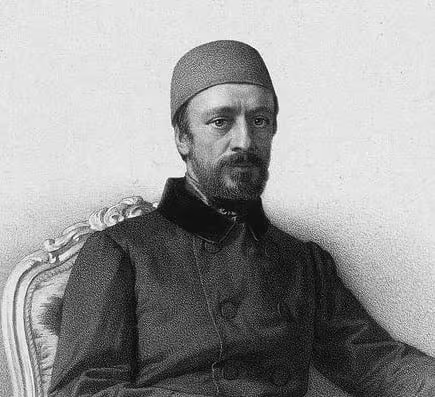
Mehmed Emin Ali Pasha
1815 - 1871
Biography
Mehmed Emin Âli Pasha (1815–1871) stands as one of the most formidable, complex, and decisive statesmen in the history of the late Ottoman Empire. As a preeminent architect of the Tanzimat (literally 'Reorganization') era—the sweeping period of administrative, legal, military, and social modernization spanning from 1839 to 1876—Âli Pasha represented the apex of bureaucratic autocracy and diplomatic Realpolitik at the Sublime Porte (Bâb-ı Âli). Serving five distinct terms as Grand Vizier (Sadrazam) and eight terms as Minister of Foreign Affairs (Hariciye Nazırı), his political career spanned four decades of intense existential crisis for the Ottoman state.
Working in close alignment with his mentor, Mustafa Reşid Pasha, and his lifelong political ally, Keçecizade Fuad Pasha, Âli Pasha navigated the empire through the geopolitical cataclysms of the mid-nineteenth century, notably the Crimean War (1853–1856), the Congress of Paris (1856), the Cretan Insurrection (1866–1869), and the rapid expansion of European economic and political hegemony across the Near East. His legacy remains a subject of profound historiographical debate: to his supporters and European contemporaries, he was the consummate diplomat and rationalist administrator who preserved the structural integrity of the empire through legal equalization and institutional secularization; to his domestic critics, particularly the intellectual figures of the Young Ottoman movement, he was an autocratic oligarch who subverted traditional Islamic governance, alienated religious sensibilities, and capitulated to Western imperial pressures.
Born on March 5, 1815, in the Mercan quarter of Istanbul, Mehmed Emin was the son of Ali Rıza Efendi, a modest shopkeeper and petty official associated with the Spice Bazaar. In an imperial system historically dominated by military elites or established bureaucratic dynasties, Âli Pasha's social origins were decidedly humble, highlighting the meritocratic pathways created by the administrative reforms of Sultan Mahmud II (r. 1808–1839). Lacking elite patronage, the young Mehmed Emin received his initial education in local neighborhood Koran schools and madrasas before securing an entry-level clerkship in the imperial bureaucracy. His breakthrough occurred in 1830 when he gained admission to the Tercüme Odası (the Sublime Porte's Translation Office). Established as a crucial instrument of state after the Greek War of Independence (1821–1829)—which had eroded the Porte's traditional reliance on Phanariot Greek interpreters—the Translation Office functioned as the primary nursery for a new generation of Westernizing Muslim diplomat-statesmen. It was within this intellectual incubator that Mehmed Emin acquired fluency in French, mastered administrative Ottoman Turkish, and absorbed classical Persian and Arabic prose. Recognizing his extraordinary intellect, meticulous work ethic, and calm temperament, his superiors bestowed upon him the honorific name Âli ('Exalted'), by which he would be known for the remainder of his life.
Âli Pasha's formative exposure to European international relations occurred during a series of diplomatic postings in major European capitals. In 1836, he was dispatched to Vienna as a secretary to the Ottoman embassy, where he observed firsthand the Austrian bureaucratic apparatus and studied Prince Klemens von Metternich’s conservative statecraft. In 1838, he was transferred to London as embassy secretary under Mustafa Reşid Pasha, the principal architect of the Edict of Gülhane (1839). Reşid Pasha recognized Âli's exceptional diplomatic acumen and mentored him in the intricacies of European diplomacy, international law, and constitutional theory.
Following brief appointments as ambassador to London (1841–1844) and member of the Supreme Council of Judicial Ordinances (Meclis-i Vâlâ-yı Ahkâm-ı Adliye), Âli Pasha was appointed Minister of Foreign Affairs for the first time in 1846, a position he would hold intermittently for nearly twenty-five years. His political philosophy crystallized during this period around the doctrine of Osmanlıcılık (Ottomanism)—an ideological framework aimed at fostering a supra-religious, civic identity among the empire's diverse Muslim, Christian, and Jewish populations. By guaranteeing legal equality, security of life and property, and non-discriminatory taxation regardless of confessional affiliation, Âli Pasha sought to neutralize Balkan ethno-nationalism and dismantle the pretexts used by European powers, particularly Tsarist Russia, to intervene in Ottoman domestic affairs.
The apex of Âli Pasha's international prestige arrived with the conclusion of the Crimean War. Serving as Grand Vizier, he represented the Ottoman Empire as chief plenipotentiary at the Congress of Paris in 1856. Alongside Fuad Pasha, Âli Pasha negotiated the Treaty of Paris (March 30, 1856), which formally incorporated the Ottoman Empire into the Public Law and Concert of Europe, guaranteed its territorial integrity, and neutralized the Black Sea. Prior to the signing of the treaty, and under direct pressure from Britain and France, Âli Pasha drafted and promulgated the landmark Islahat Fermanı (Imperial Reform Edict of February 18, 1856).
This monumental decree radically expanded the principles of the 1839 Gülhane Edict by granting full civil and political equality to non-Muslim subjects, opening state employment and military service to all citizens, authorizing non-Muslim participation in local administrative councils, and sanctioning the reform of Christian millet governance. On the domestic front, Âli Pasha enacted groundbreaking structural reforms that reshaped the Ottoman state apparatus. In 1864, he oversaw the enactment of the Vilayet Law (Provincial Reform Ordinance), which restructured provincial administration into rationalized administrative units governed by centralized provincial governors (vali). In 1868, he established the Şura-yı Devlet (Council of State), a supreme administrative tribunal and legislative advisory body co-founded with Midhat Pasha, and inaugurated the Lycée de Galata-Saray (Mekteb-i Sultani), an elite secular French-medium school designed to educate Muslim and non-Muslim youths together for civil service.
Âli Pasha's governance was characterized by an unyielding commitment to bureaucratic centralism and state supremacy, which inevitably brought him into fierce conflict with emerging political movements. The mid-1860s witnessed the rise of the Young Ottomans (Yeni Osmanlılar), a group of dissident intellectuals and journalists—including Namık Kemal, Ziya Pasha, and Ali Suavi—who launched scathing critiques against Âli Pasha and Fuad Pasha in newly established private newspapers such as Tasvir-i Efkâr and Hürriyet. The Young Ottomans condemned Âli Pasha's autocratic suppression of political opposition, his imposition of the draconian Press Regulations of 1864 (Matbuat Nizamnamesi), and his perceived subservience to European economic interests, arguing that true modernization required constitutional parliamentarism synthesized with Islamic principles rather than blind imitation of Western secular models.
Despite this resistance, Âli Pasha maintained absolute control over the government until his death. Following the death of his close ally Fuad Pasha in 1869, Âli Pasha assumed the combined responsibilities of Grand Vizier and Foreign Minister, managing the Cretan crisis through the implementation of the Cretan Organic Statute (1868) and resisting Sultan Abdülaziz's attempts to reassert royal absolutism. Suffering from chronic tuberculosis, Mehmed Emin Âli Pasha died in his waterfront mansion in Bebek, Istanbul, on September 7, 1871. His death marked the conclusion of the high Tanzimat period; his famous political testament (Siyasi Vasiyetname), dictated shortly before his demise, warned future generations that the survival of the Ottoman state depended entirely on unwavering administrative centralization, fiscal discipline, judicial equality, and cautious diplomacy among the Great Powers.
Bibliography
- Temperley, Harold. "The Treaty of Paris of 1856 and Its Execution." The Journal of Modern History 4, no. 3 (1932): 387–414.
- Mardin, Şerif. The Genesis of Young Ottoman Thought: A Study in the Modernization of Turkish Political Ideas. Princeton: Princeton University Press, 1962, pp. 107–132.
- Davison, Roderic H. Reform in the Ottoman Empire, 1856–1876. Princeton: Princeton University Press, 1963, pp. 52–113.
- Shaw, Stanford J., and Ezel Kural Shaw. History of the Ottoman Empire and Modern Turkey: Volume 2, Reform, Revolution, and Republic: The Rise of Modern Turkey 1808–1975. Cambridge: Cambridge University Press, 1977, pp. 55–171.
- Findley, Carter V. Bureaucratic Reform in the Ottoman Empire: The Sublime Porte, 1789–1922. Princeton: Princeton University Press, 1980, pp. 154–188.
- Davison, Roderic H. "Ali Pasha, Mehmed Emin." In Encyclopaedia of Islam, 2nd ed., edited by P. Bearman, Th. Bianquis, C. E. Bosworth, E. van Donzel, and W. P. Heinrichs, Vol. 1, 398–399. Leiden: E. J. Brill, 1986.
- Davison, Roderic H. Essays in Ottoman and Turkish History, 1774–1923: The Impact of the West. Austin: University of Texas Press, 1990, pp. 96–124.
- Hanioğlu, M. Şükrü. A Brief History of the Late Ottoman Empire. Princeton: Princeton University Press, 2008, pp. 72–108.
- Barlas, Dilek, and Serhat Güvenç. "Structure and Agency in Ottoman Diplomacy: Mehmed Emin Âli Pasha and the Paris Peace Conference." Middle Eastern Studies 50, no. 5 (2014): 741–756.
Beyond the names: biographies and bibliographies on this page are curated by Abu, the AI scholar crafted by Buonvecchio exclusively for Govi Rare Books.