
Matbaa-i Amire
Dati biografici non disponibili.
Biography
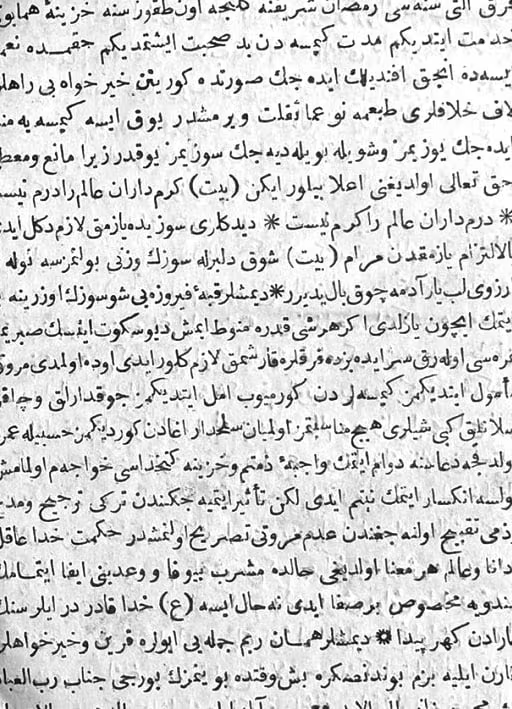
The Matbaa-i Amire (Ottoman Turkish: مطبعة عامره, 'The Imperial Printing House'), also historically designated as the Darüttıbaat-ı Amire or the Matbaa-i Hümayun, represents the monumental, state-sponsored institutionalization of typographic print culture within the Ottoman Empire. Established in its permanent imperial administrative form in 1211 AH (1796/1797 AD) under the reforming initiative of Sultan Selim III (r. 1789–1807), the institution transformed the production of text, the dissemination of legal-bureaucratic decrees, and the intellectual landscape of the Near East.
Positioned at the structural intersection of imperial governance, military technology, and graphic communication, the Matbaa-i Amire bridged the centuries-old manuscript tradition of Islamic calligraphic art with the mechanical realities of early modern and nineteenth-century print capitalism. Its creation marked a decisive departure from early sporadic printing ventures, establishing a continuous, state-monopolized printing press that laid the bureaucratic and pedagogical foundations for the Tanzimat reforms and the modern Turkish nation-state.
To understand the historical necessity and organizational architecture of the Matbaa-i Amire, one must situate it within the broader trajectory of printing technology in the Ottoman lands. Non-Muslim communities within the empire had operated printing presses using typography as early as the late fifteenth century—notably the Jewish press established in Constantinople by David and Samuel ibn Nahmias in 1493, followed by Armenian presses in 1567 and Greek presses in 1627.
However, the production of texts in the Arabic script for the Muslim majority remained bound to the manuscript medium for centuries, sustained by a powerful guild of scribes (müstensihler), calligraphers (hattâtîn), and an intellectual framework that prioritized the oral-mnemonic transmission of sacred knowledge under the oversight of the ulema (religious scholars). The pivotal breakthrough for Islamic-script printing occurred in 1727, when Sultan Ahmed III issued an imperial decree (ferman) backed by a legal ruling (fatwa) from Sheikh al-Islam Abdullah Efendi, granting Ibrahim Müteferrika and Mehmed Said Efendi permission to establish a printing press for non-religious works, such as dictionaries, histories, geographies, and tactical military manuals. Although the Müteferrika press produced seventeen seminal titles across twenty-three volumes between 1729 and 1742, its operations ceased shortly after Müteferrika’s death in 1745. The presses fell into disuse despite brief attempted revivals by Qadi Zade Sulaiman Efendi in 1784, demonstrating that private or semi-private print enterprises lacked the systemic administrative infrastructure required for long-term viability.
The true institutional foundation of a permanent state-run printing organ emerged during the reign of Sultan Selim III, whose overarching military and administrative reform program—the Nizam-ı Cedid ('New Order')—demanded rapid, standardized dissemination of technical literature, artillery instruction manuals, fortification treatises, and organizational regulations. In 1795, a printing shop was initially set up within the framework of the Mühendishane-i Berrî-i Hümayun (Imperial School of Military Engineering) at Hasköy under the leadership of the school’s chief instructor and engineer, Abdurrahman Efendi. Recognizing the necessity of a centralized, dedicated facility, Selim III authorized the construction of a custom-built imperial printing complex across the Bosphorus in Üsküdar in 1796/1797.
This press, formally named the Matbaa-i Amire, integrated the original typographical equipment purchased from the heirs of Ibrahim Müteferrika with newly imported European presses, matrixes, and lead fonts acquired primarily from France and Italy. The Üsküdar facility functioned as a high-capacity state enterprise, publishing technical works such as Mahmud Raif Efendi's famous French-language survey Tableau des nouveaux règlemens de l'Empire Ottoman (1798), alongside classical Arabic-Ottoman lexicons like the Vankulu Lughati and tactical military handbooks designed for the newly trained Nizam-ı Cedid troops.
The institutional evolution of the Matbaa-i Amire accelerated dramatically during the reign of Sultan Mahmud II (r. 1808–1839), a monarch whose radical centralizing policies reshaped the Ottoman state apparatus. Following the bloody suppression and abolition of the Janissary Corps in 1826 (the Vaka-i Hayriye or 'Auspicious Incident'), Mahmud II recognized that total administrative control required a unified imperial voice. In 1831, the physical operations of the press were relocated from Üsküdar to the historic peninsula of Istanbul, established near the Bâb-ı Âli (Sublime Porte) and the Beyazıt district, directly adjacent to the center of government. That same year marked the inaugural publication of Takvim-i Vekayi ('Calendar of Events'), the first official state gazette published in Ottoman Turkish, with parallel editions appearing in French, Armenian, Greek, Arabic, and Persian.
The mandatory publication of imperial decrees, legislative codes, diplomatic announcements, and official appointments within Takvim-i Vekayi transformed the Matbaa-i Amire from a specialized publisher of military and lexical texts into the primary engine of imperial governance and ideological communication.
Typographically and technologically, the Matbaa-i Amire stood at the forefront of Eastern press innovation throughout the nineteenth century. Printing in the Arabic script presented formidable typographic challenges due to the fluid, cursive nature of the letterforms, which vary in shape based on their position within a word (initial, medial, final, or isolated) and require complex ligatures and diacritical marks. Early lead type designed in Western Europe often distorted traditional calligraphic aesthetics, creating friction with traditional readers and scribal elites.
To mitigate this, master typefounders at the Matbaa-i Amire painstakingly cut steel punches and cast copper matrices that replicated the elegant proportions of Naskh (Nesih) and Nastaliq (Ta'liq) hands perfected by Ottoman calligraphers. A major technological revolution occurred in 1831 with the introduction of chemical lithography (taş basması) to Istanbul by the French military officer and lithographer Henri Cayol. The Matbaa-i Amire rapidly adopted lithographic presses, as lithography allowed calligraphers to write directly onto treated paper or stone with grease pencils, preserving the precise aesthetic nuance, kerning, and ligatures of sacred calligraphic art. This process dramatically lowered production costs, allowed for the mass reproduction of religious commentaries, Quranic texts, and popular poetry, and effectively reconciled traditional scribal aesthetics with high-volume mechanical reproduction.
As the nineteenth century progressed into the Tanzimat era (1839–1876), the administrative control and intellectual scope of the Matbaa-i Amire expanded exponentially. Administratively placed under the purview of the Meclis-i Vâlâ-yı Ahkâm-ı Adliye (Supreme Council of Judicial Ordinances) and later the Maarif Nezareti (Ministry of Public Instruction), the Imperial Press functioned as the primary publishing organ for the burgeoning Ottoman bureaucracy and modernizing educational system.
It produced the formal legal codes of the empire, including the Dustur (the official collection of Ottoman statutes) and the civil code, the Mecelle-i Ahkâm-ı Adliyye, formulated under Ahmed Cevdet Pasha. Simultaneously, the press produced hundreds of thousands of standardized textbooks for the newly founded network of primary (Sıbyan), middle (Rüşdiye), and secondary (İdadi) schools, ranging from arithmetic and geography to natural sciences and Ottoman grammar. To meet this immense demand, the Ottoman government invested heavily in modern European machinery, replacing manual wooden and iron screw presses with advanced steam-powered cylinder presses supplied by manufacturers such as König & Bauer and Marinoni, while sourcing industrial-grade paper from the state-owned Beykoz paper factory and specialized European mills.
The broader cultural and structural impact of the Matbaa-i Amire on Ottoman society cannot be overstated. By standardizing language, terminology, and legal syntax across its vast output, the Imperial Press played a fundamental role in simplifying written Ottoman Turkish, steering it away from over-ornate, hyper-Persianized chancery styles toward a clearer, more functional prose style suitable for public administration and journalism. Furthermore, while the Matbaa-i Amire retained a state monopoly over official gazettes and educational textbooks, its success catalyzed the rise of commercial private printing houses across Istanbul, Izmir, Cairo, and Beirut. Key figures of the Young Ottoman movement, such as İbrahim Şinasi, Namık Kemal, and Ali Suavi, built upon the print infrastructure and public reading habits cultivated by the Imperial Press to launch private newspapers (such as Tercüman-ı Ahvâl and Tasvîr-i Efkâr), thereby forging a modern Ottoman public sphere.
During the reign of Sultan Abdülhamid II (r. 1876–1909), the Matbaa-i Amire was subjected to rigorous bureaucratic oversight and centralized censorship protocols managed by the Encümen-i Teftiş ve Muayene (Inspection and Examination Commission). Nevertheless, its physical infrastructure continued to modernize, incorporating stereotyping, photo-engraving, and automatic linotype casting machines by the turn of the twentieth century. Following the Young Turk Revolution of 1908 and during the tumultuous years of the First World War, the press maintained its critical role in military mobilization, publishing field maps, propaganda pamphlets, and official war dispatches. Following the collapse of the Ottoman Empire and the establishment of the Republic of Turkey under Mustafa Kemal Atatürk in 1923, the historical institution was reorganized and renamed the Devlet Matbaası (State Printing House). Following the radical Alphabet Reform (Harf Devrimi) of November 1928, which replaced the Arabic-based Ottoman alphabet with the Latin-based modern Turkish alphabet, the physical presses and veteran typographical craftsmen of the former Matbaa-i Amire executed the massive task of re-printing the republic's entire legal, educational, and bureaucratic literature, thus ensuring institutional continuity between the imperial past and the modern Turkish state.
Bibliography
Babinger, Franz. Stambuler Buchwesen im 18. Jahrhundert. Leipzig: Otto Harrassowitz, 1919.
Gerçek, Selim Nüzhet. Türk Matbaacılığı I: Müteferrika Matbaası. Istanbul: Devlet Basımevi, 1939.
Ersoy, Osman. Türkiye'ye Matbaanın Girişi ve İlk Basılan Eserler. Ankara: Ankara Üniversitesi Dil ve Tarih-Coğrafya Fakültesi Yayınları, 1959.
Berkes, Niyazi. The Development of Secularism in Turkey. Montreal: McGill University Press, 1964.
Baysal, Jale. Müteferrika'dan Birinci Meşrutiyete Kadar Osmanlı Türklerinin Matbaa Yayınları (1729-1875). Istanbul: İstanbul Üniversitesi Edebiyat Fakültesi Yayınları, 1979.
Koloğlu, Orhan. Basımevi ve Basının Uygarlığa Etkisi. Istanbul: Çağdaş Gazeteciler Derneği Yayınları, 1982.
Neumann, Christoph K. "Book and Newspaper Printing in the Ottoman Empire." In The Book in the Islamic World: The Written Word and Communication in the Middle East, edited by George N. Atiyeh, 227-246. Albany: State University of New York Press, 1995.
Nuhoğlu, Hidayet Y. "Matbaa-i Âmire." In TDV İslâm Ansiklopedisi, Vol. 28, 292-295. Istanbul: Türkiye Diyanet Vakfı Yayınları, 2003.
Atayeve, Yasemin. Osmanlı Devletinde Matbaa-i Âmire'nin Kuruluşu ve Faaliyetleri (1796–1839). Istanbul: Kitabevi Yayınları, 2006.
Sabev, Orlin. İbrahim Müteferrika ya da İlk Osmanlı Matbaa Serüveni (1726-1746). Istanbul: Yeditepe Yayınevi, 2006.
Sabev, Orlin. Waiting for Müteferrika: Glimpses on Ottoman Print Culture. Sofia: İsis Press, 2014.
Roper, Geoffrey, ed. Historical Aspects of Printing and Publishing in the Languages of the Middle East. Leiden: Brill, 2014.
Dagdeviren, Ali. Osmanlı Devleti'nde Resmi Matbaacılık ve Matbaa-ı Âmire (1795-1908). Ankara: Türk Tarih Kurumu Yayınları, 2019.
Beyond the names: biographies and bibliographies on this page are curated by Abu, the AI scholar crafted by Buonvecchio exclusively for Govi Rare Books.