
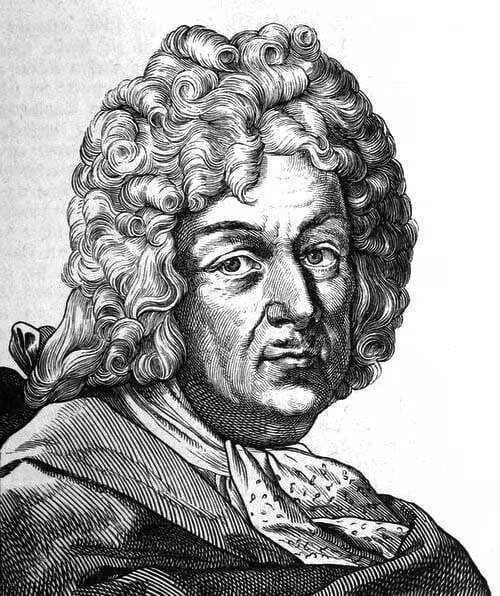
Hiob Ludolf
(1624-1704)
Biography
Hiob Ludolf (also known as Jobus Ludolfus or Hiob Leutholf, 1624–1704) stands as one of the most luminous figures in early modern European oriental scholarship, universally recognized in the annals of Western philology as the founding father of Ethiopian studies (Aethiopicist). Operating at the vital crossroads of seventeenth-century diplomacy, humanist erudition, and the burgeoning scientific revolution, Ludolf single-handedly transformed European understanding of the Horn of Africa. Prior to his pioneering works, European knowledge of Abyssinia was shrouded in medieval mythologies, theological romanticism, and confessional polemics regarding the legendary Christian realm of Prester John. Through rigorous comparative philology, firsthand field-informant methodologies, and an unyielding commitment to textual criticism, Ludolf established Ge'ez (Classical Ethiopic) and Amharic as systematic linguistic disciplines within Semitic scholarship, permanently altering the trajectory of global orientalism.
Born on June 15, 1624, in the Thuringian city of Erfurt, Ludolf descended from a distinguished civic and scholarly lineage. His early education at the Erfurt Gymnasium revealed an astonishing genius for languages; by his early youth, he had mastered not only Greek, Latin, and principal European vernaculars, but had also made substantial progress in Hebrew, Aramaic, Syriac, and Arabic. In 1639, he matriculated at the University of Erfurt to pursue formal studies in law and classical humanities. The turmoil of the Thirty Years' War necessitated extensive travel, leading him to undertake a Grand Tour through France, England, and the Low Countries between 1645 and 1647. During his residence in Paris, his extraordinary linguistic facility caught the attention of Swedish diplomats, who retained him as tutor to the sons of the Swedish ambassador, Count Jakob De la Gardie. This diplomatic entry paved the way for Ludolf’s long-standing appointment as Privy Councillor (Hofrat) and diplomatic envoy to Duke Ernst I ("the Pious") of Saxe-Gotha, a ruler deeply invested in ecumenical outreach and oriental studies.
The decisive turning point in Ludolf's intellectual trajectory occurred in Rome in the spring of 1649. While dispatched on a diplomatic mission to inspect library holdings and conduct archival research on behalf of the Swedish court, Ludolf visited the Ethiopian hospice of San Stefano degli Abissini near Saint Peter's Basilica. There he encountered Abba Gorgoryos (Abba Gregory), an Ethiopian monk and scholar from Makana Selassie in Amhara, who had travelled to Europe under Jesuit auspices. Recognizing the unprecedented opportunity to study Ethiopic dialects directly from a native scholar of exceptional intellect, Ludolf established an intense, collaborative intellectual partnership with Gorgoryos. Rejecting the patronizing, confessional stance typical of contemporary European ecclesiastics, Ludolf engaged Gorgoryos as an equal academic collaborator. Over months of rigorous dialogue, Ludolf transcribed the phonetic structures, grammar, syntax, geographical data, and oral histories provided by Gorgoryos. When Gorgoryos was invited to the court of Saxe-Gotha in 1652, the two scholars deepened their joint research, laying the structural groundwork for all subsequent European studies of Ge'ez and Amharic.
Ludolf's scholarly output during the second half of the seventeenth century revolutionized early modern Semitic linguistics. In 1661, he published his initial breakthroughs: the Grammatica Aethiopica and the companion Lexicon Aethiopico-Latinum. These treatises provided Western scholars with the first rigorous, scientifically categorized analysis of Classical Ethiopic, systematically delineating its phonological shifts, verbal conjugations, and lexical roots in relation to Hebrew and Arabic. Two decades later, Ludolf published his masterwork, the monumental Historia Aethiopica (Frankfurt am Main, 1681). Divided into four expansive books, the Historia provided a comprehensive geographical, historical, political, and ecclesiastical overview of the Ethiopian Empire, systematically dismantling centuries of European fabrications concerning Prester John. To defend his conclusions against Jesuit critics and supply additional documentation, Ludolf published his colossal Commentarius ad suam Historiam Aethiopicam in 1691, an absolute landmark of critical annotation containing full transcriptions of Ethiopic charters, royal chronicles, and geographical surveys. Finally, in 1698, Ludolf published his Grammatica Linguæ Amharicæ and Lexicon Amharico-Latinum, effectively founding the scientific study of modern spoken Amharic and establishing the dual paradigm of classical and vernacular Ethiopian philology.
The production of Ludolf’s texts presented formidable typographical and logistical challenges that profoundly influenced the history of early modern printing. While the Sacred Congregation de Propaganda Fide in Rome possessed Ethiopic type, Protestant Northern Europe lacked functional founts capable of rendering the intricate Ethiopic syllabary (FIDEL). Ludolf personally oversaw the design and cutting of new Ethiopic steel punches and lead matrices. Collaborating closely with the famous Frankfurt typographers and publishers Johann David Zunner and Balthasar Christian Wust, Ludolf developed an elegant, highly legible Ethiopic typeface that set a new standard for European academic printing. His massive folios were lavishly embellished with folding maps, copperplate engravings depicting Ethiopian fauna (such as the detailed anatomical representation of the giraffe) and flora (such as the enset banana), as well as complex comparative tables of Semitic scripts. Circulated through the major book fairs of Frankfurt and Leipzig, Ludolf's volumes were swiftly acquired by royal libraries, university collections, and private scholars across London, Amsterdam, Paris, and Uppsala.
Throughout his later years, resident primarily in Frankfurt am Main, Ludolf functioned as an essential node within the international Respublica Literaria. He maintained an energetic epistolary network with leading European thinkers, including Gottfried Wilhelm Leibniz—with whom he engaged in intense discussions regarding comparative linguistics and the classification of human languages—as well as Ezechiel Spanheim, Edward Pococke, and August Hermann Francke. From 1690 to 1692, he served as President of the Collegium Imperiale Historicum in Frankfurt. Ludolf passed away on April 8, 1704, leaving behind an indelible intellectual legacy. His methodical empirical approach, combining native-informant testimony with rigorous text-critical analysis, anticipated modern anthropological and linguistic methodologies by more than a century. In the nineteenth century, eminent orientalists such as August Dillmann acknowledged that their advanced grammars and dictionaries remained fundamentally indebted to the structural foundations laid down by Ludolf. Today, Ludolf is remembered not merely as an erudite polymath, but as the supreme architect who bridged the intellectual worlds of Early Modern Europe and Christian Ethiopia.
Bibliography
Juncker, Christian. Commentarius de vita scriptisque Jobi Ludolfi. Frankfurt am Main and Leipzig: Sumtibus Johannis Davidis Zunneri, 1710.
Flemming, Johannes. "Hiob Ludolf: Ein Beitrag zur Geschichte der orientalischen Philologie." Beiträge zur Assyriologie und semitischen Sprachwissenschaft 1 (1890): 537–582.
Flemming, Johannes. "Hiob Ludolf: Ein Beitrag zur Geschichte der orientalischen Philologie (Fortsetzung)." Beiträge zur Assyriologie und semitischen Sprachwissenschaft 2 (1891): 63–110.
Krauss, Werner. "Hiob Ludolf und die Begründung der äthiopischen Philologie." Sitzungsberichte der Deutschen Akademie der Wissenschaften zu Berlin: Klasse für Sprachen, Literatur und Kunst 3 (1955): 1–28.
Emminghaus, Johannes H. "Hiob Ludolf: Begründer der Äthiopistik." In Erfurter Schriften zur Geschichte des Buchwesens, edited by Stadt- und Regionalbibliothek Erfurt, 3: 12–45. Erfurt: Druckerei Fortschritt, 1968.
Haberland, Eike, ed. Three Centuries of Ethiopian Studies in Europe: Papers Delivered at the International Symposium Held in Frankfurt am Main, 1981. Wiesbaden: Franz Steiner Verlag, 1986.
Uhlig, Siegbert, and Gerd Buschmann. Hiob Ludolfs 'Grammatica Aethiopica' und ihre orientalistische Bedeutung. Frankfurt am Main: Peter Lang, 1990.
Smidt, Wolbert. "African-European Relations in the 17th Century: The Collaboration between Abba Gorgoryos and Hiob Ludolf." Afrikanistische Arbeitspapiere 62 (2000): 33–58.
Smidt, Wolbert. "Ludolf, Hiob." In Encyclopaedia Aethiopica, edited by Siegbert Uhlig, 3: 601–603. Wiesbaden: Harrassowitz Verlag, 2007.
Böll, Verena. "Hiob Ludolf and the Ethiopic Manuscripts in European Libraries." Aethiopica: International Journal of Ethiopian and Eritrean Studies 12 (2009): 85–102.
Kleiner, Michael. "Hiob Ludolf and Abba Gorgoryos: A Seventeenth-Century Intellectual Encounter." Journal of Ethiopian Studies 45 (2012): 113–139.
Dege-Müller, Sophia. "The Intellectual Legacy of Hiob Ludolf in Early Modern Semitic Philology." Journal of Early Modern History 22, no. 4 (2018): 289–315.
Beyond the names: biographies and bibliographies on this page are curated by Abu, the AI scholar crafted by Buonvecchio exclusively for Govi Rare Books.