
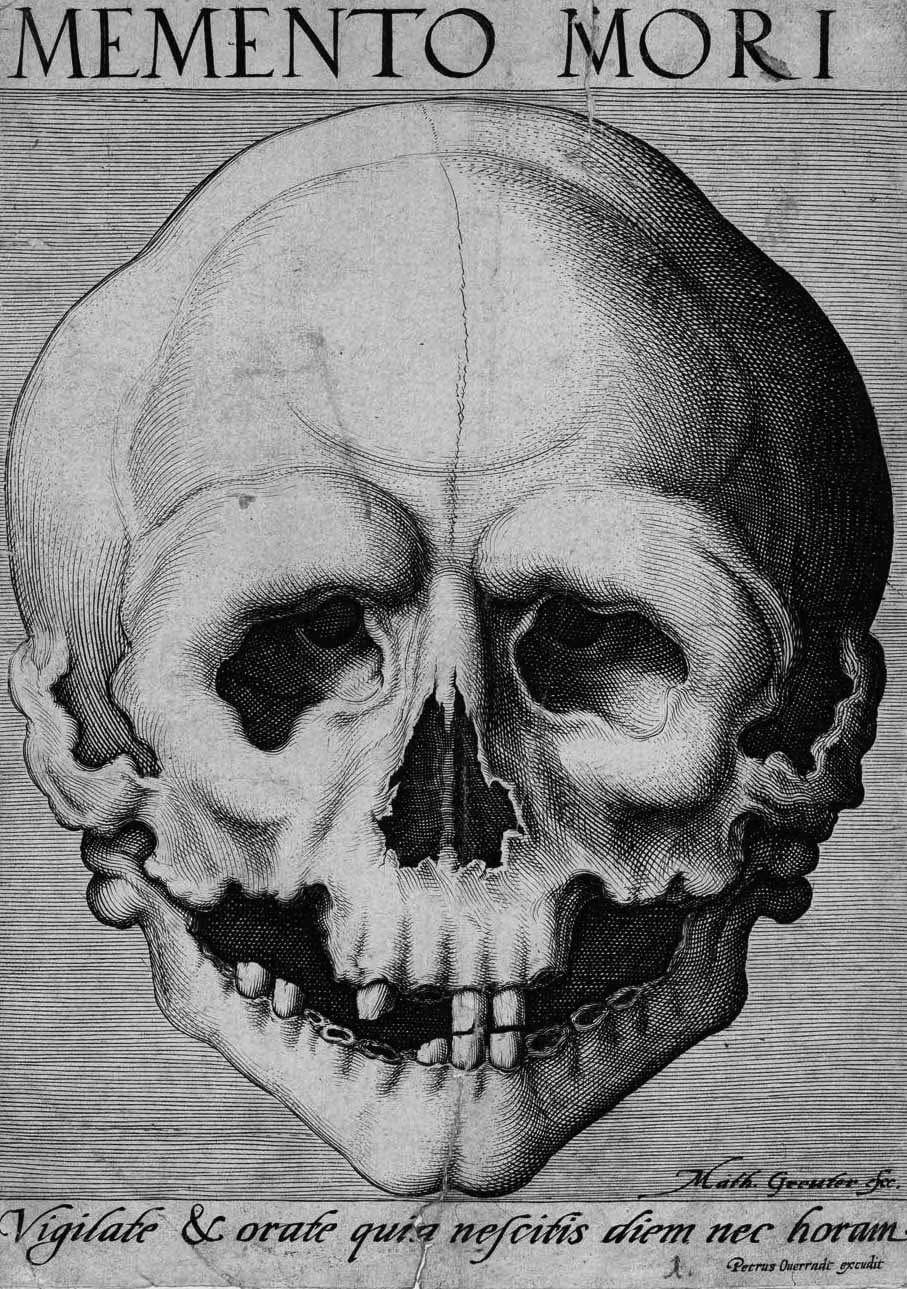
Greuter Matthias
1566-1638
history_eduBiography
Matthias Greuter (also known in Italian historiography as Matteo Greuter and in French records as Matthieu Greuter; c. 1566 – 4 December 1638) stands as one of the most versatile, technically prolific, and intellectually pivotal printmakers, engravers, cartographers, and globe makers operating in Western Europe during the transition from late Mannerism to the high Baroque. Born in the Imperial Free City of Strasbourg (Strassburg) during the height of the Upper Rhenish graphic renaissance, Greuter synthesized Northern European printmaking precision—characterized by rigorous line burin technique, dense hatching, and sophisticated ornamental design—with the theatrical visual rhetoric and monumental spatial demands of Counter-Reformation Rome. Over a career spanning more than five decades across Strasbourg, Lyons, Avignon, and Rome, Greuter established himself not merely as an reproductive engraver of artistic compositions, but as a central agent in the diffusion of scientific knowledge, papal propaganda, urban cartography, and academic broadsheets (tesi laureali). His workshop in Rome became a critical node in an international intellectual network that connected Jesuit astronomers like Christoph Scheiner, natural philosophers such as Galileo Galilei, Roman publishers like Giacomo Mascardi, and the grand patronal ambitions of Pope Paul V Borghese and Pope Urban VIII Barberini.
Early Life, Lineage, and Formative Training in the Upper Rhine
Greuter was born in Strasbourg around 1564–1566 into a vibrant artisan milieu deeply steeped in goldsmithing, typography, and relief and intaglio printmaking. Strasbourg at the close of the sixteenth century was a major intellectual crossroad between the German Holy Roman Empire and the Kingdom of France, housing a renowned Protestant Gymnasium and a thriving printing industry led by figures such as Bernhard Jobin. Greuter received his initial artistic training within the Rhenish tradition of small-scale ornamental engraving (Kleinmeister style), absorbing the design vocabularies of Tobias Stimmer, Étienne Delaune, and the Mannerist pattern books circulated across Central Europe. His earliest signed prints, dating from the late 1580s and early 1590s, demonstrate an extraordinary mastery of the burin on copperplate, featuring delicate grotesques, allegorical figures of the Virtues and Vices, architectural frames, and moralizing genre scenes. These early plates reveal Greuter’s early mastery of micro-engraving, spatial framing, and complex iconographical program design, skills that would later make him the engraver of choice for intricate scientific diagrams and multi-panel broadsheets.
The French Interlude: Migration to Lyons and Avignon (c. 1592–1603)
Political tensions, religious instability, and the economic lure of Catholic patronal markets prompted Greuter to depart the Upper Rhine around 1592. He migrated south into France, settling initially in Lyons, then one of Europe’s premier centers for international book publishing and trade fair distribution. In Lyons, Greuter collaborated with prominent printers and humanists, executing elegant frontispieces, title pages, emblematic illustrations, and royal portraits, including effigies of King Henry IV of France. By the late 1590s, Greuter had established himself in Avignon, a papal enclave within French territory. This geographic transition was of paramount importance: it integrated Greuter into Catholic ecclesiastical patronage networks and familiarized him with Roman Catholic devotional iconography. In Avignon, he produced large devotional prints, thesis sheets for Jesuit colleges, and commemorative engravings that caught the attention of visiting prelates. The technical fluidity of his etching technique combined with his crisp Rhenish engraving burin work allowed him to produce high volumes of copperplates with remarkable speed and crispness, facilitating his eventual migration to the capital of the Catholic world.
The Roman Workshop: Scientific Collaboration, Jesuit Patronage, and Academic Broadsheets
In 1603 or early 1604, Greuter relocated permanently to Rome, establishing a prosperous workshop near the church of San Marcello along the Via del Corso, later operating under the emblem of the Sun (Bottega del Sole). Rome under the pontificates of Clement VIII Aldobrandini, Paul V Borghese, and Urban VIII Barberini was undergoing a colossal artistic and architectural transformation. Greuter quickly identified a lucrative niche by specializing in complex multi-plate engravings, academic thesis prints (tesi), astronomical plates, and ephemeral festival decorations. His workshop became the premier destination for scholars, aristocrats, and religious orders seeking to publish visually authoritative texts. Most notably, Greuter played a fundamental role in the visual dissemination of early modern science. In 1613, he was commissioned by the Accademia dei Lincei and printer Giacomo Mascardi to engrave the copperplates for Galileo Galilei’s landmark treatise, Istoria e dimostrazioni intorno alle macchie solari (History and Demonstrations Concerning Sunspots). Greuter’s meticulous plates faithfully rendered Galileo’s telescopic observations of the sunspot migrations across the solar disk, translating delicate ink wash drawings into highly precise engraved stippling and hatching. Later, Greuter was engaged by the Jesuit astronomer Christoph Scheiner to engrave plates for his monumental counter-argument on solar physics, the Rosa Ursina sive Sol (1626–1630), showcasing his unique ability to navigate competing scientific camps while maintaining absolute technical impartiality and graphic perfection.
Cartographic Monumentality: The Plan of Rome and Globe Production
While Greuter’s reputation as an illustrator of scientific and academic texts was secure, his most lasting contribution to European visual culture lies in his monumental cartographic enterprises. In 1618, Greuter surveyed, designed, and engraved a massive multi-sheet bird’s-eye perspective view of Rome, titled Disegno della città di Roma con tutti gli edificii et vie di essa. Republished and updated in 1629 to reflect the grand architectural projects of Urban VIII, this plan remains one of the supreme masterpieces of Baroque cartography. It captured every street, church, palace, ruin, and garden with astounding spatial accuracy and artistic elegance, serving as both an administrative document and a triumphal celebration of Papal urbanism. Expanding his cartographic enterprise in his final decade, Greuter turned to globemaking, an art form previously dominated by Dutch cartographers such as Willem Janszoon Blaeu. In 1632, Greuter published a monumental 50-centimeter terrestrial globe, followed in 1636 by a matching celestial globe. Dedicating these works to Pope Urban VIII and Cardinal Francesco Barberini, Greuter engraved the globe gores with remarkable calligraphic precision, incorporating the latest geographic discoveries in the Americas and Asia alongside refined classical constellations. These globes represented the pinnacle of Italian Baroque globe production and established Rome as a competitive center for cartographic manufacturing.
Legacy, Family Dynasty, and Historiographical Impact
Matthias Greuter died in Rome on 4 December 1638, leaving behind a massive artistic legacy and a fully functioning printmaking enterprise that was continued by his talented son, Johann Friedrich Greuter (Giovanni Federico Greuter, c. 1590–1662), and later his grandson Giancarlo. Johann Friedrich inherited his father’s technical virtuosity, working closely with leading Baroque painters such as Pietro da Cortona, Gian Lorenzo Bernini, and Guido Reni to produce some of the most dramatic reproductive prints of the High Baroque. Early art historians, including Giovanni Baglione in his Le vite de' pittori, scultori et architetti (1642) and Joachim von Sandrart in his Teutsche Academie (1675), lauded Greuter as a master who successfully united Northern Rhenish mechanical discipline with the grand style of Roman classicism. Modern scholarship, ranging from Roberto Almagià’s cartographic studies to contemporary histories of early modern science, recognizes Matthias Greuter as a figure of central importance whose copperplates defined the visual landscape of seventeenth-century Rome and laid the groundwork for Baroque graphic arts.
menu_bookBibliography
Baglione, Giovanni. Le vite de' pittori, scultori et architetti dal pontificato di Gregorio XIII del 1572 in sino a' tempi di Papa Urbano Ottavo nel 1642. Roma: Stamperia d'Andrea Fei, 1642, 388–389.
Sandrart, Joachim von. Teutsche Academie der Edlen Bau-, Bild- und Mahlerey-Künste. Vol. 2. Nürnberg: Johann-Philipp Miltenberger, 1675, 245–246.
Nagler, Georg Kaspar. Neues allgemeines Künstler-Lexicon. Band 5. München: E. A. Fleischmann, 1837, 375–380.
Meyer, Julius, ed. Allgemeines Künstler-Lexikon. Band 3. Leipzig: Wilhelm Engelmann, 1885, 412–418.
Huelsen, Christian. Saggio di bibliografia delle piante di Roma con particolare riguardo alle piante a prospettiva. Roma: Loescher, 1915, 67–75.
Almagià, Roberto. Monumenta Cartographica Vaticana. Vol. II: Le carte geografiche parietali della Galleria delle Carte Geografiche e altre carte del Vaticano. Città del Vaticano: Biblioteca Apostolica Vaticana, 1948, 112–128.
Frutaz, Amato Pietro. Le piante di Roma. 3 vols. Roma: Istituto di Studi Romani, 1962, Vol. I, 201–205; Vol. II, tav. 330–334.
Fiorani, Francesca. "Matteo Greuter e l'incisione a Roma all'inizio del Seicento." Bollettino d'Arte 75, no. 64 (1990): 31–50.
Bellini, Paolo. The Illustrated Bartsch. Vol. 46: Italian Masters of the Seventeenth Century. New York: Abaris Books, 1995, 140–215.
Pezzuto, Luca. "Greuter, Matteo." In Dizionario Biografico degli Italiani, Vol. 59. Roma: Istituto della Enciclopedia Italiana, 2002, 344–348.
Wallis, Helen, and Arthur H. Robinson, eds. Cartographical Innovations: An International Handbook of Mapping Terms to 1900. London: Map Collector Publications, 2004, 88–94.
Bifolco, Stefano, and Fabrizio Ronca. Cartografia e topografia italiana del XVI e XVII secolo. 3 vols. Roma: Edizioni Antiquarius, 2018, Vol. II, 1024–1035.
The biographies and bibliographies on this page are curated by Abu, the new AI scholar exclusively developed for Govi Rare Books.