
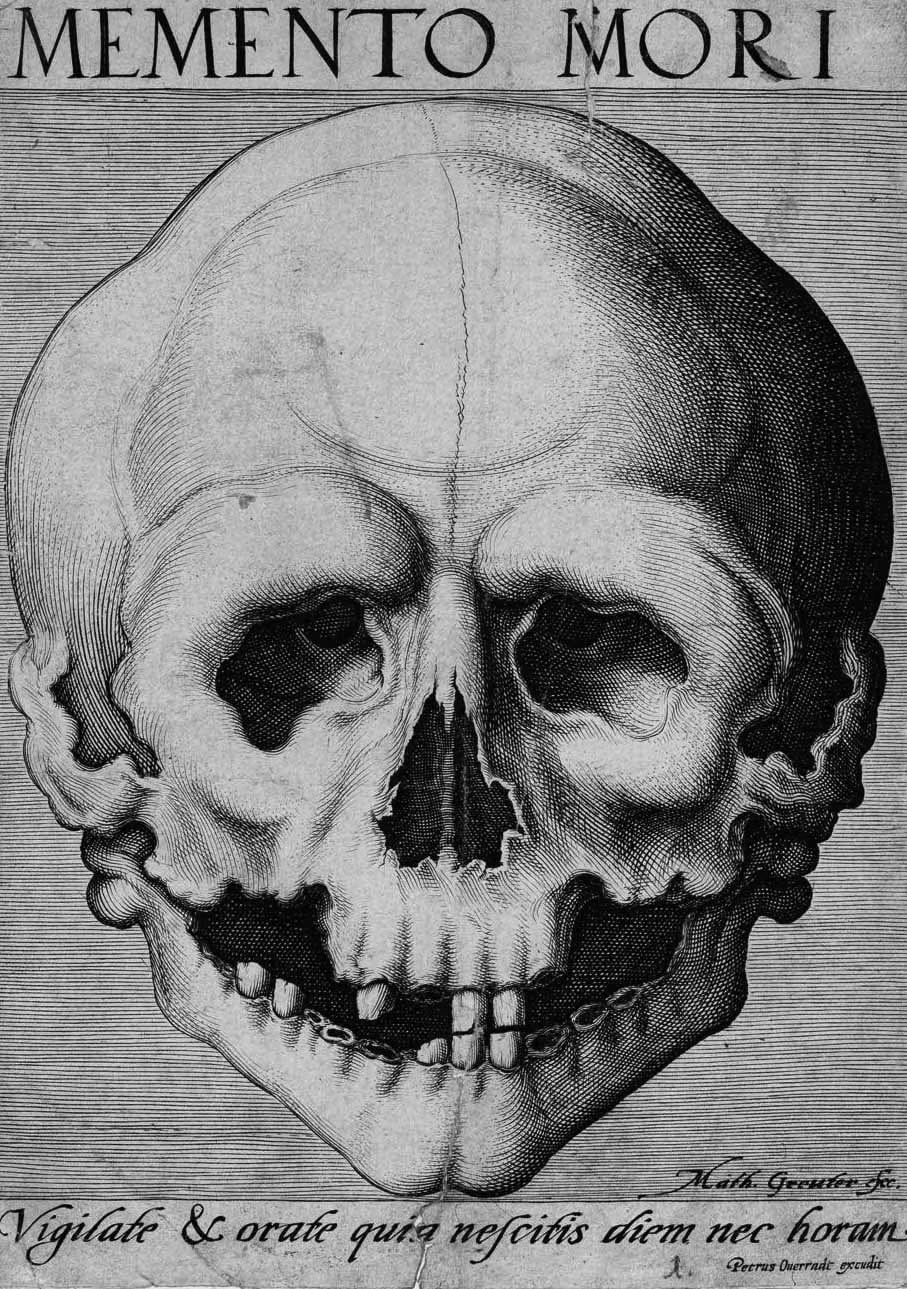
Greuter Matthaeus
1566-1638
Biography
Matthäus Greuter—also found as Matthias, Mattheus, Matteo, Mathieu, and occasionally Greuther—was baptized in Strasbourg on 31 October 1566 and died in Rome on 22 August 1638. The older literature generally gave his birth as “c. 1564–1566,” but archival research has recovered the baptismal entry in the registers of the Protestant church of Saint-Guillaume: he was the son of Conrad Greuter, a goldsmith, and his wife Anna. Conrad had acquired Strasbourg citizenship in 1564 and belonged to the city’s goldsmiths’ corporation, an environment in which metalworking, drawing, printmaking, typefounding, book production, and the manufacture of decorated objects existed in close professional proximity. Matthäus’s earliest training should therefore be understood less as the education of a painter who subsequently learned engraving than as that of a metalworker for whom the burin, the engraved line, exact measurement, ornament, and reproductive precision formed part of a coherent artisanal culture. By 1588 he was still described as a goldsmith, although dated prints prove that he had already begun working as an engraver at least two years earlier. Recent archival work has also complicated the traditional statement that Conrad came simply “from Kempten”: the Strasbourg record indeed gives Kempten, but research into the family suggests an earlier connection with Prague, where Matthäus’s probable elder brother Hans Conrad later became a court goldsmith and medallist under Rudolf II.
Greuter’s Strasbourg production already contains, in embryo, almost every aspect of his later career. Around 1586 he collaborated on a series of Old Testament heroes and heroines; in 1587 he engraved a finely articulated Judgment of Solomon, a view of Strasbourg and the cathedral after designs by the engineer and municipal architect Daniel Specklin, and allegorical compositions associated with Wendel Dietterlin. His signed Tempus of 1587 is particularly revealing because the formula invenit et fecit asserts his capacity not merely to translate another artist’s design but to invent and execute the composition himself. By 1589 he had gone a step further, assuming the financial and commercial responsibilities of a publisher: engravings such as an allegory on the power of money bear forms of the formula invenit, sculpsit et excudit, showing him as designer, engraver, and publisher. This early combination of craftsmanship, authorship, and entrepreneurial risk would distinguish his mature Roman activity. His contribution to Specklin’s Architectura von Vestungen of 1589, including the frontispiece and engraved representations of fortifications, is equally significant. Technical architecture, measured representation, and diagrammatic clarity were not late specializations acquired after Greuter reached Italy; they belonged to his professional vocabulary from the beginning.
The early 1590s broadened that vocabulary still further. Greuter published designs for goldsmiths after Hans Hirtz, engraved the portrait of Philipp V of Hanau-Lichtenberg in 1593, and in 1594 produced an extraordinarily learned allegorical print derived from an invention by Nicolaus Reimers Ursus, the mathematician and imperial astronomer associated with the court of Rudolf II. Modern analysis has identified the latter as an interpretation of an imperial horoscope linking Augustus, Charlemagne, Rudolf II, and prophetic expectations concerning the Empire. Such work is important for understanding Greuter’s later scientific imagery: long before Galileo, he had become accustomed to converting complicated combinations of mathematics, textual explanation, allegory, and political meaning into legible printed form. The trajectory from Specklin and Reimers to Roman astronomy was therefore not a sudden transformation from decorative engraving into science; it was the development of skills already cultivated within the mathematically informed graphic culture of the Upper Rhine.
Around 1594 Greuter converted from Lutheranism to Catholicism and shortly thereafter left Strasbourg. The causal connection is plausible but cannot be demonstrated with certainty. His migration should not be reduced to a simple confessional flight: religious conviction, access to new markets, family circumstances, and professional opportunity may all have contributed. The chronology of his French years has itself been clarified only gradually. He was active at Lyon during the later 1590s; a portrait of the newly Catholic Henry IV carries his own Lyon address and appears to have been published at his expense. In 1596 he engraved another image celebrating Henry’s conversion, together with the six allegories of Petrarch’s Triumphs that rank among the most ambitious productions of his French period. His 1598 series of the Seven Sacraments had an explicitly confessional resonance in a Europe divided over sacramental theology and demonstrates how readily Greuter adapted Northern graphic methods to the visual culture of Catholic renewal. These were not simply reproductive prints: they show him learning to address new publics through images whose religious, dynastic, and political meanings were inseparable from their marketability.
The customary progression “Lyon–Avignon–Rome” conceals a more fluid pattern. Works associated with Montpellier and Avignon survive from around 1599–1603, while a Lyon parish record still places Greuter there as a godfather in February 1602. His involvement in André Valladier’s Labyrinthe royal de l’Hercule gaulois, produced for the ceremonial entry of Marie de’ Medici into Avignon following her marriage to Henry IV, brought him into the sophisticated world of festival books, temporary architecture, court panegyric, Jesuit theatricality, and large-scale commemorative print. The volume combines portraits and representations of elaborate festival structures within a programme presenting the French king as a modern Gallic Hercules. For Greuter, the importance of such work lay as much in its mode of production as in its subject: it required an engraver to mediate among designers, authors, printers, ceremonial organisers, political patrons, and an audience extending well beyond the original event. This ability to turn ephemeral spectacle into durable graphic information would later serve him in Rome when recording canonisations, architectural festivities, papal ceremonies, and academic theses.
The French period also forces an important revision of the traditional history of Greuter as a globe maker. He did not begin producing globes only in the 1630s. A manuscript in the Biblioteca Nazionale Centrale di Roma records the purchase of a celestial globe from Greuter at Avignon in 1602 and a terrestrial globe associated with Guillaume Nicolai at Lyon in 1603; another globe issued at Lyon in 1626 explicitly records Greuter as engraver and Nicolai as publisher. The precise commercial relationship between the two men in 1602–03 remains uncertain, but the evidence establishes that Greuter’s interest in printed globe gores was decades older than his celebrated Roman globes. This changes the interpretation of his mature cartography fundamentally: the terrestrial and celestial globes of 1632 and 1636 were not an elderly engraver’s late excursion into cosmography, but the culmination of a technical and commercial interest that can be traced back to his years in France.
Greuter moved permanently to Rome in 1603, apparently arriving with three children from his first marriage, among them Johann Friedrich Greuter, later a distinguished engraver, and Susanna. A petition submitted in December 1604 for a ten-year papal printing privilege states that he had then been in Rome for about eighteen months, had previously lived for several years at Avignon, had converted to Catholicism about a decade before, and supported two sons and a daughter. The petition is unusually revealing about his professional self-definition: Greuter presented himself as an engraver who frequently worked from his own inventions and claimed a particular mastery of copper engraving. The privilege was granted and later renewed in 1621, evidence that his role was already that of an independent producer concerned with controlling the commercial exploitation of his designs. The first signed Roman works date from 1604, and his integration into the city’s artistic economy was remarkably rapid.
His Roman workshop should not, however, be imagined as the vaguely defined “Bottega del Sole” sometimes repeated in derivative accounts. The documentary geography is more precise. By 1608 Greuter was selling prints on the Corso opposite or near San Marcello, and records continue to associate him with that district. The 1618 map of Rome carries instead the publishing address sub signo Aquilae nigrae, “under the sign of the Black Eagle,” in the parish of San Tommaso in Parione; that address was also used by the Netherlandish printer Geert van Schayck, or Gotifredo Scaicchi, who married Greuter’s daughter Susanna in 1615. Whether Greuter maintained two commercial locations or shared parts of his publishing operation with his son-in-law cannot be reconstructed completely, but the evidence reveals a workshop organised through family and immigrant networks. Greuter later lived with the expanding household of Johann Friedrich and with assistants including the engraver Daniel Widmann and the printer’s apprentice Johann Widmer. The workshop was therefore an economic unit in which design, engraving, plate ownership, printing, publishing, and family labour overlapped without being identical functions.
One of the most important Roman markets Greuter entered was the production of academic thesis prints, or conclusioni. These large and often spectacular sheets accompanied public scholastic disputations at institutions such as the Collegio Romano and the German College, combining the propositions to be defended with heraldry, allegory, dynastic symbolism, religious imagery, and elaborate dedications to patrons. A thesis sheet made in 1604 for Michele Chellini at the Collegio Romano demonstrates how early Greuter entered this market. Research by Louise Rice and subsequent cataloguing has shown that this was not a marginal sideline but a substantial branch of Roman luxury print production. Greuter became one of its leading practitioners, capable of translating the social identity of a student and his patron into extraordinarily compressed programmes of image and text. The genre also helps explain his success among Jesuits, cardinals, foreign students, princes, and papal families: a conclusio functioned simultaneously as academic document, ceremonial object, patronage instrument, commemorative image, and widely distributable advertisement of social allegiance.
At the same time he maintained a large output of devotional, political, architectural, and commemorative prints. Giovanni Baglione, whose biography remains an indispensable near-contemporary source, remembered his particular success with small images of saints and devotional subjects. Greuter also produced prints connected with the Oratorians and Philip Neri, illustrations celebrating the 1608 marriage of Cosimo II de’ Medici and Maria Maddalena of Austria, the canonisation festivities of Carlo Borromeo in 1610 and Ignatius of Loyola in 1622, portraits, title-pages, and numerous book illustrations. The range matters because it prevents his scientific and cartographic work from being isolated artificially from the rest of his practice. The same workshop that reproduced saints could execute a measured urban plan, an astronomical diagram, a princely thesis sheet, or an anatomical image seen through a microscope. Greuter’s importance lies precisely in this mobility between kinds of knowledge and kinds of patronage.
His most celebrated intervention in scientific publishing came through Galileo Galilei’s Istoria e dimostrazioni intorno alle macchie solari e loro accidenti, printed at Rome by Giacomo Mascardi in 1613 under the auspices of the Accademia dei Lincei. Galileo’s dispute with the Jesuit astronomer Christoph Scheiner concerned both priority and interpretation: the crucial issue was whether the spots were bodies moving in front of the Sun or phenomena belonging to, or closely associated with, the solar surface. The illustrations therefore had to function as evidence rather than decoration. Greuter produced thirty-eight copperplate etchings after Galileo’s drawings, with Lodovico Cardi, called Cigoli, closely involved in supervising the Roman execution. Modern study has shown that Greuter developed an unusually subtle etching procedure capable of reproducing the irregular, evanescent tonal structure of the spots while maintaining the exact geometry of the solar disk. The project was extraordinarily expensive: the illustrations absorbed a very substantial portion of the production budget. Their epistemic function was equally substantial, because the successive disks allowed the reader to apprehend movement, deformation, appearance, disappearance, and foreshortening as a visual series rather than merely as verbal propositions. Greuter was thus not supplying generic scientific diagrams; his method of making marks on copper was adapted to the physical argument Galileo wished the reader to see.
This episode also requires a correction to the familiar narrative in which Greuter is said simply to have “illustrated both Galileo and Scheiner.” His relationship with Scheiner’s monumental Rosa Ursina sive Sol, begun at Bracciano in 1626 and completed in 1630, was real but more differentiated than that formula suggests. Greuter is securely associated with the work’s engraved title-page or title vignette, while his assistant Daniel Widmann executed at least one documented plate explaining methods of observation; the enormous illustrative apparatus was the product of a broader collaborative enterprise and should not indiscriminately be attributed to Greuter. What is historically striking is that the same Roman graphic milieu could serve opposing participants in a major astronomical controversy. Greuter’s workshop occupied an infrastructural position within scientific communication: its value lay not in adherence to Galileo’s or Scheiner’s cosmological interpretation, but in the capacity to give complex observations and instruments printable form.
His association with the Accademia dei Lincei extended far beyond the sunspots. In 1625 he drew and engraved the celebrated Melissographia, the large plate representing bees examined microscopically by Francesco Stelluti and presented within an elaborate Barberini programme honouring Urban VIII, whose family emblem consisted of three bees. The print belongs to the earliest history of microscopic representation: magnified natural observation, Lincean experimental culture, heraldic symbolism, poetry, and papal patronage are deliberately made to occupy the same sheet. The result is exemplary of Greuter’s mature method. The scientific image is not separated from the political and ceremonial environment that made its production possible; conversely, Barberini praise is grounded in the new authority of instrument-assisted observation. Greuter later contributed to other Lincean projects, including the engraved apparatus around Stelluti’s Persio and Trattato del legno fossile, while his circle participated in the wider publishing programme that eventually produced the Rerum medicarum Novae Hispaniae thesaurus derived from the materials of Francisco Hernández.
Greuter’s scientific interests were inseparable from his mastery of topographical representation. The decisive work is the 1618 Disegno nuovo di Roma moderna, whose full title announces an exact representation of the city’s streets, sites, and buildings under Paul V. It is a monumental axonometric portrait of Rome and one of the richest documents for the urban transformations of the Borghese pontificate. Modern research has demonstrated its extraordinary value by testing details of its urban fabric against archival evidence; it records a city being reorganised through streets, aqueducts, palaces, gardens, churches, new development, and the great poles of San Pietro, the Quirinal, and Santa Maria Maggiore. The print is therefore neither a purely celebratory bird’s-eye view nor a modern plan in the later cadastral sense. Its achievement lies in combining measurement with the perspectival intelligibility of the city portrait. Only one complete example of the first state is presently known, preserved in the Biblioteca Nazionale Centrale di Roma, a circumstance that contributed to the map’s surprisingly limited historiographical visibility until its systematic re-examination in recent scholarship.
Authorship of the 1618 view itself illustrates why Greuter’s workshop practice must be treated carefully. The map explicitly presents him as the man who designed and published the work, and modern scholarship describes it as conceived and engraved under his direction; yet Baglione reported that although Greuter had drawn the city, “some young men” engraved it. This testimony is consistent with the structure of a large workshop undertaking and may also illuminate the connection with his son-in-law Scaicchi, whose Black Eagle address appears in the same commercial orbit. Rather than diminishing Greuter’s authorship, such evidence clarifies its early modern meaning. The author of a monumental multi-sheet print could be surveyor, designer, project director, publisher, financial entrepreneur, and owner of matrices without personally cutting every line into every plate. The map was subsequently reissued and altered, with states associated with 1626 and 1638; distinguishing those states is essential because urban cartography of this kind was capable of being updated as the city itself changed.
The Rome map led naturally into further architectural and geographical enterprises. Greuter produced a large view of Frascati and its surrounding villas in 1620, followed by representations associated with Villa Borghese, Villa Montalto, and other suburban estates, as well as important views connected with Saint Peter’s. Such prints belong to the history of both cartography and patronage: the villas were not isolated architectural monuments but expressions of aristocratic possession, landscape control, water management, ceremonial movement, and proximity to Rome. Greuter was equally capable of giving graphic form to events that demanded quite different kinds of spatial knowledge. His 1627 map of Apulia showing the effects of the earthquake of 30 July employed a graduated four-level system to represent degrees of destruction, an unusually early example of thematic mapping in which graphic differentiation communicates the geographical distribution of an event rather than simply physical topography.
In the early 1630s he returned on a grand scale to the production of globes. His terrestrial globe of 1632, dedicated to Jacopo Boncompagni, survives in several collections and was constructed from printed copper-engraved gores applied to a sphere approximately forty-nine to fifty centimetres in diameter. Its cartography drew substantially upon Willem Jansz Blaeu, whose globes had achieved enormous international commercial prestige, but Greuter did not simply reproduce a Dutch model unchanged: surviving examples incorporate revised nomenclature and geographical information, and their multilingual inscriptions reveal the hybrid accumulation of classical geography and reports of modern exploration. A revised terrestrial issue followed in 1636, the same year as his corresponding celestial globe. The pair demonstrates both the strength and the limits of Roman globe production. Greuter was working within a field dominated commercially and scientifically by Netherlandish precedents, yet he succeeded in producing a Roman alternative that joined sophisticated engraving, up-to-date geographical compilation, elegant figure work, and the patronage culture of the papal city. His earlier French globe activity makes clear that the underlying expertise had been cultivated for more than thirty years.
The afterlife of these objects is particularly revealing. Greuter’s globe plates later passed into the hands of the De Rossi publishing dynasty and were used for new impressions, including an edition of 1695. Other copperplates from his workshop likewise entered the De Rossi stock and ultimately the institutional history of the Roman calcographic collections. Such transmission matters because engraved copperplates had lives independent of their makers: matrices could be inherited, sold, corrected, retitled, combined with new text, and reprinted decades after the information they contained had ceased to be current. Greuter’s cartographic legacy therefore cannot be reconstructed simply by dating the first appearance of a design. Each surviving impression potentially belongs to a longer publishing genealogy involving altered plates, new proprietors, and changed markets.
His most ambitious geographical undertaking was an enormous map of Italy in twelve sheets, more than two metres across. Older accounts often date the map straightforwardly to 1630, but the evidence is more nuanced. Greuter appears to have begun the enterprise around 1630; he did not live to see its publication, which occurred posthumously in 1640. Its relation to the cartographic tradition associated with Giovanni Antonio Magini, its great scale, and its later revisions placed it within an evolving genealogy of seventeenth-century Italian mapping rather than among wholly independent geographical inventions. Greuter’s achievement was characteristically synthetic: he selected and transformed authoritative cartographic information into a technically ambitious, commercially viable printed object on an unprecedented scale.
During these final years his workshop remained deeply involved in book illustration and the Roman art world. Greuter supplied engravings for Antonio Bruni’s Epistole heroiche and other literary works, participated in Barberini-sponsored publications, produced church and monument images later collected in works such as the Varie e belle invenzioni, and between approximately 1632 and 1636 contributed, alongside his son and numerous other engravers, to the Galleria Giustiniana, the monumental printed record of antiquities in the collection of Vincenzo Giustiniani. Documentary payments attribute thirteen plates to Matthäus even where signatures are absent, an instructive reminder that signed impressions provide only part of the evidence for workshop production. The Galleria was among the last major enterprises on which father and son worked together.
The succession to Johann Friedrich Greuter was consequently gradual rather than abrupt. Johann Friedrich, born probably around 1590 and trained in his father’s workshop, began signing independent work by the 1610s and developed into one of the accomplished reproductive engravers of Baroque Rome. His career differed subtly from Matthäus’s. Whereas the elder Greuter repeatedly supplied his own inventions, ventured into publishing, cartography, scientific illustration, and globe production, Johann Friedrich more often translated designs supplied by other artists and became closely integrated into the reproductive culture of Roman painting. Baglione, writing only a few years after Matthäus’s death, considered the son even more accomplished in the contemporary manner; such a judgment is better understood as evidence of stylistic change than as a straightforward hierarchy of technical skill. What continued across the generations was the workshop’s capacity to mediate between Northern European engraving traditions and the increasingly international visual culture of seventeenth-century Rome.
Greuter died in the parish of Sant’Eustachio on 22 August 1638, shortly before his seventy-second birthday if the Strasbourg baptismal record is taken as definitive; the Roman death register gave his age as seventy-three, while Baglione wrote seventy-two. The often-repeated date 4 December 1638 is erroneous and may ultimately reflect confusion with family documentation: Greuter’s son Carlo Felice, born to his second wife Innocenza Grandoni, was born on 4 December 1606. By the time of Greuter’s death, the professional infrastructure he had created was strong enough to survive him, while the matrices themselves acquired further lives in Roman publishing houses.
The subsequent history of his reputation has been uneven. Baglione knew him as a highly successful engraver, publisher, mathematician-minded craftsman, and maker of an admired plan of Rome; nineteenth- and early twentieth-century writers tended to divide his achievement into separate categories—religious engraving, cartography, globe making, scientific illustration—thereby obscuring the coherence of the career. The cataloguing undertaken by Robert Zijlma and, more recently, Jörg Diefenbacher’s New Hollstein research, together with studies of Greuter’s thesis prints, Galileo’s sunspot images, and the 1618 Rome map, has instead made it possible to see the underlying unity. The old attribution problem surrounding prints signed only “M.G.F.” has also been substantially clarified: a body of Italian Mannerist engravings of the 1580s formerly assigned to Greuter cannot be his, since documentary evidence places him in Strasbourg, and their style differs from his secure early work. Attribution must therefore proceed from chronology, signatures, plate history, documentary payments, and stylistic comparison rather than from monograms alone.
What makes Matthäus Greuter historically important is ultimately the conjunction of activities that older disciplinary categories tended to separate. He was trained within the material precision of goldsmith culture; learned to invent, engrave, and publish his own prints while still in Strasbourg; used confessional and royal imagery to establish himself in France; entered globe production before reaching Rome; mastered the market for academic and devotional broadsheets; obtained papal privileges and organised a productive family workshop; transformed telescopic and microscopic observations into printed evidence; constructed one of the fundamental images of early seventeenth-century Rome; and brought the same technical intelligence to globes, architectural views, earthquake mapping, literary illustration, and monumental antiquarian publishing. His career therefore belongs simultaneously to the histories of engraving, publishing, cartography, astronomy, microscopy, confessional culture, courtly representation, and the Roman book trade. The crucial continuity is not a single style or subject but a particular conception of graphic work: engraving as a technology for converting information—visual, mathematical, devotional, political, topographical, or scientific—into reproducible and commercially mobile form. That capacity explains why the same craftsman could serve Galileo, the Lincei, Jesuit intellectual culture, Borghese and Barberini patrons, antiquarians, students defending theses, and the consumers of maps and globes without those activities constituting separate careers. Greuter’s workshop stood at the point where observation became image, image became copperplate, copperplate became edition, and edition entered the international circulation of seventeenth-century knowledge.
Bibliography
Baglione, Giovanni. Le vite de’ pittori, scultori et architetti dal pontificato di Gregorio XIII del 1572 in fino a’ tempi di Papa Urbano Ottavo nel 1642. Roma: nella Stamperia d’Andrea Fei, 1642, pp. 398–400.
Nagler, Georg Kaspar. Neues allgemeines Künstler-Lexicon oder Nachrichten von dem Leben und den Werken der Maler, Bildhauer, Baumeister, Kupferstecher etc. Vol. V. München: E. A. Fleischmann, 1837, pp. 365–366.
Fiorini, Matteo. Sfere terrestri e celesti di autore italiano oppure fatte o conservate in Italia. Roma: Società Geografica Italiana, 1899, pp. 282–294, 367–370.
Hülsen, Christian. Saggio di bibliografia ragionata delle piante icnografiche e prospettiche di Roma dal 1551 al 1748. Roma: Reale Società Romana di Storia Patria, 1915; originariamente in Archivio della R. Società Romana di Storia Patria 38 (1915): 5–105.
Almagià, Roberto. L’Italia di Giovanni Antonio Magini e la cartografia dell’Italia nei secoli XVI e XVII. Napoli–Città di Castello–Firenze: Società Anonima Editrice Francesco Perrella, 1922, pp. 123–125.
Thieme, Ulrich, and Felix Becker, eds. Allgemeines Lexikon der bildenden Künstler von der Antike bis zur Gegenwart. Vol. XV. Leipzig: E. A. Seemann, 1922, pp. 7–9.
Noack, Friedrich. Das Deutschtum in Rom seit dem Ausgang des Mittelalters. Vol. I. Stuttgart–Berlin–Leipzig: Deutsche Verlags-Anstalt, 1927, p. 134.
Frutaz, Amato Pietro. Le piante di Roma. 3 vols. Roma: Istituto di Studi Romani, 1962, vol. I, pp. 205–206; tavv. 285–293.
Zijlma, Robert, in F. W. H. Hollstein, German Engravings, Etchings and Woodcuts, ca. 1400–1700. Vol. XII: Conrad Grale to Johann Georg Guttwein, edited by Tilman Falk. Amsterdam: Van Gendt, 1983, pp. 107–174.
Irmscher, Günter. “Fine Novum Imperium Instituesque Rudolphe Secunde: Zu einem Stich Matthäus Greuters nach Nicolaus Reimers.” Jahrbuch der Staatlichen Kunstsammlungen in Baden-Württemberg 30 (1993): 24–44.
Vertova, Luisa. “A Late Renaissance View of Rome.” The Burlington Magazine 137 (1995): 445–451.
Hallowell, Elizabeth. “Matthäus Greuter’s ‘Hercules Tri-Mysticus’: A Study in Renaissance Iconography.” In Renaissance Papers 1996, edited by George Walton Williams and Philip Rollinson, pp. 75–82. Columbia, SC: Camden House, 1996.
Leuschner, Eckhard. “The Papal Printing Privilege.” Print Quarterly 15, no. 4 (1998): 359–370.
De Cavi, Sabina. “Le incisioni di Matthäus Greuter per le Epistole heroiche di Antonio Bruni (1627–1628).” Annali dell’Istituto Italiano per gli Studi Storici 15 (1998), esp. pp. 126–128, 163–165, 214.
Gallottini, Angela. “La Galleria Giustiniana. Nascita e formazione.” Rendiconti dell’Accademia Nazionale dei Lincei. Classe di Scienze Morali, Storiche e Filologiche, ser. 9, 9 (1998), esp. p. 245.
Wyss, Edith. “Matthäus Greuter’s Engravings for Petrarch’s Triumphs.” Print Quarterly 17, no. 4 (2000): 347–363.
Guerrieri Borsoi, Maria Barbara. “Greuter, Matthäus.” In Dizionario Biografico degli Italiani. Vol. 59. Roma: Istituto della Enciclopedia Italiana, 2002, pp. 343–345.
Bell, Peter J. “Greuter, Matthäus.” In Allgemeines Künstlerlexikon: Die Bildenden Künstler aller Zeiten und Völker. Vol. 61. München–Leipzig: K. G. Saur, 2009, pp. 503–505.
Rice, Louise. “Matthaeus Greuter and the Conclusion Industry in Seventeenth-Century Rome.” In Ein privilegiertes Medium und die Bildkulturen Europas: Deutsche, französische und niederländische Kupferstecher und Graphikverleger in Rom von 1590 bis 1630, edited by Sybille Ebert-Schifferer, Elisabeth Kieven, and Eckhard Leuschner, pp. 221–238. München: Hirmer, 2012.
Roca De Amicis, Augusto. “La Roma di Matteo Greuter. Ritratto moderno di una città moderna.” In Piante di Roma dal Rinascimento ai Catasti, edited by Mario Bevilacqua and Marcello Fagiolo, pp. 182–185. Roma: Artemide, 2012.
Diefenbacher, Jörg. “Matthäus Greuter aus Straßburg (1566 bis 1638), Kupferstecher und Verleger.” Zeitschrift für die Geschichte des Oberrheins 161 (2013): 113–126.
Maier, Jessica. Rome Measured and Imagined: Early Modern Maps of the Eternal City. Chicago and London: University of Chicago Press, 2015, esp. pp. 163–210.
Diefenbacher, Jörg, comp.; Eckhard Leuschner, ed. The New Hollstein German Engravings, Etchings and Woodcuts 1400–1700: The Greuter Family. Part I: Matthäus Greuter. Ouderkerk aan den IJssel: Sound & Vision Publishers, 2016.
Diefenbacher, Jörg, comp.; Eckhard Leuschner, ed. The New Hollstein German Engravings, Etchings and Woodcuts 1400–1700: The Greuter Family. Part II: Matthäus Greuter (continued); Prints Published by Matthäus Greuter and Engraved by Other Family Members or Monogrammist MGF. Ouderkerk aan den IJssel: Sound & Vision Publishers, 2016.
Noyes, Ruth S. “Mattheus Greuter’s Sunspot Etchings for Galileo Galilei’s Macchie Solari (1613).” The Art Bulletin 98, no. 4 (2016): 466–487.
Beyond the names: biographies and bibliographies on this page are curated by Abu, the AI scholar crafted by Buonvecchio exclusively for Govi Rare Books.