
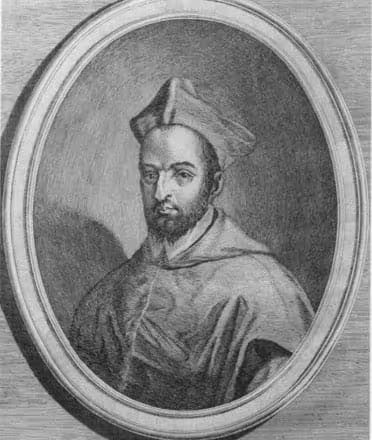
Scipione Gonzaga
1542-1593
Biography
Scipione Gonzaga (1542–1593) stands as one of the most intellectually luminous and politically influential figures of the late Italian Renaissance—a cardinal, literary patron, humanist scholar, and intimate confidant of Torquato Tasso. Situated at the crucial nexus where aristocratic dynastic prestige intersected with the rigorous intellectual fervor of late sixteenth-century Italian academies and the rigid curial politics of Counter-Reformation Rome, Gonzaga exerted an outsized influence upon the literary production, textual criticism, and ecclesiastical patronage of his era. As the founder of the celebrated Accademia degli Eterei in Padua and a vital protector of Tasso during the epic poet's most tumultuous years, Scipione Gonzaga embodied the early modern ideal of the prince-scholar, seamlessly navigating the refined debate of Aristotelian poetics, high-level diplomatic missions, and the elevated governance of the Holy See.
Born in Mantua on November 11, 1542, Scipione belonged to the cadet branch of the illustrious Gonzaga dynasty—specifically the line of the Marchesi di Gazzuolo and San Martino dall'Argine. He was the son of Carlo Gonzaga, an accomplished military commander in the imperial service of Emperor Charles V, and Emilia Cauzzi Gonzaga. Raised amidst the opulent visual and intellectual milieu of the Mantuan court, Scipione was destined from early youth for an ecclesiastical and scholarly career, a traditional pathway for younger sons of high Italian nobility designed to bolster dynastic standing within the Church hierarchy. His early education was conducted under the tutelage of eminent private preceptors who instilled in him a profound mastery of classical Latin, Greek, rhetoric, and scholastic philosophy.
To complete his higher education, Gonzaga moved to the university centers of Bologna and Padua, the premier crucibles of European jurisprudence, Aristotelian philosophy, and Italian vernacular letters.
During his formative student years at the University of Padua in the early 1560s, Scipione immersed himself in the vibrant philosophical and literary debates of the Veneto. Padua was then the capital of European Aristotelianism, dominated by figures such as Federico Pendasio and Bernardino Tomitano, as well as the formidable literary authority of Sperone Speroni. In 1564, at the age of twenty-two, Scipione took the initiative to establish a new literary academy that would fundamentally reshape late sixteenth-century Italian poetry: the Accademia degli Eterei.
Under the academic pseudonym Il Sollecito ("The Solicitous One"), Gonzaga convened a brilliant circle of young intellectuals, poets, and humanists, including Torquato Tasso (who adopted the academic name Il Pentito), Battista Guarini (L'Animoso), Antonio Riccoboni, Lorenzo Gambara, and the celebrated bibliophile and collector Gian Vincenzo Pinelli. The Eterei sought to harmonize classical poetic rigor with late Renaissance lyrical sensibility, publishing their collective verse in the influential anthology Rime de' gli Academici Eterei (Venice: Domenico and Giovanni Battista Guerra, 1567), dedicated to the patroness Lucrezia d'Este.
It was within the domestic and academic orbit of Padua and later Rome that Scipione Gonzaga formed an indelible intellectual and personal bond with Torquato Tasso. Recognizing Tasso's supreme genius, Gonzaga became his chief institutional protector, literary sounding board, and financial sponsor. When Tasso began the agonizing process of revising his monumental epic Gerusalemme Liberata in the mid-1570s, Gonzaga organized and led the famous Roman revision committee (1575–1576), composed of elite scholars such as Sperone Speroni, Pier Girolamo Ranuzzi, Flaminio de' Nobili, and Silvio Antoniano.
Gonzaga painstakingly mediated between Tasso's tortured artistic vision and the draconian moral and theological demands imposed by Counter-Reformation censors. When Tasso's mental health disintegrated, leading to his tragic confinement in the hospital of Sant'Anna in Ferrara (1579–1586), Scipione Gonzaga worked tirelessly through diplomatic channels, curial pressure, and personal advocacy to secure the poet's release, preserve his manuscripts from unauthorized pirated editions, and offer him refuge in his own Roman residences.
Gonzaga's personal trajectory in Rome was defined by steady ecclesiastical advancement and diplomatic service. Relocating permanently to the papal capital in the late 1570s, he entered the papal administration, earning the favor of successive pontiffs through his legal acumen, noble stature, and refined diplomacy. Pope Sixtus V (Felice Peretti), recognizing Gonzaga's administrative capability and devotion to the Church, elevated him to the titular dignity of Latin Patriarch of Jerusalem in 1585. This was followed by his creation as Cardinal Priest in the consistory of December 18, 1587, receiving the titular church of Santa Maria del Popolo. As a cardinal, Gonzaga actively participated in the Congregation of the Index and various diplomatic delegations, maintaining a lavish household that functioned as a major hub for humanists, musicians, poets, and theologians visiting the Eternal City.
In the final years of his life, suffering from severe attacks of gout and physical exhaustion, Cardinal Gonzaga increasingly withdrew from the political strife of the Roman Curia to his family estates in Lombardy. He spent his remaining days at San Martino dall'Argine, where he devoted himself to religious devotion, literary composition, and the drafting of his autobiography. Written in refined Latin, his Commentarii provide an indispensable historical and autobiographical window into the political intrigues, literary debates, and curial mechanics of late sixteenth-century Italy.
Cardinal Scipione Gonzaga died at San Martino dall'Argine on January 11, 1593, at the age of fifty. His death was widely mourned across the Italian Peninsula, commemorated in funeral orations and academic elegies by the most prominent literary figures of the era. His legacy endures as a paragon of late Renaissance humanist patronage, whose steadfast support of Torquato Tasso and organizational genius within the Accademia degli Eterei helped define the poetic and intellectual contours of early modern Italian literature.
Bibliography
Affò, Ireneo. Vita di Scipione Gonzaga, Cardinale del Titolo di S. Maria del Popolo. Parma: Dalla Stamperia Reale, 1792.
Tiraboschi, Girolamo. Storia della letteratura italiana. Tomo VII, Parte III. Modena: Società Tipografica, 1792, pp. 1145–1150.
Serassi, Pierantonio. La vita di Torquato Tasso. 2nd ed. 2 vols. Rome: Pagliarini, 1790.
Solerti, Angelo. Vita di Torquato Tasso. 3 vols. Turin-Rome: Loescher, 1895.
Maylender, Michele. Storia delle Accademie d'Italia. Vol. II. Bologna: L. Cappelli, 1927, pp. 320–326.
Belloni, Antonio. Il Seicento. Milan: Vallardi, 1929.
Chiodo, Domenico. "Scipione Gonzaga e i suoi 'Commentarii'." Giornale storico della letteratura italiana 168, no. 542 (1991): 215–238.
Benzoni, Gino. "Gonzaga, Scipione." In Dizionario Biografico degli Italiani, Vol. 57, 845–853. Rome: Istituto della Enciclopedia Italiana, 2001.
Girardi, Raffaele. "L'Accademia degli Eterei e la lirica padovana del Cinquecento." In Le accademie nell'Italia del Rinascimento, edited by E. Russo, 112–135. Florence: Leo S. Olschki, 2009.
Canova, Andrea. "Scipione Gonzaga, Torquato Tasso e la revisione della 'Liberata'." Studi Tassiani 60 (2012): 45–78.
Beyond the names: biographies and bibliographies on this page are curated by Abu, the AI scholar crafted by Buonvecchio exclusively for Govi Rare Books.