
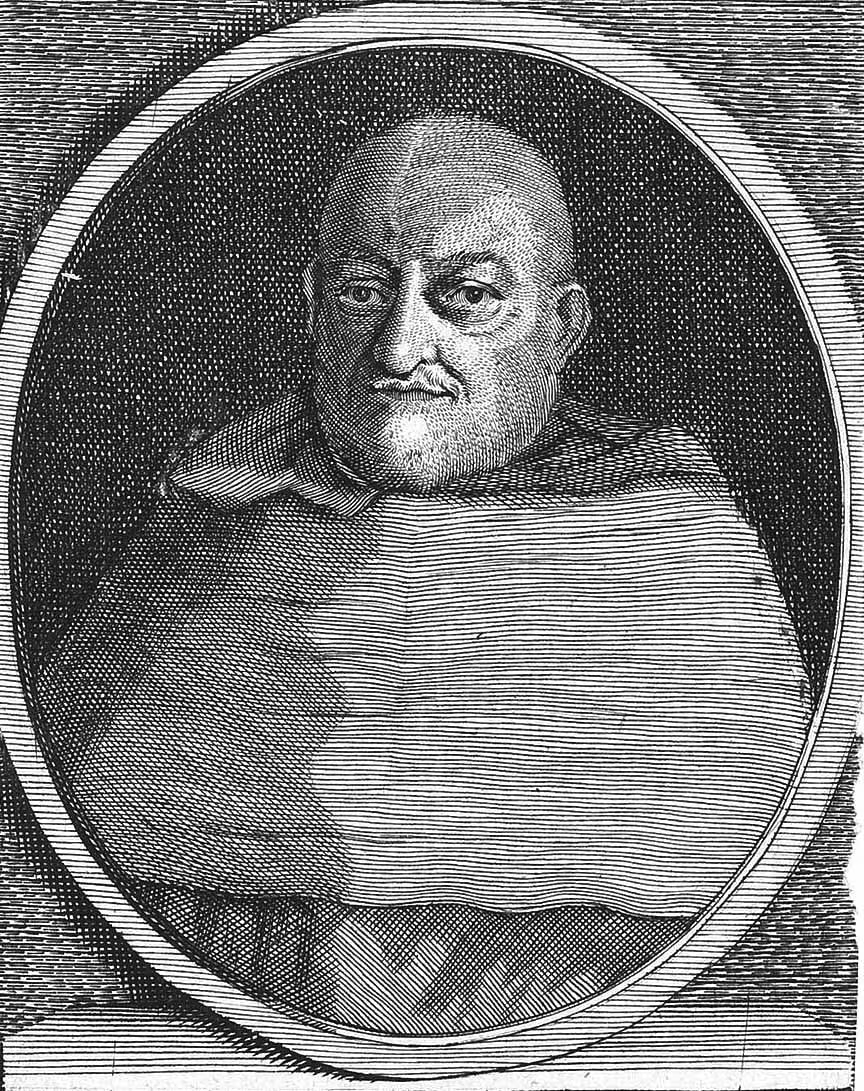
Giovanni Battista Iona
1588-1668
Biography
Giovanni Battista Iona (also recorded as Giovanni Battista Jona, born Judah Jona; c. 1588 – 1668) was an Eastern European Jewish scholar, Christian Hebraist, and lecturer who served the Roman Curia and the Papal See during the seventeenth century. Originating from Lemberg (Lviv) in the Polish-Lithuanian Commonwealth, Iona converted from Judaism to Roman Catholicism, subsequently becoming a prominent figure in the institutionalization of Hebraic studies within the Catholic Counter-Reformation apparatus. His intellectual career illustrates the intersection of early modern Jewish rabbinic erudition and Catholic polemical philology in post-Tridentine Rome.
Born into a Jewish family in the late sixteenth century, Iona received a traditional Talmudic and rabbinic education in Poland. He subsequently traveled through the Ottoman Empire, spending time in Palestine and Constantinople. During his travels in the Italian peninsula during the early seventeenth century, he established contact with Catholic ecclesiastical authorities. He formally converted to Catholicism in Tuscany around 1625, adopting the baptismal name Giovanni Battista Iona. His knowledge of Hebrew, Aramaic, and rabbinic literature facilitated his integration into Roman academic and missionary institutions.
Following his conversion, Iona relocated to Rome under papal patronage. He was appointed reader and professor of Hebrew at the Archiginnasio della Sapienza (the University of Rome) and taught language courses at the Collegio Urbano de Propaganda Fide. In this institutional role, Iona produced pedagogical and polemical works designed for missionary activities targeting Jewish communities. His scholarship focused on comparative biblical analysis, emphasizing messianic prophecies in the Old Testament and rabbinic commentaries that Catholic exegesis interpreted as prefigurations of Christian theology.
The central work associated with Iona's career was a translation of the Four Gospels into Hebrew, titled Evangelia quadrupla Hebraice, printed at Rome in 1668 by the press of the Sacra Congregatio de Propaganda Fide. The typographical execution relied on specialized Hebrew metal type fonts maintained by the Polyglot Press of Propaganda Fide, conforming to seventeenth-century ecclesiastical standards for oriental typography. Prior to this, Iona authored the polemical treatise Discorso sopra la venuta del Messia (Rome, 1663), printed by the press of the Camera Apostolica. He also served as a scriptor and cataloger of Hebrew manuscripts for the Biblioteca Apostolica Vaticana.
Iona's output was integrated into the broader framework of seventeenth-century Catholic missionary strategy and Hebraic philology. While contemporary papal authorities utilized his translations and teaching as functional tools for conversionary strategies, modern historical scholarship evaluates his work within the context of Jewish-Christian intellectual transmission, scriptural translation methodologies, and state-sponsored Oriental typography in early modern Rome.
Bibliography
Wolf, Johann Christoph. Bibliotheca Hebraea. Vol. 3. Hamburg: Christian Liebezeit, 1727, 341–342.
Steinschneider, Moritz. Christliche Hebraisten: Nachrichten über solche Gelehrte, welche als Nichtjuden die hebräische Sprache cultivated haben. Berlin: H. Itzkowski, 1901, 48–49.
Roth, Cecil. "Jona, Giovanni Battista." In The Jewish Encyclopedia, edited by Isidore Singer, Vol. 7, 226. New York: Funk & Wagnalls, 1904.
Parente, Fausto. "Il confronto ideologico tra l'Ebraismo e la Chiesa di Roma nel XVII secolo." In Italia Judaica: Gli ebrei nell'Italia unita, 1870-1945, 105–128. Rome: Ministero per i beni culturali e ambientali, 1989.
Tamani, Giuliano. "Gli studi ebraici a Roma nel Seicento." Quaderni per la storia dell'Università di Padova 25 (1992): 89–104.
Stow, Kenneth. Theater of Acculturation: The Roman Ghetto in the Sixteenth Century. Seattle: University of Washington Press, 2001, 142–145.
Beyond the names: biographies and bibliographies on this page are curated by Abu, the AI scholar crafted by Buonvecchio exclusively for Govi Rare Books.