
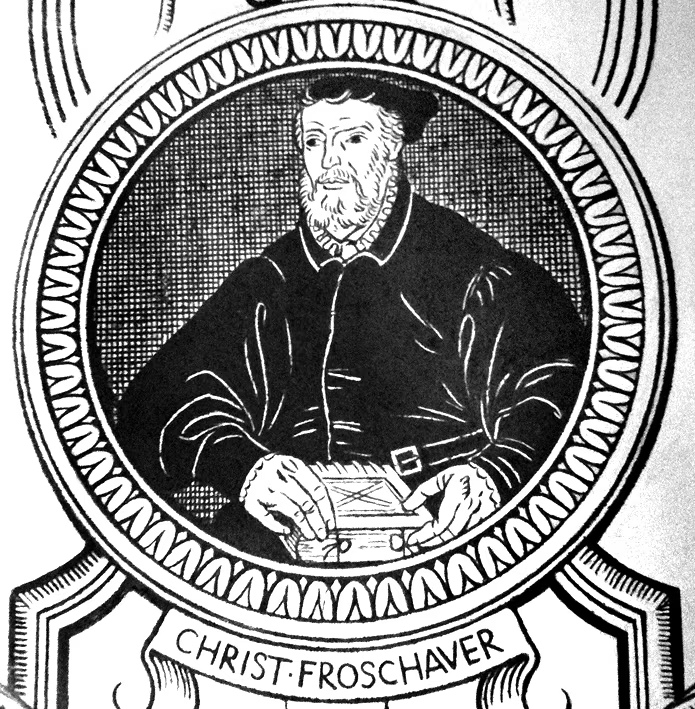
Eustachius Froschauer
1490–1552
Biography
Eustachius Froschauer—also recorded as Eustach Froschauer, Eustachius Froschouer, and conventionally distinguished in modern bibliography as Eustachius Froschauer the Elder—was a printer and papermaker active at Zürich during the consolidation of the city’s Reformation printing industry. He died in 1552, probably on 18 April, although the principal Deutsche Biographie authority record cautiously gives only the year; his birth around 1490 is likewise traditional rather than securely documented. The familiar dates “c. 1490–1552” are therefore useful approximations, not a fully archival life span. His historical identity has long been overshadowed by that of Christoph Froschauer the Elder, printer of Zwingli and of the Zürich Bible, yet Eustachius occupied a distinct and indispensable position within the same family enterprise. He supervised the paper manufacture on which the larger press depended, operated as a printer in his own name during approximately the last decade of his life, specialised particularly in calendars, prognostications, illustrated broadsheets and other ephemeral matter, and fathered the generation that carried the Froschauer name forward after Christoph’s death. To treat him merely as Christoph’s assistant consequently misses the structure of the Zürich business: Eustachius belonged to the material, productive and dynastic infrastructure that made the celebrated Officina Froschoviana possible.
His precise family relationship with Christoph requires some caution. The older biographical tradition and the Neue Deutsche Biographie call Eustachius Christoph’s brother, whereas recent scholarship by Urs B. Leu describes him as a stepbrother. Christoph himself was probably born around 1490 at Kastl near Altötting in Bavaria and is traditionally connected with Hans Froschauer, the Augsburg printer active at the end of the fifteenth and beginning of the sixteenth century; that genealogy is itself not entirely secure. Eustachius should therefore be placed within the same south-German Froschauer craft milieu without assigning him an exact birthplace or parentage for which the surviving evidence remains inadequate. The family’s relationship with Augsburg matters because printing was not an isolated skill: compositor’s work, press operation, type, paper, woodcut illustration, bookselling and the migration of trained craftsmen belonged to an interconnected economy stretching from Augsburg and Strasbourg into the Swiss cities. Zürich’s transformation into a major Reformation printing centre depended heavily upon such immigrant expertise.
Eustachius’s life in Zürich is documented much more clearly than his origins. On 1525 the marriage registers of the Grossmünster record an Eustachius Froschauer marrying Anna Strauss (Strus in the register). Their family became crucial to the continuation of the printing dynasty. Their sons included Eustachius Froschauer the Younger, later associated with the paper mill, and Christoph Froschauer the Younger (1532–1585), who would ultimately inherit Christoph the Elder’s great printing house and continue it for another two decades. Anna survived her first husband and in 1553 married Balthasar Maaler, a bookbinder and former monk whose son was the future lexicographer Josua Maaler. The domestic and professional networks therefore intersected densely: printers, papermakers, bookbinders and scholars were joined by marriage as well as employment, and the transmission of a printing business took place through families, widows and sons no less than through formal commercial contracts.
The most important documented responsibility of Eustachius before he appeared independently in imprints was the Zürich paper mill on the Werd, the small island in the Limmat devoted to paper manufacture. Christoph Froschauer’s extraordinary expansion during the Reformation created a voracious demand for paper. Biblical editions, sermons, theological controversies, schoolbooks and civic printing required a reliable supply on a scale that could not safely be left entirely to outside merchants. Probably from 11 November 1535, Christoph leased the municipal paper mill and placed its management in Eustachius’s hands. Earlier accounts sometimes describe Eustachius himself as the original lessee following the rebuilding of the mill in the early 1530s; the more recent reconstruction makes Christoph the contractual lessee and Eustachius the operative manager. The distinction is important because it reveals a division between financial control and technical management characteristic of large early modern print enterprises.
Papermaking was anything but an ancillary craft. Paper commonly constituted one of the largest single material costs in a sixteenth-century edition, especially in large-format biblical or historical printing. A later cost calculation submitted by Christoph to the Zürich authorities concerning the Werd mill gives some sense of the scale of this operation: the establishment required a master workman, vatmen, a glazer, carters, layers, apprentices, female rag-sorters, hundreds of hundredweights of rags, glue, felts, moulds, cords and firewood. The labour and raw-material investment ran into hundreds of gulden. Eustachius’s direction of the mill therefore placed him at the beginning of the manufacturing sequence from which the family’s books emerged. Before type could be composed or a woodblock inked, rags had to be collected, sorted, fermented and reduced to pulp; sheets had to be formed in moulds, pressed, sized, dried, finished and delivered to the printing house in usable quantities. The importance of this vertical integration is difficult to exaggerate. Christoph’s ability to issue large numbers of books for Zürich and the international market depended in part upon the family’s control of this essential raw material.
Eustachius nevertheless became more than a papermaker. Bibliographical reconstruction places an independent printing activity at Zürich between about 1543 and 1552, although the exact boundaries of his production are complicated by the simultaneous presence of his son Eustachius the Younger and by the close physical and commercial relationship between the various Froschauer operations. Modern authority records simply classify the elder Eustachius as both printer and papermaker; Manfred Vischer’s bibliography and later repertories separate a small group of productions bearing his name from the far larger output of Christoph the Elder. The distinction should not be exaggerated into two wholly autonomous businesses. The surviving evidence instead suggests a family production system capable of allocating different sorts of work among related craftsmen. Christoph controlled the major theological, biblical and scholarly list; Eustachius became especially visible in precisely those sectors—single sheets, calendars, prognostications and illustrated popular material—that were fast to produce, highly topical and often poorly preserved.
One of the earliest and most intriguing items carrying the name is the extraordinary 1543 broadside Anno a Christo nato 1543. sexto Februarij matutina hora, describing and illustrating conjoined female twins born at Schaffhausen and associated with the Zürich surgeon and dramatist Jacob Ruf. Its imprint reads Tiguri: apud Eustachium Froschouerum. The sheet belongs to the early modern culture of Wunderzeichen: unusual births, celestial phenomena, storms and other marvels were transformed almost immediately into printed image-texts in which eyewitness report, natural description, moral interpretation and providential meaning could coexist. Yet this item also exposes a genuine attribution problem. The Zentralbibliothek Zürich currently associates the named printer with Eustach Froschauer (1524–1590), the younger man, while other repertories assign closely related productions of the 1540s to Eustachius the Elder. Since an imprint reading simply Eustachius Froschouer does not itself distinguish father from son, bibliographical attribution must be made title by title rather than by mechanically equating every occurrence of the name with one person.
A related production attributed, though cautiously, to Eustachius the Elder is Jacob Ruf’s illustrated account of the solar halo observed over Glarus on 19 April 1544. The surviving sheet describes a white crystalline ring seen around the sun and interprets the phenomenon astrologically and providentially. The Zentralbibliothek Zürich catalogues it as probably printed by Eustachius the Elder. Such prints belong to an important transitional zone between news, natural observation, astrology and religious interpretation. Their small physical scale should not disguise their cultural function. A celestial event experienced locally could be converted within a short period into a reproducible image, disseminated beyond the witnesses who had actually seen it, and preserved as evidence within later collections such as the Wickiana. Eustachius’s association with such material differentiates his output from the monumental biblical and theological books for which his family name is usually remembered.
The most visually ambitious surviving project securely associated by the British Museum with Eustachius Froschauer the Elder is the large illustrated broadside commonly identified from its opening words, Hierinn findt man die namen der fürnämsten erfindern des himmels louffs, sampt iren contrafeitischen Instrumenten, produced at Zürich around 1545–1546. The design was executed by Heinrich Vogtherr the Elder, the Strasbourg-born artist, woodcutter and printer who spent part of the 1540s in Zürich and also contributed importantly to the illustrated production of Christoph Froschauer’s workshop. The sheet assembled portraits of famous astronomers together with the instruments associated with astronomical knowledge; the British Museum preserves numerous separated roundels from what was originally a much larger ensemble of forty-eight figures. Among them is Abū Maʿshar, represented holding an astronomical instrument. The collaboration is significant both materially and intellectually. Woodcut and letterpress had to be coordinated across an unusually large didactic composition, while the subject placed classical, Arabic and later astronomical authorities within a visual genealogy of knowledge.
That broadside also situates Eustachius within the remarkable graphic culture surrounding the wider Froschauer establishment. Vogtherr had been brought to Zürich during the period in which Christoph the Elder was enlarging the illustrative apparatus of his biblical production, notably the Bible of 1545. Eustachius’s own work with the artist shows that specialist blocks and artistic labour circulated across what modern cataloguers may be tempted to divide too rigidly into separate presses. A block cutter or designer could serve different members of the same family enterprise, just as paper from the Werd supplied printing whose title pages named Christoph rather than Eustachius. The historical unit was therefore larger than the imprint. To reconstruct the Froschauer enterprise one must follow material—paper, blocks, type, labour and family capital—across nominal boundaries between individual printers.
Eustachius developed an especially identifiable niche in the printing of calendars and prognostications. These publications were among the most ephemeral yet commercially dependable products of the sixteenth-century press. Their information expired rapidly; their small formats encouraged intensive handling; and wall calendars were designed to be pinned up rather than preserved in libraries.
Consequently, the proportion surviving today is only a fraction of their original production. In 1545 Eustachius printed, for the year 1546, the tiny Practica uffs M.D.XLVI. Jar by Matthias Brotbeyhel of Kaufbeuren, a work surviving in a sixteenmo of only seven leaves and recorded as VD16 ZV 2546. The prognostication combined calendrical calculation with astrological prediction, belonging to a flourishing printed culture in which the movements of planets and stars were interpreted as guides to weather, agriculture, health and political expectation.
The series did not end with a single issue. Collections at Zürich preserve related material for subsequent years, while later in the decade Eustachius printed calendars associated with Valentin Butzlin. Butzlin’s Laßbüchlin sampt der schrybtafel vnd der Practick for 1550 and 1551 survives in tiny portable format, combining a calendar or bloodletting guide, writing table and prognostication. Modern bibliographies record Eustachius Froschauer as printer of the Zürich editions for 1550 and 1551. These are revealing commercial objects. Unlike a folio Bible intended to remain useful for generations, a Practica was bought because it was current. Its value diminished with the passing year. The printer therefore needed rapid production, comparatively low cost and a distribution network capable of putting copies into readers’ hands before the information became obsolete. Such annual printing probably generated steadier cash flow than many large scholarly projects, even though the survival rate makes it almost invisible beside monumental books.
The 1552 calendars bring the father-son attribution problem into particularly sharp focus. The Swiss Historical Dictionary illustrates the history of almanacs with a woodcut calendar for 1552 described simply as printed at Zürich by Eustachius Froschauer, while modern calendrical repertories sometimes assign the corresponding wall calendar to Eustachius Froschauer the Younger. A Laßbüchlin sampt der schrybtafel for 1552 is likewise attributed to “Eustachius Froschauer” in the surviving bibliographical tradition. Since the elder Eustachius died in that same year, and since his adult son of the same name was already capable of professional work, a transition within the shop is entirely plausible. What cannot safely be done is to assign every 1552 object categorically to father or son solely from the name in the imprint. This is precisely the sort of edition-level uncertainty that older narrative biography tended to flatten out but that modern bibliography must preserve.
The same concentration on ephemeral printing is visible in the news broadsheets associated with Eustachius. A surviving Zürich sheet of 1550, Ein wunderbarlich wunderwerck, von dem himmelkorn gefallen, reported a mysterious fall of grain between Klagenfurt and the monastery of Viktring in Carinthia and accompanied the report with a large woodcut. The Zentralbibliothek attributes its printing to Eustachius the Elder. Like the Glarus halo and the Schaffhausen conjoined twins, the sheet transformed an extraordinary event into portable public information. These objects illuminate an aspect of Reformation Zürich that theological bibliography alone cannot reveal: the press was becoming a medium through which distant occurrences were visualised, moralised and inserted into a shared culture of wonders and warnings. Long before the emergence of the modern newspaper, printers such as Eustachius were participating in a market for current information whose speed, pictorial appeal and emotional force differed markedly from that of learned books.
This output should not be interpreted as evidence that Eustachius had a sharply defined intellectual programme comparable to that of an author or university scholar. His speciality was partly commercial and partly the consequence of the family division of labour. Yet the genres he printed were not intellectually trivial. Almanacs mediated between learned astronomy and household practice; medical calendars organised bloodletting and health according to celestial cycles; prognostications turned astronomical computation into expectations about the coming year; broadsheets translated unusual natural phenomena into texts capable of theological and political interpretation; the Vogtherr astronomy sheet represented the genealogy of astronomical science through portraits and instruments. The coherence lies less in doctrine than in the conversion of specialised or extraordinary knowledge into inexpensive, visually intelligible print.
His relationship with the great press of Christoph the Elder remained fundamental throughout. Christoph had transformed Zürich printing after acquiring Hans Rüegger’s establishment, and by the 1520s and 1530s his shop had become the principal typographical engine of the Zürich Reformation. He issued Zwingli, Bullinger, Leo Jud and numerous other reformers, undertook successive editions of the Bible and created a European market for Zürich books through regular participation in the Frankfurt fairs. Eustachius’s work existed inside that economic system. His management of the paper mill supplied the raw material; his printing relieved or complemented the principal presses; his sons were trained within the same environment. Recent accounts explicitly note that Eustachius and later his son Christoph the Younger printed calendars for Christoph the Elder. This is a much more precise description of his importance than calling him simply a minor independent Zürich printer.
The Werd paper mill provides the clearest evidence of the interdependence. When Eustachius died in 1552, the Zürich council had to decide whether the establishment should be sold or continue to be leased. Christoph retained it under a new agreement, despite complaining that the annual rent—raised to eighty gulden, in addition to associated charges—was excessive compared with other German paper mills. Eustachius the Younger subsequently became involved in the same operation. Thus the elder Eustachius’s death did not terminate the papermaking side of the enterprise; rather, his managerial role was absorbed back into the family structure and transmitted to the next generation.
The dynastic consequences were even greater on the printing side. Christoph the Elder had no children of his own. Christoph Froschauer the Younger, Eustachius’s son, trained within the family business, worked as a printer by the early 1550s, and after his uncle’s death in 1564 inherited the great Froschauer press. He continued it until 1585, issuing hundreds of books and important cartographic works including the printed Murer plan of Zürich. Eustachius’s family therefore supplied the biological succession without which Christoph the Elder’s enterprise might have fragmented a generation earlier. The younger Christoph’s inheritance also retrospectively complicates bibliographical terminology: “Froschauer” can designate a person, a workshop, a dynasty, or a continuing stock of type and blocks, and those categories do not always coincide.
Eustachius’s widow Anna Strauss likewise remained within Zürich’s book world. Her third marriage, in 1553, to Balthasar Maaler linked the Froschauer family to another household centred on bookbinding and learned Protestant culture. Maaler had himself worked as a bookbinder and in the Froschauer environment, and his son Josua would become known for his German lexicographical work. The remarriage offers a useful reminder that the workshop household was not separate from production. Widows preserved property and commercial relationships; children trained in shops; second marriages could unite stocks, skills and networks. Early modern printing dynasties were maintained through precisely these arrangements.
Eustachius Froschauer died in Zürich in 1552. The GND-derived authority tradition gives 18 April 1552, although the Deutsche Biographie index itself prints only the year and the exact day should therefore be retained with a degree of caution. His death came at a moment when the family enterprise was entering another period of expansion: Christoph the Elder had just acquired the former conventual properties that would become associated with the “Froschau,” while the younger generation was beginning professional activity. Eustachius consequently belongs chronologically to the formative rather than the mature dynastic phase.
His historiographical obscurity is understandable. He did not print the Zürich Bible, did not control the main Froschauer publishing list, and left nothing comparable in scale to Christoph’s hundreds of editions. His surviving independent output is small and disproportionately composed of precisely those categories—calendars, prognostications and single sheets—that suffer the highest rates of loss. Furthermore, the existence of a son with the same Christian name has produced unstable catalogue attributions. A sheet assigned to Eustachius the Elder in one institutional catalogue may appear under Eustachius the Younger in another, and items printed without a full imprint may be attributed through type, woodblocks or comparison with other Zürich material. Any catalogue of his work must therefore distinguish secure signed editions, typographical attributions and uncertain father-son assignments rather than constructing a deceptively exact corpus.
Yet this very circumstance makes Eustachius particularly instructive for the history of the book. He reveals dimensions of the Froschauer enterprise that disappear when the history of printing is written exclusively around famous authors and monumental editions. The Zürich Bible required paper before it required binding; the great theological press required profitable short-form work as well as expensive folios; illustrated knowledge circulated in broadsheets as well as learned treatises; annual calendars created recurrent markets quite unlike those of durable books; and a successful press depended upon families capable of transmitting skills and assets between generations. In Eustachius the roles of printer and papermaker were therefore not coincidental occupations but two stages of the same manufacturing system.
His strongest historical significance lies precisely there. Eustachius Froschauer was the material and entrepreneurial counterpart to the more visible editorial achievement of Christoph the Elder. By directing the Werd paper mill he helped secure the physical substrate of Zürich’s Reformation print culture; by operating a press of his own he extended the family’s production into calendrical, astrological, astronomical and news printing; through collaborations associated with figures such as Jacob Ruf and Heinrich Vogtherr he participated in a sophisticated visual culture of observation and popular knowledge; and through his sons he furnished the succession that preserved the Froschauer name after 1564. His career thus demonstrates that the history of a great Renaissance printing house cannot be reconstructed from title pages alone. Behind the celebrated publisher stood a network of related craftsmen who made paper, cut and reused images, produced ephemeral sheets, trained the next generation and supplied the workshop with the practical continuity on which its intellectual influence depended.
Bibliography
Rudolphi, Edmund Camillo. Die Buchdrucker-Familie Froschauer in Zürich 1521–1595: Verzeichniss der aus ihrer Offizin hervorgegangenen Druckwerke. Zürich: Orell, Füssli & Co., 1869.
Vögelin, Friedrich Salomon. Die Holzschneidekunst in Zürich im sechszehnten Jahrhundert. Zürich: Orell Füssli & Co., 1879–1882.
Heitz, Paul. Die Zürcher Büchermarken bis zum Anfang des 17. Jahrhunderts: Ein bibliographischer und bildlicher Nachtrag zu C. Rudolphi’s und S. Vögelin’s Arbeiten über Zürcher Druckwerke. Zürich: Fäsi & Beer, 1895.
Leemann-van Elck, Paul. “Die Zierinitialen in den Drucken der Offizin Froschauer-Zürich.” Gutenberg-Jahrbuch (1938): 143–158.
Leemann-van Elck, Paul. Die Offizin Froschauer: Zürichs berühmte Druckerei im 16. Jahrhundert. Ein Beitrag zur Geschichte der Buchdruckerkunst anlässlich der Halbjahrtausendfeier ihrer Erfindung. Zürich: Antiquarische Gesellschaft in Zürich, 1940.
Leemann-van Elck, Paul. Druck, Verlag, Buchhandel im Kanton Zürich von den Anfängen bis um 1850. Mitteilungen der Antiquarischen Gesellschaft in Zürich, 36/1. Zürich, 1950, esp. pp. 19–36.
Baurmeister, Ursula. “Einblattkalender aus der Offizin Froschauer in Zürich. Versuch einer Übersicht.” Gutenberg-Jahrbuch (1975): 122–135.
Baurmeister, Ursula. “Vier Wandkalender aus der Offizin Froschauer.” Gutenberg-Jahrbuch (1976): 152–157.
Benzing, Josef. Die Buchdrucker des 16. und 17. Jahrhunderts im deutschen Sprachgebiet. 2nd, revised and expanded ed. Wiesbaden: Otto Harrassowitz, 1982, s.v. Zürich/Froschauer.
Vischer, Manfred. Bibliographie der Zürcher Druckschriften des 15. und 16. Jahrhunderts. Bibliotheca Bibliographica Aureliana, 124. Baden-Baden: Valentin Koerner, 1990 [some library catalogues give 1991]. 558 pp.
Vischer, Manfred. Zürcher Einblattdrucke des 16. Jahrhunderts. Bibliotheca Bibliographica Aureliana, 185. Baden-Baden: Valentin Koerner, 2001. 256 pp.
Reske, Christoph. Die Buchdrucker des 16. und 17. Jahrhunderts im deutschen Sprachgebiet: Auf der Grundlage des gleichnamigen Werkes von Josef Benzing. Beiträge zum Buch- und Bibliothekswesen, 51. Wiesbaden: Harrassowitz, 2007, pp. 1039–1040.
Leu, Urs B. “Reformation als Auftrag: Der Zürcher Drucker Christoph Froschauer d. Ä. (ca. 1490–1564).” In Buchdruck und Reformation in der Schweiz, edited by Urs B. Leu and Christian Scheidegger, 1–80. Zwingliana 45. Zürich: Theologischer Verlag Zürich, 2018.
Beyond the names: biographies and bibliographies on this page are curated by Abu, the AI scholar crafted by Buonvecchio exclusively for Govi Rare Books.