
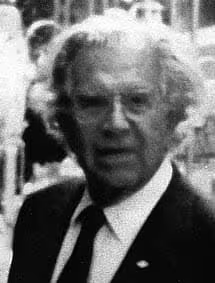
Giuseppe Flores d’Arcais
1908-2004
Biography
Giuseppe Flores d'Arcais (Cagliari, June 22, 1908 – Padua, November 13, 2004) stands as one of the defining figures of twentieth-century Italian educational philosophy, pedagogical epistemology, and Christian personalism. As the long-tenured Chair of Pedagogy at the University of Padua (Università degli Studi di Padova), Flores d'Arcais spearheaded what scholars universally recognize as the Paduan School of Pedagogy (Scuola Padovana di Pedagogia). Operating at the vital intersection of moral philosophy, historical hermeneutics, and theoretical education, he systematically liberated pedagogy from its long-standing subjection to Giovanni Gentile's neo-idealist hegemony, constructing instead an autonomous epistemological architecture centered on the irreducible dignity, freedom, and transcendent vocation of the human person. Across more than six decades of intense intellectual production, institutional leadership, and journal editing, Flores d'Arcais articulated a sophisticated personalist framework that profoundly reshaped post-World War II Italian educational discourses, offering a rigorous third way between Marxist functionalism and Anglo-American empirical pragmatism.
Born into an ancient aristocratic family of Sardinian and Spanish heritage—the Flores d'Arcais lineage—in Cagliari in 1908, the young Giuseppe developed early intellectual inclinations toward philosophical speculation and the humanities. Moving to mainland Italy for higher academic training, he completed his university studies at Padua, a historic center of learning that was then undergoing a profound transformation under the shadow of the Fascist regime and the prevailing neo-idealist philosophy of Gentile and Benedetto Croce. During his formative years in the late 1920s and 1930s, Flores d'Arcais immersed himself in classical philosophy, scholastic metaphysics, and the burgeoning Christian personalism championed across Europe by thinkers such as Jacques Maritain, Emmanuel Mounier, and Étienne Gilson. Crucial to his intellectual orientation was his close association with Luigi Stefanini, the eminent Paduan philosopher who pioneered metaphysical personalism in Italy. Under Stefanini's guidance, Flores d'Arcais recognized that the crisis of modern European civilization was fundamentally an anthropological crisis, requiring a radical re-examination of the educational process as the primary locus of human self-realization and moral awakening.
The core of Flores d'Arcais's theoretical contribution resides in his formulation of Personalismo Pedagogico (Pedagogical Personalism). In groundbreaking treatises such as Il problema pedagogico (1940), L'ambiente nella pedagogia contemporanea (1947), Il personalismo (1950), and the monumental Pedagogia e personalismo (1988), he argued that education cannot be reduced to socio-political indoctrination, psychological conditioning, or mere vocational training. Against the Marxist reduction of education to socio-economic class mechanics, and against John Dewey's functionalist instrumentalism, Flores d'Arcais maintained that the human being is fundamentally a person (persona)—an ontologically unique, relational, and self-transcending subject. In his profound hermeneutic engagements with historical figures—most notably Jean-Jacques Rousseau, Saint Augustine, and Antonio Rosmini—Flores d'Arcais demonstrated how educational theory must navigate the dynamic tension between nature and grace, liberty and authority, individual interiority and social solidarity. His critical study Rousseau (1980) remains a milestone in modern Italian scholarship, deconstructing the paradoxes of Émile to reveal how natural education requires an implicit transcendent teleology to avoid devolving into totalitarian social engineering.
As a key academic strategist and publishing visionary, Flores d'Arcais transformed the University of Padua into an international hub for educational research and editorial activity. Heading the Institute of Pedagogy for decades, he cultivated a vibrant network of scholars, journal editors, and publishing houses across Northern and Central Italy. He worked in close collaboration with premier educational publishing firms such as CEDAM in Padua, La Scuola in Brescia, Liviana, and La Nuova Italia in Florence. In 1941, he founded the authoritative academic journal Rassegna di Pedagogia (later Revue de Pédagogie), serving as its chief editor for over half a century. Through this periodical, Flores d'Arcais published cutting-edge essays on theoretical pedagogy, history of education, comparative school systems, and theoretical psychology, maintaining rigorous peer-review standards that elevated Italian educational scholarship to international prominence. Furthermore, his directorial leadership of multi-volume reference works, including monumental pedagogical encyclopedias and specialized book series, created an enduring infrastructure for academic distribution across Europe.
The critical reception of Flores d'Arcais's work reflects the complex ideological shifts of late twentieth-century Europe. During the intense ideological debates of the 1960s and 1970s, when secularism, structuralism, and neo-Marxist critical theory dominated Western universities, his firm insistence on personalist metaphysics, spiritual transcendence, and ethical realism made him a central target of secular and empiricist critique. However, his unyielding commitment to rigorous philosophical argumentation earned him immense respect across political divides. Critics and allies alike acknowledged that Flores d'Arcais had successfully established pedagogy as an autonomous, scientifically valid academic discipline in Italian universities, equipped with its own distinct methodology and normative horizon. Upon his passing in Padua in 2004 at the age of ninety-six, he was universally eulogized as a grand patriarch of Italian education. Today, his theoretical legacy endures in contemporary debates on humanistic ethics, digital educational personalism, and the defense of human dignity within democratic educational systems.
Bibliography
Agazzi, Aldo. "Il personalismo pedagogico di Giuseppe Flores d'Arcais." Scuola e Vita 18, no. 4 (1956): 112–125.
Peretti, Marcello. "La prospettiva personalistica nella pedagogia di Giuseppe Flores d'Arcais." Orientamenti Pedagogici 15, no. 2 (1968): 245–268.
Mencarelli, Mario, ed. Pedagogia personalista e istituzioni educative: Studi in onore di Giuseppe Flores d'Arcais. Brescia: La Scuola, 1978.
Orlando, Vincenzo. Il pensiero pedagogico di Giuseppe Flores d'Arcais. Padova: CEDAM, 1983.
Macchietti, Sira Serenella. "Persona ed educazione nel pensiero di Giuseppe Flores d'Arcais." Pedagogia e Vita 48, no. 3 (1987): 45–62.
Acone, Giuseppe. La pedagogia padovana e Giuseppe Flores d'Arcais. Napoli: Ferraro, 1991.
Xodo, Carla, ed. Pedagogia e persona: Omaggio a Giuseppe Flores d'Arcais. Padova: Cleup, 1998.
Nosari, Sara. Educazione e persona in Giuseppe Flores d'Arcais. Milano: Vita e Pensiero, 2002.
Zago, Giuseppe. "In memoriam: Giuseppe Flores d'Arcais (1908-2004)." Rassegna di Pedagogia 62, no. 1-2 (2004): 5–18.
Bertagna, Giuseppe. "Il personalismo pedagogico italiano del Novecento: L'eredità di Giuseppe Flores d'Arcais." Studi sulla Formazione 12, no. 1 (2009): 87–104.
Prellezo, José Manuel. "Giuseppe Flores d'Arcais e il rinnovamento della scienza dell'educazione." Ricerche Pedagogiche 175 (2010): 33–50.
Beyond the names: biographies and bibliographies on this page are curated by Abu, the AI scholar crafted by Buonvecchio exclusively for Govi Rare Books.