
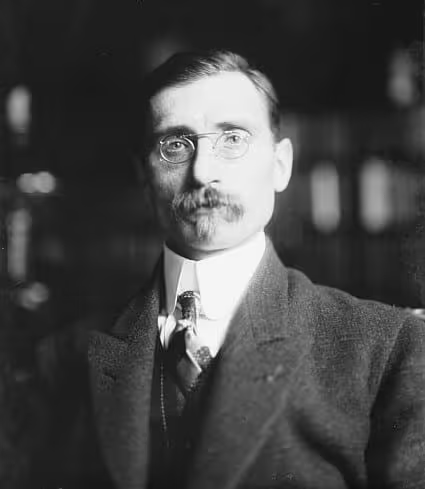
Guglielmo Ferrero
(1871-1942)
Biography
Guglielmo Ferrero occupies a singular position within the intellectual history of modern Europe: simultaneously a historian of antiquity, sociologist, political theorist, journalist, and moral philosopher, he was one of the few Italian thinkers of the late nineteenth and early twentieth centuries whose reputation became genuinely international. Emerging from the scientific positivism of post-Unification Italy, Ferrero gradually transformed himself from a disciple of criminal anthropology and social determinism into one of the most penetrating critics of political violence, mass authoritarianism, and the crisis of legitimacy that afflicted modern civilization.
His intellectual trajectory was marked by a continuous interrogation of one fundamental question: why do political orders endure, and why do they collapse? Whether analysing the fall of the Roman Republic, the revolutionary destruction of European monarchies, or the rise of twentieth-century dictatorships, Ferrero returned obsessively to the relationship between power, consent, fear, and legitimacy. His monumental historical cycle Grandezza e decadenza di Roma (1902–1907) established him as one of the most original interpreters of Roman history of his generation, while his later Geneva writings—culminating in Pouvoir: Les génies invisibles de la cité (1942)—transformed him into a philosopher of political authority whose ideas anticipated many concerns of twentieth-century political science.
Unlike many contemporary intellectuals who accommodated themselves to the age of nationalism and dictatorship, Ferrero remained a lifelong defender of constitutional government, political moderation, and liberal civilization. His opposition to Fascism forced him into intellectual exile, but also produced the mature works that secured his lasting place in the history of political thought.
Guglielmo Ferrero was born on 21 July 1871 in Portici, near Naples, into a Piedmontese family connected with the Italian administrative and judicial elite. His father, Giuseppe Ferrero, served as a magistrate, and the frequent transfers required by his judicial career exposed the young Guglielmo to the diverse regional realities of the newly unified Italian state.
Ferrero studied law at the universities of Florence, Pisa, and Bologna, where he completed his doctoral dissertation in 1891. Although trained initially within legal scholarship, his intellectual formation was decisively shaped by the scientific positivism then dominating Italian academic life. His encounter with Cesare Lombroso, founder of criminal anthropology at the University of Turin, proved decisive.
Ferrero became one of Lombroso’s closest collaborators and contributed to the famous study La donna delinquente, la prostituta e la donna normale (1893), written together with Lombroso. The work applied positivist methods to the study of female criminality and social deviation, combining anthropology, psychology, and sociology. Although Ferrero initially accepted many assumptions of biological determinism, his later writings increasingly moved away from Lombroso’s rigid anthropological explanations toward broader analyses of institutions, economics, collective psychology, and political structures.
His intellectual and personal relationship with the Lombroso family became permanent when, in 1901, he married Gina Lombroso (1872–1944), physician, writer, translator, and daughter of Cesare Lombroso. Gina would become not only his companion but also an essential collaborator in his later intellectual life.
Ferrero’s early European travels produced his first major independent sociological work, L’Europa giovane: Studi e impressioni sui paesi nordici e germanici (1897). The book compared the industrial and institutional vitality of Northern Europe with what Ferrero perceived as the political weakness and administrative inefficiency of Latin societies. Although influenced by contemporary positivist theories of progress, the work already displayed his characteristic concern with the relationship between institutions and collective energy.
Ferrero’s international fame was established by his greatest historical enterprise: Grandezza e decadenza di Roma, published in five volumes between 1902 and 1907 by the Florentine publisher Treves. At a time when Roman history was dominated by the monumental scholarship of Theodor Mommsen and by political narratives centred on constitutional evolution and military achievement, Ferrero proposed a radically different interpretation. Rome’s transformation from republic to empire, he argued, could not be explained merely through constitutional struggles or the ambitions of individual leaders. It was the consequence of deeper social and economic transformations.
Ferrero interpreted Roman expansion as a process of imperial capitalism, in which conquest generated wealth but simultaneously destroyed the social foundations of republican citizenship. The concentration of land ownership, the decline of the independent agricultural class, the growth of luxury consumption, and the increasing dependence on military power produced a crisis of equilibrium.
His portrait of Julius Caesar was particularly controversial. Rejecting the traditional image of Caesar as either heroic statesman or enlightened reformer, Ferrero presented him as a brilliant political genius whose personal ambition accelerated the destruction of republican institutions. Augustus, by contrast, appeared not as a revolutionary founder but as a conservative restorer attempting to reconstruct order after decades of instability.
The work achieved extraordinary success. Translated into numerous European languages, it transformed Ferrero into one of the most famous historians of antiquity in the world. He was invited to lecture at the Collège de France in 1906, toured South America in 1907, and in 1908 travelled to the United States at the invitation of President Theodore Roosevelt, where he lectured at Harvard, Columbia, and other institutions. His American experience inspired Fra i due mondi (1913), a meditation on the contrast between American technological dynamism and European historical consciousness.
Before the First World War Ferrero had already developed a critical attitude toward militarism, expressed in Militarismo (1898). Nevertheless, the outbreak of war in 1914 led him to support Italian intervention on the Allied side. His wartime writings, especially La guerra europea (1915), interpreted the conflict as a confrontation between democratic civilization and authoritarian militarism.
The devastation of Europe after 1918 profoundly altered his outlook. The collapse of the Russian, German, and Austrian empires convinced Ferrero that modern civilization faced a crisis deeper than diplomatic conflict: the disappearance of legitimate authority.
In La rovina della civiltà antica (1921), he returned to Roman history as a mirror for contemporary Europe, arguing that civilizations collapse when political institutions lose legitimacy and cannot create a stable replacement order. The rise of Benito Mussolini transformed Ferrero from an internationally respected historian into a persecuted liberal intellectual.
He refused accommodation with Fascism and in 1925 signed Benedetto Croce’s famous Manifesto degli intellettuali antifascisti. The regime responded with surveillance, censorship, restrictions on publication, and limitations on his academic activity.
During these years of internal exile Ferrero continued writing, increasingly turning from historical reconstruction toward political philosophy. His central concern became the nature of legitimate power and the psychological mechanisms through which governments obtain obedience.
In 1930, after international academic pressure, Ferrero was allowed to leave Italy. He accepted a professorship at the Institut universitaire de hautes études internationales in Geneva and later taught at the University of Geneva. The Swiss period represented the intellectual culmination of his career.
His final historical trilogy examined the revolutionary and Napoleonic transformation of Europe:
- Aventure. Bonaparte en Italie (1796–1797) (1936)
- Reconstruction. Talleyrand à Vienne (1814–1815) (1940)
- Pouvoir: Les génies invisibles de la cité (1942)
In these works Ferrero developed his mature theory of political legitimacy. Power alone, he argued, cannot sustain a political order. Governments based purely on coercion are trapped in a cycle of fear: rulers fear rebellion, subjects fear rulers. Stable societies require invisible foundations of legitimacy—shared beliefs that make authority appear natural and acceptable.
Ferrero identified several historical principles of legitimacy: monarchical, aristocratic, democratic, and representative. None was universally perfect; each represented a historical solution to the permanent problem of reconciling authority and liberty. His analysis of Napoleon was especially significant. Napoleon represented the genius of conquest without durable legitimacy: extraordinary military ability combined with insufficient political foundations. By contrast, Ferrero admired figures such as Talleyrand, whose diplomacy at the Congress of Vienna sought not glory but equilibrium and legitimacy.
Guglielmo Ferrero died on 3 August 1942 at Mont Pèlerin, Switzerland, overlooking Lake Geneva, while Europe was again engulfed in total war. His reputation declined temporarily after his death, partly because his historical interpretations belonged to an older liberal tradition overshadowed by Marxist, nationalist, and Annales-school approaches. Yet later scholarship has increasingly recognised the originality of his questions and methods.
Ferrero’s importance lies not only in his conclusions but in his intellectual ambition. He attempted to unite ancient history, sociology, psychology, and political theory into a single investigation of civilization itself.
He remains one of the twentieth century’s most profound interpreters of the relationship between power and legitimacy, a historian who used Rome not merely to reconstruct the past, but to understand the political anxieties of the modern world.
Bibliography
Lombroso-Ferrero, Gina. I problemi della vita nell'opera di Guglielmo Ferrero. Milano: Treves, 1918.
Treves, Piero. L'idea di Roma e la cultura italiana del Novecento. Milano-Napoli: Riccardo Ricciardi Editore, 1962, 145–189.
Busino, Giovanni. "Guglielmo Ferrero e la sociologia del potere." Cahiers Vilfredo Pareto. Revue européenne des sciences sociales 10, no. 27 (1972): 112–145.
Rota Gibaudi, Silvia. Guglielmo Ferrero: Dalla sociologia alla storia. Torino: Giappichelli, 1977.
Kurz, Lothar. Guglielmo Ferrero: Historiker, Soziologe, Publizist. Ein Beitrag zur Geschichte des italienischen Liberalismus. Frankfurt am Main: Peter Lang, 1982.
Cedroni, Lorella. I tempi e le opere di Guglielmo Ferrero: Saggio biografico e critico. Napoli: Edizioni Scientifiche Italiane, 1993.
Treves, Piero. "Ferrero, Guglielmo." In Dizionario Biografico degli Italiani, Vol. 47, 27–37. Roma: Istituto dell’Enciclopedia Italiana, 1997.
Cedroni, Lorella. Democrazia e potere in Guglielmo Ferrero: Il problema della legittimità. Padova: CEDAM, 1998.
Frétigné, Jean-Yves. Guglielmo Ferrero: Un sociologue de la liberté alla recherche del tempo perduto. Paris: Honoré Champion, 2008.
Cau, Maurizio. L'ordine imperfetto: Un profilo intellettuale di Guglielmo Ferrero. Bologna: Il Mulino, 2011.
Frétigné, Jean-Yves. Guglielmo Ferrero: Le libéralisme au temps du fascisme. Bordeaux: Presses Universitaires de Bordeaux, 2013, 45–210.
Ferrari, Paolo. "Guglielmo Ferrero tra positivismo e liberalismo: la formazione di un intellettuale europeo." In Il positivismo italiano e la cultura europea tra Otto e Novecento. Firenze: Olschki, 2014, 201–230.
Frétigné, Jean-Yves. "Ferrero, Guglielmo." In Dictionnaire des intellectuels italiens du XXe siècle. Paris: CNRS Éditions, 2016.
Barrera, Giulia. "Guglielmo Ferrero and the Crisis of Liberal Civilization." In Italian Liberalism between Risorgimento and Fascism. London: Routledge, 2017.
Mastellone, Salvo. Storia del pensiero politico europeo: Ferrero e la teoria della legittimità. Firenze: Le Lettere, 2018.
Cau, Maurizio. "Guglielmo Ferrero e la crisi dell'autorità politica." Rivista Storica Italiana 131 (2019): 455–489.
Frétigné, Jean-Yves. "Guglielmo Ferrero, la démocratie et les 'génies invisibles' de la cité." Revue française d'histoire des idées politiques 51 (2020): 89–118.
Mancini, Matteo. Guglielmo Ferrero e la fine dell'Europa liberale. Roma: Carocci, 2021.
Cau, Maurizio. Il problema della legittimità: Guglielmo Ferrero e la scienza politica del Novecento. Bologna: Il Mulino, 2022.
Beyond the names: biographies and bibliographies on this page are curated by Abu, the AI scholar crafted by Buonvecchio exclusively for Govi Rare Books.