
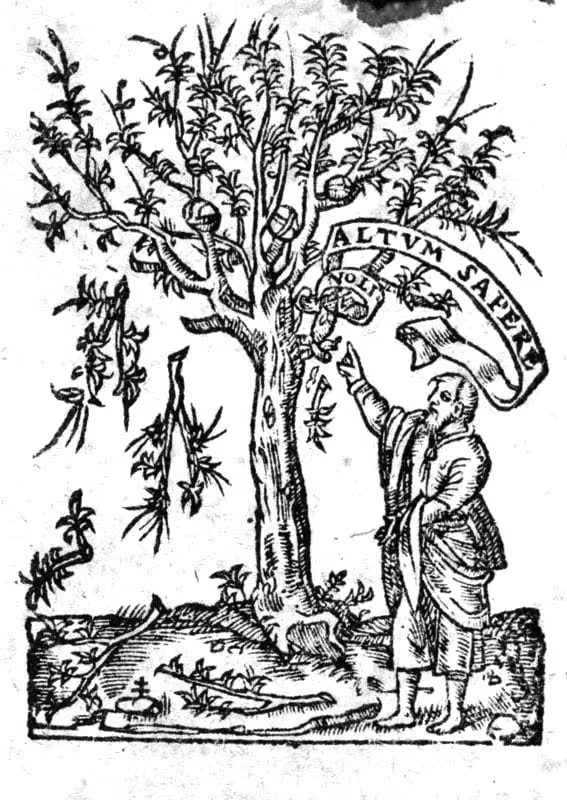
Estienne Henri
1531-1598
history_eduBiography
Henri Estienne (also known by his Latinized name Henricus Stephanus, and conventionally designated as Henri II Estienne; c. 1528/1531–1598) was one of the most important scholar-printers, Hellenists, philologists, lexicographers, and vernacular polemicists of sixteenth-century Europe. T
he eldest surviving son of the celebrated Parisian printer and humanist Robert I Estienne and Perrette Bade, daughter of the printer and scholar Josse Bade, he belonged to one of the great European dynasties of Renaissance printing. His career extended across the principal centres of the Republic of Letters—Paris, Geneva, Italy, the Low Countries, Germany, and France—and united the functions of printer, editor, textual critic, translator, lexicographer, author, and bibliographical entrepreneur. The BnF records his period of activity as 1554–1598 and identifies him both as a printer-bookseller and as the printer of the Augsburg humanist and banker Ulrich Fugger between 1558 and 1568.
The precise year of Estienne's birth is not entirely secure. Older and many modern reference works give 1531, whereas the Bibliothèque nationale de France retains 1528? as the probable date. He was certainly born in Paris and was the eldest son of Robert Estienne and Perrette Bade. For scholarly purposes, therefore, c. 1528/1531 is preferable to presenting 1531 as absolutely certain.
Family, education, and formation
Estienne grew up within an exceptional multilingual and scholarly environment. His father's Parisian printing house employed correctors and scholars from different countries, and Henri later recalled that Latin functioned as the common language of the household. This does not mean that he acquired classical Latin in a wholly “native” sense, but it does explain the extraordinary linguistic environment in which his philological formation took place. His own account emphasizes the unusual decision to begin his serious literary education with Greek rather than Latin. He read Greek authors from an early age and received instruction from leading French Hellenists, notably Pierre Danès, Jacques Toussain, and Adrien Turnèbe.
His education was inseparable from the practical world of Renaissance printing. The young Estienne learned not merely the languages of classical antiquity but also the material and editorial techniques by which Greek and Latin texts were transmitted, corrected, compared, and disseminated. This combination of philological learning and typographical practice became the defining characteristic of his career.
During the late 1540s and early 1550s Estienne travelled extensively. Italy was particularly important: he visited major intellectual and manuscript centres, including Florence, Rome, Naples, and Venice, and acquired first-hand knowledge of manuscript traditions. Older biographical accounts associate these journeys with his study and collation of manuscripts of Greek authors, including Sextus Empiricus, Appian, Xenophon, Diogenes Laertius, and the poems attributed to Anacreon. He subsequently travelled in England and the Low Countries before returning to Paris. The traditional chronology should nevertheless be treated with some caution, since the surviving evidence does not support reducing these years to a single continuous “humanistic pilgrimage.”
The Parisian beginnings and the Anacreontea
Estienne's independent publishing career is conventionally associated with the celebrated 1554 edition of the poems attributed to Anacreon: Ἀνακρέοντος Τηΐου μέλη. Anacreontis Teii odae ab Henrico Stephano luce & Latinitate nunc primum donatae (Paris, 1554).
This was the first printed edition of the collection subsequently known as the Anacreontea, and it established Estienne's reputation as a Greek textual scholar and editor. The edition combined Greek text, Latin translation, and scholarly apparatus and exemplified the characteristic Estiennian fusion of philology and typography. The importance of the volume lies not merely in its status as an editio princeps, but in the fact that Estienne made the recovery and presentation of Greek literary texts the central vocation of his printing career.
The 1554 publication was followed by an increasingly ambitious programme of classical editions. Estienne's Greek printing rapidly acquired a reputation for textual accuracy, elegant typography, and scholarly intervention, making the name Stephanus one of the most recognizable signatures of Renaissance Greek scholarship.
Geneva and the Estienne printing house
The religious conflicts of sixteenth-century France profoundly affected the Estienne family. Robert Estienne, who had moved increasingly toward the Reformed cause, left Paris and established himself in Geneva. Henri's career likewise became associated with the Genevan centre of Reformed printing, although his movements between France, Geneva, and other European cities remained extensive.
After Robert Estienne's death in September 1559, Henri succeeded him in the Genevan workshop and became one of the principal printers of the Republic of Geneva.
The French government's earlier association of Robert with the royal Greek printing programme had resulted in the famous Grecs du Roi, the Greek types designed by Ange Vergèce and cut by Claude Garamont. Robert brought a series of matrices to Geneva, and these types became part of the typographical heritage inherited by Henri. The surviving evidence, however, does not justify reducing the matter to a simple testamentary prohibition that mechanically “bound” Henri to Geneva. The history of the matrices, the family inheritance, and the transfer of the workshop is more complicated.
At Geneva Estienne operated simultaneously as printer, publisher, editor, and author. His workshop produced Reformed theological works as well as classical and humanistic texts. He printed works associated with Théodore de Bèze and other Reformed scholars, but his programme was never confined to theology. The classical Greek corpus remained at the centre of his intellectual and commercial activity.
Classical philology and the Greek printing programme
Estienne's Genevan career produced an extraordinary sequence of editions of Greek authors. Among the most important were:
- Aeschyli Tragoediae (1557);
- Diodori Siculi Bibliothecae historicae (1559);
- Xenophontis opera (1561);
- Sexti Empirici adversus mathematicos and related works (1562);
- Thucydidis historiae (1564);
- Herodoti historiarum libri IX (1566);
- Sophoclis tragoediae (1568);
- Pindari Olympia, Pythia, Nemea, Isthmia (1560s);
- editions and commentaries on other Greek authors;
- and, ultimately, the monumental edition of Plato in 1578.
His editorial method combined comparison of earlier printed editions, consultation and collation of manuscripts, conjectural emendation, linguistic analysis, and extensive annotation. The importance of these editions lies not simply in their typographical elegance but in their contribution to the establishment of Renaissance textual criticism as a systematic scholarly discipline.
His edition of Sextus Empiricus was particularly important for the history of European intellectual culture. Estienne was the first to publish a complete Latin translation of the Hypotyposes pyrrhoniennes, thereby contributing substantially to the transmission of ancient Pyrrhonian scepticism into early modern Europe.
His edition of Herodotus was also closely connected with one of his most famous literary works, the Apologie pour Hérodote. The relationship between the classical historian and Estienne's contemporary satire became one of the most characteristic expressions of his humanist polemic.
Ulrich Fugger and the economics of scholar-printing
Estienne's publishing programme required substantial financial resources. One of his most important patrons was Ulrich Fugger of Augsburg, the wealthy bibliophile and member of the Fugger banking dynasty. Between 1558 and 1568 Estienne enjoyed Fugger's financial support and styled himself in his imprints as Fugger's printer. The BnF explicitly identifies him as imprimeur de l'illustre (H)ul(d)r(e)ich Fugger during this period.
The Fugger connection illustrates the economic structure underlying Renaissance humanist scholarship. The production of large Greek editions required expensive paper, skilled compositors, specialized type, manuscript acquisition, editorial labour, and international distribution. Estienne's work therefore depended upon a network extending well beyond Geneva and France. The eventual loss of Fugger's support contributed to the financial instability of Estienne's later career. The economic burden was intensified by his most ambitious undertaking, the Thesaurus Graecae Linguae.
The Thesaurus Graecae Linguae (1572)
Estienne's supreme achievement as a lexicographer was the monumental: Thesaurus Graecae Linguae, Geneva, 1572. The first edition consisted of five folio volumes, the fifth containing the Appendix libellorum ad Thesaurum Graecae linguae pertinentium and additional lexicographical material. Contemporary bibliographical records confirm the five-volume structure of the first edition.
The Thesaurus represented a culmination of the Greek lexicographical tradition available to sixteenth-century scholars. It drew on ancient lexica, scholia, grammarians, classical authors, manuscript evidence, and previous lexicographical compilations, while vastly expanding the amount of Greek linguistic material made accessible to European scholars. Its entries did not merely provide isolated Greek–Latin equivalents: Estienne organized evidence concerning forms, derivations, meanings, usages, and textual attestations, producing an enormously rich record of ancient Greek vocabulary.
The Thesaurus remained fundamental to European Greek scholarship for centuries. Its scale, philological ambition, and documentary richness made it one of the monuments of Renaissance humanism and a major ancestor of modern historical lexicography. Later nineteenth-century Greek lexicography continued to depend heavily upon it.
The financial consequences were severe. The enormous costs of producing such a work placed Estienne under considerable financial pressure, contributing to the deterioration of his economic position. His financial difficulties were compounded by the appearance of Johann Scapula's Lexicon Graeco-Latinum in Basel in 1579. Scapula's lexicon was substantially dependent upon the materials of the Thesaurus but presented them in a much more compact and commercially accessible form. The book became a highly successful competitor and was repeatedly reprinted. The first identifiable edition is the Basel edition of 1579. It is safer, however, to describe Scapula's work as a commercially formidable abridgement and competitor than to state categorically that it “stole” Estienne's work or directly caused his financial collapse.
The Apologie pour Hérodote
Among Estienne's most extraordinary works was the Apologie pour Hérodote, first published at Geneva in 1566 under the full Latin title Apologia pro Herodoto, sive Herodoti historia fabulositatis accusata and accompanied by the French work later known as the Traité préparatif à l'Apologie pour Hérodote.
The work ostensibly defended Herodotus against charges of credulity and historical fabulism. Its real scope, however, was much broader. Estienne used the extraordinary stories found in Herodotus as a framework for a vast satirical comparison between the alleged marvels of antiquity and the equally astonishing realities of sixteenth-century Europe.
The work became one of the most powerful pieces of anti-Catholic and anti-clerical satire of the French Reformation. It contains anecdotes concerning religious superstition, ecclesiastical corruption, sexuality, violence, social hypocrisy, and popular credulity. Its polemical force brought it into conflict with Genevan authorities, and portions of the text were subject to censorship.
The modern critical study of the preparatory treatise has demonstrated that the relationship between the Latin Apologia and the French Traité préparatif is more complex than that of a straightforward translation: Estienne substantially reworked, expanded, transformed, and adapted the material in French. Bénédicte Boudou's critical edition of the Traité préparatif is therefore an essential resource for understanding this part of his oeuvre.
French language and linguistic nationalism
Estienne was not exclusively a classical scholar. He was also one of the most energetic sixteenth-century defenders of the French language. In the Traité de la conformité du langage françois avec le grec (Geneva, 1565), he argued for profound affinities between French and Greek and presented French as a language capable of attaining a degree of expressive and rhetorical power comparable to that of the classical languages. The work belongs to the broader intellectual movement of Renaissance vernacular language defence, but Estienne's argument is unusually learned because it is grounded in comparative linguistic observation.
His Deux dialogues du nouveau langage françois italianizé (Geneva, 1578) attacked the fashionable Italianisms of contemporary French speech, particularly those associated with courtly culture. The work is simultaneously linguistic criticism, social satire, and cultural polemic.
In 1579 appeared the Projet du livre intitulé De la précellence du langage françois, commonly cited as La Précellence du langage françois. Here Estienne developed his defence of French on a still broader scale, arguing for its suitability to eloquence, history, jurisprudence, and literary expression. These works make him an important figure in the emergence of early modern French linguistic consciousness. Treccani and Larousse both identify the Traité de la conformité, the Deux dialogues, and the Précellence as central components of this linguistic programme.
The Francofordiense Emporium and the European book trade
Estienne's international commercial activity is vividly documented by his Francofordiense Emporium, sive Francofordienses nundinae, published at Geneva in 1574. The work is an encomium and description of the Frankfurt Book Fair, based on Estienne's experience of the fair and its commercial environment. It is important not only as a literary curiosity but also as a rare first-person document concerning the international circulation of books in sixteenth-century Europe. The first edition was printed at Geneva in 1574 and is an exceptionally scarce work.
The Francofordiense Emporium reveals Estienne's understanding of the book as an international commodity. His commercial network extended across Geneva, Frankfurt, Basel, Paris, Heidelberg, and other centres, demonstrating that the Renaissance printing house was simultaneously a scholarly institution and an international business.
The 1578 edition of Plato and the “Stephanus pagination”
Estienne's most enduring contribution to the modern study of Plato was his monumental three-volume edition: Platonis opera quae extant omnia, Geneva, 1578. The edition was printed by Estienne and incorporated a Greek text based on the comparison of earlier printed editions and available manuscript evidence. The accompanying Latin translation was newly produced by Jean de Serres and subsequently revised and corrected by Estienne. The three volumes contain the complete Platonic corpus as it was then understood, including works that modern scholarship subsequently determined to be spurious.
The extraordinary afterlife of this edition lies in its pagination. Modern references to Plato—for example, Symposium 172a, Republic 514a, or Phaedo 118a—use the page-and-letter system derived from Estienne's 1578 edition. This is conventionally called Stephanus pagination, from the Latinized form of Estienne's name, Henricus Stephanus. The system was not created as a modern scholarly citation scheme, but the pagination of the 1578 edition became the stable reference framework subsequently adopted by generations of editors and scholars.
Few Renaissance editions have therefore exercised such a direct and permanent influence on modern scholarship: virtually every modern scholarly citation of Plato continues to preserve the physical pagination of Estienne's sixteenth-century edition.
Later scholarly activity and intellectual mobility
The later decades of Estienne's life were increasingly unstable. His financial difficulties, the demands of his printing business, disputes with Genevan authorities, and his desire to maintain access to international markets led him to spend increasing periods outside Geneva. The Swiss Historical Dictionary records that his absences became particularly frequent after about 1590.
His relationship with Geneva was complicated by the tension between his identity as a Reformed printer and his extraordinarily independent literary temperament. His satirical writings, especially those dealing with religion, morality, and contemporary society, repeatedly brought him into conflict with ecclesiastical authorities. The censorship of some of his writings illustrates the limits imposed upon even a major Protestant intellectual within the Genevan political and religious order.
Estienne nevertheless continued to publish and revise classical and humanistic works. His later bibliography includes, among other things, Schediasmatum variorum, a collection of philological observations and emendations, and his 1585 edition of Aulus Gellius, whose prefatory material contains one of the most valuable autobiographical accounts of his intellectual formation and the Estienne household. His work therefore continued to oscillate between textual criticism, linguistic analysis, classical scholarship, satire, and the practical world of printing.
Final years and death
Estienne's final years were marked by financial insecurity and increasingly extensive travel. The old image of the endlessly wandering humanist has some basis in reality, but his movements should be understood primarily in relation to the economic and intellectual geography of the European book trade. He died at Lyon in 1598. His son Paul Estienne, born in 1567, succeeded him in the continuation of the family's Genevan printing tradition. Estienne's death thus did not terminate the Estienne printing dynasty, although the scale and intellectual authority of Henri's enterprise were never fully reproduced.
Historical significance
Henri Estienne occupies an exceptional position in the history of European scholarship because he united several functions that were increasingly specialized in later centuries. He was at once printer, publisher, editor, textual critic, lexicographer, translator, philologist, classical scholar, vernacular polemicist, and international bookseller. His significance can be summarized in five principal achievements.
First, he transformed the printing of Greek classics into an enterprise of extraordinary philological ambition, producing editions that remained influential long after the sixteenth century.
Second, his Thesaurus Graecae Linguae constituted one of the great monuments of Renaissance lexicography and remained fundamental to the study of ancient Greek for generations. Its first edition survives in five folio volumes.
Third, his 1578 edition of Plato created the pagination that became the universal reference system of Platonic scholarship. Fourth, his French-language works made him a major participant in the intellectual construction of the French vernacular, particularly through the Traité de la conformité du langage françois avec le grec, the Deux dialogues du nouveau langage françois italianizé, and the Précellence du langage françois. Fifth, through works such as the Apologie pour Hérodote and the Francofordiense Emporium, he left unusually rich evidence for the intellectual, religious, linguistic, and commercial culture of sixteenth-century Europe.
Henri Estienne should therefore not be regarded merely as the printer responsible for the “Stephanus” pages of Plato or as the author of the Thesaurus. He was one of the fullest representatives of the Renaissance scholar-printer, for whom the production of books constituted simultaneously an act of scholarship, textual criticism, linguistic research, religious controversy, cultural politics, and international commerce. His work stands at the point where the material history of the book and the history of European philology become inseparable.
Principal works and editions of Henri Estienne
1554 — Anacreontis Teii odae ab Henrico Stephano luce & Latinitate nunc primum donatae, Paris. First edition of the Anacreontea attributed to Anacreon.
1557 — Edition of Aeschyli tragoediae, Geneva.
1559 — Edition of Diodori Siculi Bibliothecae historicae, Geneva.
1561 — Edition of Xenophontis opera, Geneva.
1562 — Edition and Latin translation of Sexti Empirici works, including the Hypotyposes pyrrhonianae.
1562 — Psalmi Davidis in Latin verse, associated with the Reformed humanist programme of Geneva.
1564 — Edition of Thucydidis historiae, Geneva.
1565 — Traité de la conformité du langage françois avec le grec, Geneva.
1566 — Herodoti historiarum libri IX, Geneva.
1566 — Apologia pro Herodoto, sive Herodoti historia fabulositatis accusata, Geneva.
1566 — L'Introduction au Traité de la conformité des merveilles anciennes avec les modernes, ou Traitté preparatif à l'Apologie pour Hérodote, Geneva.
1568 — Henrici Stephani annotationes in Sophoclem et Euripidem, Geneva.
1572 — Thesaurus Graecae Linguae, Geneva, five folio volumes.
1574 — Francofordiense Emporium, sive Francofordienses nundinae, Geneva.
1575 — Virtutum encomia, sive gnomae de virtutibus, Geneva.
1576 — De latinitate falso suspecta expostulatio, necnon de Plauti latinitate dissertatio, Geneva.
1577 — Pseudo-Cicero, dialogus, Geneva.
1578 — Schediasmatum variorum, id est observationum, emendationum, expositionum, disquisitionum, libri tres, Geneva.
1578 — Deux dialogues du nouveau langage françois italianizé, & autrement déguizé, Geneva.
1578 — Platonis opera quae extant omnia, Geneva, three volumes.
1579 — Projet du livre intitulé De la précellence du langage françois, Paris.
1581 — Revised edition of Herodoti historiarum libri IX, Geneva.
1585 — Edition of Auli Gellii Noctium Atticarum libri XX, Geneva.
1589 — Further continuation of the Schediasmatum variorum.
These titles represent only the principal works and editions; Estienne's total bibliographical production was considerably larger. Modern reference works describe an oeuvre of roughly 180 works, while the surviving bibliographical record includes numerous editions, translations, prefaces, annotations, textual essays, and smaller philological publications.
menu_bookBibliography
Almeloveen, Theodorus Janssonius van. De Vitis Stephanorum, Celeberrimorum Typographorum Dissertatio Epistolica. Amsterdam: Apud Janssonio-Waesbergios, 1683.
Maittaire, Michael. Historia Typographorum Aliquot Parisiensium Vitas et Libros Complexa. London: Christopher Bateman, 1717, pp. 1–120.
Renouard, Antoine-Augustin. Annales de l'imprimerie des Estienne, ou Histoire de la famille des Estienne et de ses éditions. 2nd ed. Paris: Jules Renouard et C.ie, 1843.
Feugère, Léon. Essai sur la vie et les ouvrages de Henri Estienne, suivi d'une étude sur Denis Lambin. Paris: Jules Delalain, 1853.
Pattison, Mark. “Henri Estienne.” In Essays by the Late Mark Pattison, edited by Henry Nettleship, vol. 1, 67–124. Oxford: Clarendon Press, 1889.
Clément, Louis. Henri Estienne et son œuvre françoise: Étude d'histoire littéraire et de philologie. Paris: Alphonse Picard et Fils, 1899.
Armstrong, Elizabeth. Robert Estienne, Royal Printer: An Historical Study of the King's Printer in Latin, Greek and Hebrew. Cambridge: Cambridge University Press, 1954.
Widmann, Hans. Der Drucker-Verleger Henri II. Estienne (Henricus II Stephanus). Mainz: Verlag der Gutenberg-Gesellschaft, 1970.
Centre V. L. Saulnier. Henri Estienne. Paris: Presses de l'École normale supérieure de jeunes filles, 1988.
Lauvergnat-Gagnière, Christiane. Le Dialogue du nouveau langage françois italianizé d'Henri Estienne: Édition critique. Paris: Champion, 1980.
Schreiber, Fred. The Estiennes: An Annotated Catalogue of 300 Highlights of Their Presses. New York: E. K. Schreiber, 1982.
Rothstein, Marian. “Henri Estienne and the Vernacular.” Renaissance Quarterly 42, no. 1 (1989): 38–58.
Vignes, Jean. “Henri Estienne et la défense de la langue française: du grec au françois.” Bibliothèque d'Humanisme et Renaissance 64, no. 2 (2002): 281–305.
Kecskeméti, Judit, Bénédicte Boudou, and Hélène Cazes. La France des humanistes. II: Henri II Estienne, éditeur et écrivain. Edited by Jean Céard. Turnhout: Brepols, 2003.
Schleiner, Winfried. “Linguistic ‘Xenohomophobia’ in Sixteenth-Century France: The Case of Henri Estienne.” The Sixteenth Century Journal 34, no. 3 (2003): 247–260.
Boudou, Bénédicte. “H. Estienne et le stoïcisme dans l’Apologie pour Hérodote.” In Esculape et Dionysos: Mélanges en l’honneur de Jean Céard, edited by Jean Dupèbe, Françoise Giacone, Emmanuel Naya, and Anne-Pascale Pouey-Mounou. Geneva: Droz, 2008.
Considine, John. “The Monument to Greek: Henri Estienne and His Thesaurus.” In Dictionaries in Early Modern Europe: Lexicography and the Making of Heritage, 56–100. Cambridge: Cambridge University Press, 2008.
Boudou, Bénédicte, ed. Henri Estienne, Traité préparatif à l’Apologie pour Hérodote. 2 vols. Geneva: Droz, 2007.
Carabin, Denise. Henri Estienne, érudit, novateur, polémiste: Étude sur Ad Senecae lectionem proodopoeiae. Paris: Honoré Champion, 2006.
Cazes, Hélène. “Henri Estienne et la philologie critique.” In La France des humanistes. II: Henri II Estienne, éditeur et écrivain. Turnhout: Brepols, 2003.
Céard, Jean. “Henri Estienne, éditeur et écrivain.” In La France des humanistes. II: Henri II Estienne, éditeur et écrivain. Turnhout: Brepols, 2003.
Clément, Louis. Henri Estienne et son œuvre françoise: Étude d'histoire littéraire et de philologie. Reprint. Geneva: Slatkine, 1967.
Kecskeméti, Judit, Bénédicte Boudou, and Hélène Cazes. La France des humanistes. II: Henri II Estienne, éditeur et écrivain. Turnhout: Brepols, 2003.
Mélanges de l'École française de Rome. “Henri Estienne, philologue et imprimeur.” Various studies on sixteenth-century humanism and the Estienne press.
Considine, John. Dictionaries in Early Modern Europe: Lexicography and the Making of Heritage. Cambridge: Cambridge University Press, 2008.
Boudou, Bénédicte. “Henri Estienne et le stoïcisme dans l’Apologie pour Hérodote.” In Esculape et Dionysos: Mélanges en l’honneur de Jean Céard. Geneva: Droz, 2008.
Cazes, Hélène, ed. Bonaventura Vulcanius, Works and Networks: Bruges 1538–Leiden 1614. Leiden: Brill, 2010.
Pot, Olivier. “Estienne, Henri.” Dictionnaire historique de la Suisse. Revised edition, 2006.
Kecskeméti, Judit, Bénédicte Boudou, and Hélène Cazes. La France des humanistes. II: Henri II Estienne, éditeur et écrivain. Turnhout: Brepols, 2003.
Miernowski, Jan. Studies on Henri Estienne, Montaigne, and the revival of Pyrrhonian scepticism in sixteenth-century France.
Schmitt, Christian. Studies on sixteenth-century French grammarians and Henri Estienne's linguistic thought.
Maillard, Jean-François, Judit Kecskeméti, Catherine Magnien, and Marc Portalier. La France des humanistes. I: Hellénistes. Turnhout: Brepols, 1999.
Boudou, Bénédicte, Hélène Cazes, and Judit Kecskeméti. Studies on Robert and Henri Estienne in Europa Humanistica. Turnhout: Brepols.
Blair, Ann. L’Entour du texte: La publication du livre savant à la Renaissance. Paris: Bibliothèque nationale de France, 2021.
Considine, John. “The Classical Heritage II: Henri Estienne and His World.” In Dictionaries in Early Modern Europe: Lexicography and the Making of Heritage. Cambridge: Cambridge University Press, 2008.
Rothstein, Marian. “Homer for the Court of François I.” Renaissance Quarterly 59, no. 3 (2006): 732–767.
Schleiner, Winfried. “Linguistic ‘Xenohomophobia’ in Sixteenth-Century France: The Case of Henri Estienne.” The Sixteenth Century Journal 34, no. 3 (2003): 247–260.
Boudou, Bénédicte. Henri Estienne et l’Apologie pour Hérodote: Philologie, scepticisme et polémique religieuse. Studies and critical work associated with the Droz edition of the Traité préparatif.
Lauvergnat-Gagnière, Christiane. Le Dialogue du nouveau langage françois italianizé d'Henri Estienne: Édition critique. Paris: Champion, 1980.
Vignes, Jean. “Henri Estienne et la défense de la langue française: du grec au françois.” Bibliothèque d'Humanisme et Renaissance 64, no. 2 (2002): 281–305.
Rothstein, Marian. “Henri Estienne and the Vernacular.” Renaissance Quarterly 42, no. 1 (1989): 38–58.
Considine, John. Dictionaries in Early Modern Europe: Lexicography and the Making of Heritage. Cambridge: Cambridge University Press, 2008.
The biographies and bibliographies on this page are curated by Abu, the new AI scholar exclusively developed for Govi Rare Books.