
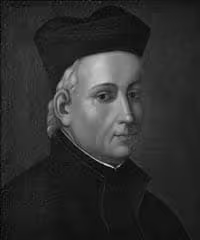
Stanisław Czerniewicz
1728–1785
Biography
Stanisław Czerniewicz—Latinized as Stanislaus Czerniewicz and variously rendered in Western European sources as Stanislas or Stanislao—was born on 15 August 1728 at Szlamowo, near Kaunas in Lithuania, and died at Stajki, near Vitebsk, on 7 July 1785 according to the Julian calendar, corresponding to 18 July in the Gregorian calendar. A Jesuit priest formed within the Polish-Lithuanian province of the old Society of Jesus, he became the principal architect of its institutional survival in the territories annexed by the Russian Empire after the First Partition of Poland. His historical importance does not rest upon an independent theological or literary oeuvre. Czerniewicz was above all a governor, administrator and correspondent: the decisions he took between 1773 and 1785 transformed a group of Jesuit colleges unexpectedly left outside the effective promulgation of Clement XIV’s suppression brief into an organised religious body possessing formation, superiors, a novitiate and, eventually, a central government recognisably modelled upon the pre-suppression Society. The continuity subsequently confirmed for Russia by Pius VII in 1801 and extended into the universal restoration of 1814 depended materially upon structures established under his government.
Czerniewicz entered the Jesuit novitiate at Vilnius on 16 August 1743, one day after his fifteenth birthday. His formation followed the traditional Jesuit sequence. He studied philosophy at the Vilnius Academy from 1747 to 1750, taught grammar and poetry at the college of Kražiai between 1750 and 1753, and returned to Vilnius for theology from 1753 to 1757; he was ordained priest during these theological studies, in 1756. The alternation between academic study and classroom teaching was characteristic of Jesuit formation and gave Czerniewicz first-hand knowledge of the educational system that he would later have to preserve under radically altered political circumstances. His identity was accordingly shaped less by a narrowly defined Lithuanian or Polish national culture than by the supranational administrative structures of the Society in the Polish-Lithuanian Commonwealth.
A decisive stage in that education came through Rome. From 1759 until 1768 Czerniewicz served as secretary to Karol Korycki, assistant for the Polish provinces at the general curia. The post introduced him directly to the machinery of Jesuit central government: correspondence between provinces and Rome, personnel decisions, the interpretation of constitutions, relations with bishops and secular courts, and the practical language through which a geographically dispersed religious order maintained institutional unity. It also gave him connections that proved indispensable after 1773. Korycki, who remained closely associated with Superior General Lorenzo Ricci and later shared his confinement in Castel Sant’Angelo, became one of Czerniewicz’s most important advisers during the years in which the status of the Russian Jesuits remained uncertain. Twenty-eight letters from Korycki to Czerniewicz written between 1779 and 1783 survive in the Roman archives of the Society and repeatedly address the problem of how the Jesuits in White Russia might preserve the Institute without compromising obedience to the Holy See.
After returning from Rome, Czerniewicz served for a period in the archives of the Masovian province. In 1769 Lorenzo Ricci appointed him rector of the Jesuit college at Polotsk, one of the most important educational establishments in the eastern territories of the Commonwealth. The appointment turned out to have consequences no one could have foreseen. Three years later the First Partition of the Polish-Lithuanian Commonwealth transferred Polotsk and a substantial portion of the eastern Jesuit network to the Russian Empire of Catherine II. When the papal suppression arrived in 1773, approximately 201 Jesuits in eighteen establishments—colleges, residences and mission stations—found themselves under Russian sovereignty; the principal educational centres included Polotsk, Vitebsk, Orsha and Daugavpils. Czerniewicz, already rector of the largest house and equipped with unusually extensive experience of Roman administration, inevitably became one of the central figures in the crisis.
The legal position created by Clement XIV’s brief Dominus ac Redemptor of 21 July 1773 has often been simplified into the claim that the Jesuits in Russia simply refused to obey the pope. The surviving evidence shows almost the opposite. The brief was not officially promulgated in the Jesuit houses now subject to Catherine II, because the Russian government prohibited its publication and ordered the communities to remain as they were. Czerniewicz and his companions knew of the suppression and initially wished to submit to it. He attempted repeatedly to obtain permission from the Russian authorities to implement the papal decision; Catherine’s government refused and eventually forbade them even to reopen the question. Local ecclesiastical authorities simultaneously ordered the communities to preserve the status quo until further instructions. The Russian Jesuits therefore found themselves caught between knowledge of the universal suppression and a civil prohibition against carrying it into effect.
Czerniewicz responded cautiously. He convened consultations rather than allowing the houses to dissolve spontaneously, while continuing to seek a way of obeying the papal brief without directly defying the sovereign whose protection determined the legal and material existence of every Catholic institution in the newly annexed territories. On 25 October 1773 he received authority over the Jesuit houses lying within Russian dominions, commonly described in the sources as that of vice-provincial or superior of the White Russian group. The precise institutional vocabulary evolved during the first months of uncertainty, but the effect was clear: the scattered communities now possessed a recognised internal superior. In early 1774 an imperial order required them to remain in their existing condition, confirmed fiscal protection for their establishments and expressly prohibited promulgation of the suppression brief.
In March 1774 Czerniewicz visited the houses for which he had become responsible. This visitation was the first decisive act of reconstruction, although it would be misleading to describe it as the foundation of a new Society. He initially maintained a deliberately restricted interpretation of what survival permitted. The communities continued schools, churches, pastoral activity and common religious life, but they did not immediately reopen a novitiate or behave as though the suppression elsewhere in Europe had never occurred. Some younger men left; numbers declined; questions arose over ordinations, profession of vows and the appointment of superiors. The Society in White Russia could continue institutionally for a few years on the strength of existing personnel, but without a mechanism for admitting and forming new members its extinction would merely be delayed.
This explains the persistence with which Czerniewicz sought indications from Pius VI, elected in 1775. On 15 October 1775 he sent, through Cardinal Giovanni Battista Rezzonico, a detailed representation of the situation. He asked principally whether former Jesuits seeking refuge in White Russia might be admitted to the surviving houses and whether the pope could in some way indicate that their continued existence was not displeasing to him. The response received in January 1776 was deliberately indirect. It contained no documentary confirmation capable of being construed publicly as a reversal of Dominus ac Redemptor, but neither did it condemn the Russian communities. Czerniewicz and his advisers interpreted that carefully guarded language as sufficient to continue while avoiding any claim that the Society had already received formal universal restoration.
The resulting policy was gradual. Former Jesuits from outside the Russian territories began seeking admission, and the communities resumed a fuller cycle of religious and educational life. Ordinations that had been interrupted could again take place, and the Russian remnant increasingly became a destination for men from suppressed provinces who wished to live once more under the Jesuit constitutions. Czerniewicz did not admit applicants indiscriminately. The preservation of institutional identity required him to distinguish between men capable of contributing to the surviving educational apostolate and those whose admission might create political difficulties with European courts. The most famous example came later when Giuseppe Pignatelli, expelled from Spain and committed to restoration of the Society, contemplated entering Russia. Czerniewicz declined to receive Spanish former Jesuits because accepting them risked provoking the Spanish Bourbon government. The episode shows the limits imposed upon a supposedly autonomous Russian refuge: nearly every personnel decision carried diplomatic consequences.
The decisive problem remained the novitiate. By the later 1770s deaths and departures were reducing the original body of 201 members, and admitting already trained former Jesuits could not provide the younger generations necessary for long-term survival. The solution emerged through an intricate interaction between Czerniewicz, Catherine II and Stanisław Bohusz Siestrzeńcewicz, bishop and later metropolitan of Mohilev. In 1778 Siestrzeńcewicz obtained from Rome extensive jurisdiction over religious orders in the Russian Empire. The authority had not been granted specifically in order to re-establish the Jesuits, yet in June–July 1779 he used it to authorise a Jesuit novitiate at Polotsk. The house formally opened on 2 February 1780. This event altered the nature of the Russian survival fundamentally. Until then the communities could plausibly be regarded as the residual continuation of institutions that had never received canonical promulgation of the suppression; with a novitiate they acquired the capacity to create new Jesuits.
Catherine’s protection was indispensable to this development, but Czerniewicz’s relationship with Russian power was never one of simple ideological alliance. The empress valued the Jesuits chiefly because they operated schools in newly acquired Catholic territories and represented a disciplined body of teachers whose disappearance would have created an educational problem for the state. Her policy also asserted imperial control over Catholic affairs within Russia against external ecclesiastical interference. The Jesuits, by contrast, regarded imperial protection as the political condition under which they could continue the Ignatian institute. Their interests converged sufficiently to make survival possible without becoming identical. Czerniewicz therefore had to protect internal religious autonomy while demonstrating the educational usefulness upon which the goodwill of the government depended.
Polotsk became the centre of this strategy. The college continued to teach, enlarged its educational resources and increasingly assumed functions once distributed through several provinces of the old Society. Catherine herself visited Polotsk in 1780, as did members of the imperial elite, demonstrating the political visibility the institution had acquired. Yet the college was not transformed under Czerniewicz into the later Polotsk Academy—the academy belongs to a subsequent stage and received university-level privileges only in the nineteenth century. During his lifetime its importance lay instead in becoming the administrative, educational and formative centre around which the surviving Jesuit network could be reconstructed.
The opening of the novitiate intensified diplomatic opposition, especially from the Bourbon courts, which had played a central part in securing the universal suppression. It also made Czerniewicz’s ambiguous title as vice-provincial increasingly inadequate. The Society now admitted novices, possessed houses and schools, received former Jesuits from abroad and followed a normal cycle of formation, yet there was no living superior general after Lorenzo Ricci’s death in confinement in 1775. The Russian Jesuits therefore sought authority to convoke a congregation capable of establishing a central government conforming as closely as possible to the Jesuit constitutions.
Catherine authorised such an election in 1782. Thirty professed fathers assembled at Polotsk in October, in what is usually called the First Congregation of Polotsk. The meeting opened on 11 October; after several ballots, on 17 October 1782, Czerniewicz was elected vicar general for life with the powers ordinarily exercised by the superior general. The choice of title was deliberate. He did not present himself as universal superior general of a Society openly restored throughout the Catholic world. Vicar general acknowledged both the extraordinary canonical circumstances and the geographically restricted sphere in which the organisation could operate. Internally, however, the election supplied precisely what the previous decade had lacked: a central authority constituted through the procedures of the Ignatian institute rather than merely through appointment by provincial or episcopal necessity.
The congregation was therefore a turning point more important than a change of title. It confirmed the institutional identity of the Russian Society, provided for government according to the Constitutions, and converted Polotsk from the administrative centre of an emergency remnant into the seat of a body capable of understanding itself as the continuing Society of Jesus. The distinction between survival and restoration nevertheless remained crucial. Czerniewicz never possessed jurisdiction over all former Jesuits throughout Europe, and his election could not cancel the papal brief of 1773. What it accomplished was to furnish the Society legitimately existing under Russian conditions with a constitutional government while its precise relation to Rome continued to be negotiated.
The decisive Roman clarification came in 1783 through the mission of Jan Benisławski, sent to Rome in connection with the organisation of the Catholic hierarchy in the Russian Empire. In an audience on 12 March 1783, Pius VI gave oral approval—traditionally described as a vivae vocis oraculo—to the continued existence of the Jesuits in Russia. This was not equivalent to the written papal brief by which Pius VII would formally confirm the Russian Society in 1801, still less to the universal restoration of 1814. It nevertheless represented a substantial change in the position of Czerniewicz and his companions: the papal attitude that had previously been communicated through carefully evasive messages could now be understood as an explicit oral acceptance of their existence.
The episode demonstrates the extraordinary legal complexity of Czerniewicz’s government. The Society had survived because Catherine prevented promulgation of a pontifical act; it had sought repeatedly to know the pope’s intentions precisely because its members did not wish political protection to become ecclesiastical disobedience; its novitiate had been erected through faculties granted by Rome to a bishop who used them in a manner the Roman diplomats had not anticipated; and its central government was elected under imperial authorization before receiving the clearer oral recognition of Pius VI. Later Jesuit historiography sometimes compressed these ambiguities into a providentially seamless continuity, while hostile accounts treated the Russian survival as straightforward defiance. Czerniewicz’s correspondence reveals a much more difficult process of continual legal and moral discernment.
That correspondence constitutes his principal written legacy. No substantial independent printed theological, philosophical or literary oeuvre by Czerniewicz has been securely identified. He was not a publishing author comparable to many earlier Jesuit theologians. His surviving intellectual production consists instead of letters, circular communications, memorials, petitions, governmental reports and acts of administration. This is not a lesser form of evidence. Because the problem facing him was institutional rather than speculative, these documents contain the real substance of his thought: how authority could be exercised without exceeding its canonical basis; who might be admitted to the surviving Society; how communities should relate to bishops and the Russian state; how the Ignatian constitutions should operate under suppression; and how information about developments in Rome and the rest of Europe should circulate among isolated former Jesuits.
The manuscript tradition is substantial enough to permit the development of his policy to be followed almost year by year. A manuscript collection now available through the Jesuit Digital Archive preserves, among other items, Czerniewicz’s letter of 13 October 1780 concerning the Society in White Russia, a letter from Obol on 15 June 1781, his communication of 5 August 1782 concerning Catherine II, letters from Polotsk of 7 and 16 May 1783, his account of the general congregation dated 6 July 1783, the important report of 10 September 1783 concerning Benisławski’s Roman mission, and communications to professed fathers and provincial superiors in January 1784. They were working documents, not literary publications, and many survive through copies rather than authorially prepared editions. Their archival rather than printed transmission accurately reflects the nature of Czerniewicz’s office: governance required controlled correspondence far more than public authorship.
Even more revealing are the twenty-eight letters exchanged with Karol Korycki between 1779 and 1783, preserved in the Russia series of the Archivum Romanum Societatis Iesu. Korycki’s advice continually returns to fidelity to the authentic Society, avoidance of institutional compromise and the necessity of remaining obedient to the Church even while exploiting whatever room Russian law provided for survival. This exchange formed a kind of remote consultation between the surviving Russian body and a representative of the former Roman central administration. The existence of an early twentieth-century plan within the Society to publish a French translation of the correspondence—never completed—shows how quickly the letters came to be recognised internally as a documentary source for the continuity crisis.
This textual situation differentiates Czerniewicz sharply from figures whose historical importance can be reconstructed through an edition chronology. There is no sequence of opera omnia, revised treatises or printed controversial works to follow. The relevant “genealogy” is instead documentary: original or copied letters entered provincial archives; circulars were transcribed into collective registers; later Jesuit historians extracted portions from these materials; the anonymous De conservata in Alba Russia Societate Jesu commentarius, composed by a Jesuit in 1786, only a year after Czerniewicz’s death, transformed institutional memory into historical narrative; nineteenth-century editions and translations then turned that internal account into the foundation for much subsequent historiography. Care is therefore required not to attribute the anonymous 1786 narrative to Czerniewicz himself. It describes and interprets his government; it is not one of his works.
As vicar general, Czerniewicz’s principal concern was preserving what contemporaries regarded as the identity of the old Society rather than founding a different congregation inspired by Jesuit spirituality. The Constitutions, the hierarchy of superiors, the novitiate, vows, the educational apostolate and the forms of communal life were to remain as close as circumstances permitted to those existing before 1773. Korycki’s correspondence reinforced precisely this principle. At the same time, absolute immobility was impossible. The Society now operated under an Orthodox empress, inside a state whose Catholic hierarchy was being reorganised and whose educational expectations differed from those of the former Commonwealth. Continuity had to be achieved through adaptation without allowing adaptation to alter the underlying Institute.
His relationship with Siestrzeńcewicz exemplified this difficulty. The bishop’s extensive faculties made him indispensable to the canonical development of the Russian houses, particularly the novitiate, yet his conception of episcopal jurisdiction did not always coincide with Jesuit claims to exemption and internal government. Czerniewicz could neither reject the bishop whose legal acts made institutional continuity possible nor surrender the internal autonomy characteristic of the Society. The resulting tension was structural rather than merely personal: the continued existence of the Jesuits raised the unresolved question of how an exempt international order could function when its former universal government had apparently ceased and its surviving houses depended upon a territorial ecclesiastical hierarchy operating under strong imperial supervision.
Czerniewicz also had to govern the return of former Jesuits. After the suppression, thousands of men throughout Catholic Europe had been secularised or incorporated into diocesan structures. News that the Society still existed in Russia created intense interest, and requests to enter or re-enter White Russia increased after the opening of the novitiate. Such admissions strengthened the surviving body but also internationalised its political problems. Every French, Spanish, Italian or German former Jesuit potentially implicated Czerniewicz in the policies of a government that had already executed the papal suppression. His cautious admissions policy was therefore part of the larger diplomatic strategy by which Russian survival avoided provoking intervention strong enough to end it.
Education remained the practical justification the Russian government understood best. Catherine valued competent schools in the recently annexed Catholic territories, and Czerniewicz ensured that Polotsk, Vitebsk, Orsha, Daugavpils and associated establishments continued to provide instruction. Jesuit schooling supplied the empire with teachers without requiring the state immediately to create an alternative educational infrastructure. Yet this usefulness imposed its own constraints. Czerniewicz could defend the Society as indispensable precisely so long as its colleges continued to meet expectations of disciplined instruction and political loyalty. The Russian Jesuits’ survival thus rested on a delicate exchange: institutional continuity in return for demonstrable public utility.
His government also preserved archives and institutional memory. This function is less spectacular than the reopening of the novitiate but equally important to the later restoration. Jesuit government depended heavily upon written records—catalogues of personnel, correspondence, rules, annual reports, administrative precedents, financial documentation and the collective memory embodied in provincial archives. Czerniewicz’s own earlier work as an archivist and his Roman experience made him unusually conscious of this documentary dimension. The Society restored in 1814 did not have to reconstruct its identity from printed constitutions alone: in Russia it inherited a living chain of personnel, administrative practice and archival continuity connecting it directly with the pre-suppression order.
The significance of the 1782 congregation therefore extends beyond Czerniewicz’s personal election. A religious institution that can educate novices, appoint superiors, deliberate collectively and preserve a central archive possesses mechanisms of reproduction that a collection of surviving individuals does not. By the time he became vicar general, the Russian body had recovered precisely those mechanisms. The later vicars general—Gabriel Lenkiewicz, Franciszek Kareu, Gabriel Gruber and Tadeusz Brzozowski—inherited not an improvised refuge but a functioning governmental system.
Czerniewicz’s last years were devoted to consolidating that achievement rather than dramatic territorial expansion. His surviving letters from 1783–84 show him communicating the Roman developments, regulating internal affairs and explaining the consequences of the congregation and papal approval to superiors and professed fathers. The political environment remained fragile. Russia’s usefulness to former Jesuits elsewhere encouraged hopes of wider restoration, but Czerniewicz could not promise an outcome dependent upon Rome and European diplomacy. His task remained the narrower and more achievable one of ensuring that the fragment entrusted to him did not cease to exist before circumstances changed.
He died while travelling at Stajki near Vitebsk in July 1785. Russian usage gave the date as 7 July; Western and Jesuit records commonly give 18 July 1785 according to the Gregorian calendar. The official Jesuit lists later remembered him as the first perpetual vicar general, elected at Polotsk on 17 October 1782 and dying on 18 July 1785. His government in that office therefore lasted less than three years, although his effective leadership of the White Russian Jesuits had extended over more than a decade.
The succession itself demonstrated the durability of what he had created. The Second Congregation of Polotsk elected Gabriel Lenkiewicz later in 1785. There was no return to the improvised uncertainty of 1773 because procedures for central government had now been established. Under Lenkiewicz and his successors, the Russian Society expanded its educational institutions, received members from other countries and became increasingly important to former Jesuits seeking institutional restoration. In 1801 Pius VII, responding to Emperor Paul I, formally confirmed the Society within the Russian Empire by the brief Catholicae fidei; in 1814 the same pope restored the Society universally. Czerniewicz did not live to see either act, and it would be anachronistic to treat every one of his decisions as though he possessed certainty that universal restoration would occur. His achievement was precisely that he preserved institutional possibilities during a period in which the final outcome remained unknown.
Later Jesuit historiography naturally cast him as a principal link between suppression and resurrection. That judgement is justified so long as it does not eliminate the contradictions under which he acted. The Society survived in Russia partly because a non-Catholic sovereign prevented execution of a papal act; its leaders sought papal approval while benefiting from that prohibition; ecclesiastical authority reached them through indirect, oral and deliberately ambiguous channels; and the gradual restoration of normal religious structures depended upon juridical opportunities that had not necessarily been designed with the Jesuits in mind. Czerniewicz’s greatness as an administrator consisted in refusing to simplify those contradictions. He neither declared the papal suppression invalid nor voluntarily dissolved communities that civil and local ecclesiastical authority ordered him to preserve.
Nor should his career be turned into a narrative of passive conservatism. The transition from preserving existing houses in 1773 to opening a novitiate in 1780 and electing central government in 1782 was a profound institutional development. Each step increased the capacity of the Russian Jesuits to reproduce themselves and therefore moved them further from being a merely residual survival. Czerniewicz advanced only when he believed sufficient ecclesiastical and civil grounds existed. That combination of caution and incremental institution-building explains why his administration succeeded where a more theatrical assertion of continuity might easily have provoked suppression by Rome, Russia or both.
His writings reinforce this interpretation. Czerniewicz left no known book around which an intellectual biography could be organised, and there is no reason to invent one. His real oeuvre is the paper government of the surviving Society: letters asking how obedience should be understood; circulars transmitting collective decisions; reports on Catherine and the Russian government; correspondence about admissions, novitiate and formation; communications after the Polotsk congregation; and documents recording the mission that obtained Pius VI’s oral approbation. These texts were not intended for a literary market and remained largely manuscript because their function was operative rather than public. Their bibliographical modesty is inseparable from their historical importance.
The difference between publication and transmission is therefore central to Czerniewicz’s legacy. A printed theological treatise seeks an audience and establishes an authorial position; Czerniewicz’s letters sought action, obedience, clarification and institutional coherence. They circulated through defined chains of superiors, were copied into administrative registers and entered archives where their authority depended upon provenance rather than commercial reproduction. Only much later did historians extract them from that bureaucratic context and turn them into sources for the history of suppression and restoration. In his case manuscript administration, not print publication, was the medium through which intellectual and institutional continuity operated.
Stanisław Czerniewicz’s historical importance consequently lies in a particular form of practical intelligence. He understood the Society’s constitutions from inside its Roman government, knew the educational structures of the Polish-Lithuanian provinces, could negotiate with a powerful secular state without treating imperial protection as ecclesiastical legitimacy, and possessed enough patience to wait for ambiguous papal signals rather than force decisions that might have destroyed the surviving communities. He converted a geographical accident of the First Partition—the presence of Jesuit houses in territory newly controlled by Catherine II—into an institutional bridge between the Society suppressed under Clement XIV and the Society ultimately restored under Pius VII.
The decisive achievements can be stated precisely. Under his leadership the dispersed houses of White Russia acquired common government; their members were prevented from dissolving chaotically while the canonical problem remained unresolved; relations with Rome were maintained through Korycki, Rezzonico and other intermediaries; formation and ordination resumed; former Jesuits were selectively reintegrated; the Polotsk novitiate gave the Society biological and institutional continuity; the 1782 congregation restored constitutional central government; and the oral approbation of Pius VI in 1783 substantially strengthened the ecclesiastical legitimacy of the entire experiment. By his death in 1785, the question was no longer whether the Russian Jesuits could survive the disappearance of their original personnel. They had become capable of producing successors.
Czerniewicz therefore belongs less to the history of Jesuit literature than to the history of the institution as a transmitted text and practice. The Society he preserved consisted not merely of men living together but of Constitutions, rules, formation, correspondence, educational methods, hierarchies, archives and collective memory. He ensured that these could pass across the apparent rupture of 1773 without being reconstructed retrospectively after 1814. That continuity is the reason his brief tenure as vicar general occupies such a disproportionate place in the history of the suppression: Czerniewicz did not restore the Society of Jesus, but he preserved the institutional conditions that made restoration possible.
Bibliography
Moroškin, Michail Jakovlevič. Iezuitȳ v Rossii s carstvovanija Ekateriny II-j i do našego vremeni. 2 vols. Saint Petersburg: Tipografija Vtorogo Otdelenija Sobstvennoj Ego Imperatorskogo Veličestva Kanceljarii, 1867–1870, esp. vol. I.
[Anonimo, gesuita della Russia Bianca]. Les Jésuites de Russie, 1772–1785: La Compagnie de Jésus conservée en Russie après la suppression de 1772. Récit d’un Jésuite de la Russie-Blanche. Preface by Jean-Xavier Gagarin, S.J. Paris: Victor Palmé, 1872. [Testo composto nel 1786.]
Nowodworski, Michał, ed. “Czerniewicz Stanisław.” In Encyklopedja Kościelna podług teologicznej encyklopedji Wetzera i Weltego. Vol. III. Warsaw: Czerwiński i Spółka, 1874, pp. 647–652.
Załęski, Stanisław. Les Jésuites de la Russie-Blanche. Translated from the Polish by Alexandre Vivier. 2 vols. Paris: Letouzey et Ané, 1886.
Załęski, Stanisław. Jezuici w Polsce. Vol. V, part I: Jezuici w Polsce porozbiorowej 1773–1820. Kraków: Drukiem i nakładem Drukarni Ludowej, 1906, esp. the sections on the Jesuits in the Russian partition, the opening of the novitiate, the First Congregation of Polotsk, and the death of Czerniewicz.
Pierling, Paul. La Russie et le Saint-Siège: études diplomatiques. Vol. V. Paris: Plon-Nourrit et Cie, 1912.
Grzebień, Ludwik, ed. Encyklopedia wiedzy o jezuitach na ziemiach Polski i Litwy, 1564–1995. Kraków: Wydział Filozoficzny Towarzystwa Jezusowego, 1996, s.v. “Czerniewicz, Stanisław.”
Inglot, Marek. La Compagnia di Gesù nell’Impero Russo (1772–1820) e la sua parte nella restaurazione generale della Compagnia. Miscellanea Historiae Pontificiae, 63. Rome: Editrice Pontificia Università Gregoriana, 1997.
Bieś, Andrzej Paweł, Robert Danieluk, Ludwik Grzebień, and Marek Inglot, eds. Polonica w Archiwum Rzymskim Towarzystwa Jezusowego. Vol. V: Russia. Źródła do Dziejów Kultury. Inwentarze i Katalogi, 5. Kraków: Wyższa Szkoła Filozoficzno-Pedagogiczna “Ignatianum”–Wydawnictwo WAM, 2008.
Pavone, Sabina. Una strana alleanza: La Compagnia di Gesù in Russia dal 1772 al 1820. Identità e alterità nell’Europa moderna, 3. Naples: Bibliopolis, 2010.
Danieluk, Robert. “I polacchi negli archivi della Curia Generalizia della Compagnia di Gesù.” In I polacchi e le loro storie private negli archivi italiani e vaticani. Atti del convegno, Roma, 20–21 ottobre 2016, pp. 82–97. Conferenze, 136. Rome: Accademia Polacca delle Scienze, Biblioteca e Centro di Studi a Roma, 2017.
Inglot, Marek. How the Jesuits Survived Their Suppression: The Society of Jesus in the Russian Empire (1773–1814). Translated by Daniel L. Schlafly Jr. Philadelphia: Saint Joseph’s University Press, 2015.
Schlafly, Daniel L., Jr. “General Suppression, Russian Survival, American Success: The ‘Russian’ Society of Jesus and the Jesuits in the United States.” In The Jesuit Suppression in Global Context: Causes, Events, and Consequences, edited by Jeffrey D. Burson and Jonathan Wright, pp. 201–215. Cambridge: Cambridge University Press, 2015.
Beyond the names: biographies and bibliographies on this page are curated by Abu, the AI scholar crafted by Buonvecchio exclusively for Govi Rare Books.