
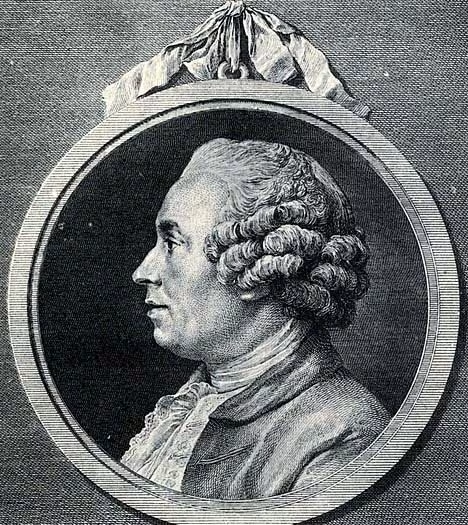
Charles-Nicholas Cochin
1715-1790
Biography
Charles-Nicolas Cochin the Younger was one of the most prominent French engravers, designers, and writers on art of the eighteenth century. Born and deceased in Paris, he belonged to a distinguished family of artists and engravers and played an important role in the artistic culture of the reign of Louis XV and the early decades of the reign of Louis XVI. His career extended across courtly representation, book illustration, printmaking, artistic criticism, and the documentation of contemporary artistic and architectural culture. He was also closely connected with the intellectual and artistic circles associated with the Enlightenment, including Denis Diderot and other figures involved in the production and circulation of illustrated books.
Cochin was the son of Charles-Nicolas Cochin the Elder (1688–1754), himself a distinguished engraver, and of Madeleine Horthemels, who also belonged to the Parisian printmaking milieu. His father produced numerous reproductive engravings after works by artists including Antoine Watteau and Jean-Baptiste-Siméon Chardin and was active in major royal and publishing enterprises. Cochin the Younger therefore grew up within an established artistic and professional environment.
His technical training developed principally through his family environment and through his studies with established artists. The Louvre identifies his father, Jean Restout, and Laurent Cars/Le Bas among the figures associated with his formation, while later accounts particularly emphasize the role of Jacques-Philippe Le Bas in his training as an etcher. Rather than treating his education as the result of a single institutional apprenticeship, it is more accurate to understand it as part of the interconnected Parisian network of painters, engravers, designers, and publishers in which he developed his practice.
Cochin's rise to prominence was closely connected with the representation of royal ceremonies and spectacles. From the late 1730s he produced engravings commemorating important events at the French court, and in 1739 he became formally associated with the Menus-Plaisirs du Roi as a designer and engraver. His collaboration with the brothers Slodtz was particularly important in documenting the elaborate theatrical and decorative settings devised for royal festivities. Among his best-known works are engravings recording the celebrations surrounding the marriage of the Dauphin in 1745, as well as representations of courtly spectacles such as the Jeu du Roi and the funeral ceremonies of members of the royal family.
Cochin was received into the Académie royale de peinture et de sculpture in 1741, consolidating his position within the institutional structure of the French art world. His activities subsequently extended beyond engraving: he worked as a designer, writer on art, and artistic adviser, while maintaining close relationships with figures involved in court culture and the emerging Enlightenment.
A decisive episode in his intellectual and artistic development was his journey to Italy in 1749–1751. At the initiative of Madame de Pompadour, Cochin accompanied her brother Abel Poisson, later Marquis de Marigny, together with the architect Jacques-Germain Soufflot and other members of the travelling group. The journey enabled him to study first-hand the painting, sculpture, architecture, and antiquities of the principal Italian cities. His subsequent writings reveal the importance of this experience for his understanding of classical art and for the development of the classicizing tendencies that would become increasingly influential in French art.
Cochin later published an account of his Italian observations in the Voyage d'Italie, published in 1758. His interest in antiquity also led to his collaboration with the architect Jérôme-Charles Bellicard on the Observations sur les antiquités de la ville d'Herculanum, first published in Paris in 1754 by Charles-Antoine Jombert. The work combined observations on the newly excavated antiquities of Herculaneum with reflections on ancient painting and sculpture and thus belongs to the broader eighteenth-century effort to document and interpret the archaeological discoveries of southern Italy.
Cochin's importance extended beyond individual prints to the wider history of illustrated books and the circulation of artistic knowledge. He contributed designs to a number of important publishing projects and occupied a particularly significant position within the visual culture surrounding the Encyclopédie of Denis Diderot and Jean le Rond d'Alembert.
The famous frontispiece of the Encyclopédie, however, requires precise attribution. Cochin did not engrave the final plate himself. He produced the original design in 1764, which was exhibited at the Salon of 1765 and discussed by Diderot. The final engraving was executed by Benoît-Louis Prévost in 1772, after Cochin's design. The image subsequently circulated among subscribers and became one of the most recognizable visual statements associated with the Encyclopédie.
This distinction is historically significant because it illustrates the collaborative nature of eighteenth-century print production: the conception of an image, its drawing, its translation into an engraved plate, and its subsequent dissemination through a large publishing enterprise could involve several different specialists. Cochin's role was therefore not simply that of an engraver but also that of a designer and intellectual contributor to the visual culture of Enlightenment publishing.
Cochin occupied a distinctive position between the institutions of the ancien régime and the changing artistic and intellectual culture of the Enlightenment. His work for the court preserved an extensive visual record of royal ceremonies and spectacles, while his activities as an engraver, designer, and writer connected him with the broader circulation of artistic knowledge through prints and books. His Italian journey and his writings on ancient art further demonstrate his engagement with the historical and theoretical dimensions of artistic practice.
His historical importance consequently lies not only in the considerable number of prints and drawings he produced, but also in the range of functions he performed within eighteenth-century French visual culture. He participated in courtly representation, academic institutions, the production of illustrated books, the documentation of antiquities, and contemporary debates concerning artistic taste. His work thus provides an important point of intersection between the traditional institutions of the French monarchy and the expanding culture of artistic and historical inquiry characteristic of the Enlightenment.
Bibliography
Duplessis, Georges. Catalogue de la collection de pièces sur les beaux-arts, imprimées et manuscrites, recueillie par Pierre-Jean Mariette, Charles-Nicolas Cochin et M. Deloynes, auditeur des comptes, et acquise récemment par le département des Estampes de la Bibliothèque nationale. Paris: A. Picard, 1881.
Rocheblave, Samuel-Élie. Les Cochin. Paris: Librairie de l’Art, G. Pierson et Cie, 1893.
Rocheblave, Samuel-Élie. Charles-Nicolas Cochin, graveur et dessinateur (1715–1790). Paris and Brussels: G. Vanoest, 1927.
Tavernier, Ludwig. Das Problem der Naturnachahmung in den kunstkritischen Schriften Charles Nicolas Cochins d. J.: Ein Beitrag zur Geschichte der französischen Kunsttheorie und Kunstkritik des 18. Jahrhunderts. Hildesheim; Zürich; New York, 1983.
Michel, Christian. Charles-Nicolas Cochin et le livre illustré au XVIIIe siècle: Avec un catalogue raisonné des livres illustrés par Cochin, 1735–1790. Genève: Droz; Paris: [diffusion] Champion, 1987.
Cochin, Charles-Nicolas. Le Voyage d’Italie de Charles-Nicolas Cochin (1758). Édité en fac-similé avec une introduction et des notes par Christian Michel. Rome: École française de Rome, 1991.
Michel, Christian. Charles-Nicolas Cochin et l’art des Lumières. Rome: École française de Rome; Paris: Diffusion de Boccard, 1993.
Foster, Carter E. “Charles-Nicolas Cochin the Younger: The Philadelphia Portfolio.” Philadelphia Museum of Art Bulletin 90, no. 381 (1994): 1–28.
Grivel, Marianne. Le Commerce de l’estampe à Paris au XVIIe siècle. Geneva: Droz, 1986.
Michel, Christian. Charles-Nicolas Cochin et le livre illustré au XVIIIe siècle: Avec un catalogue raisonné des livres illustrés par Cochin, 1735–1790. Genève: Droz; Paris: [diffusion] Champion, 1987.
Fuhring, Peter. Design into Art: Drawings for Architecture and Ornament: The Lodewijk Houthakker Collection. The Hague: Gary Schwartz; Sdu Uitgevers, 1989.
Martin, Henri-Jean, and Roger Chartier, eds. Histoire de l’édition française. Vol. 2, Le Livre triomphant, 1660–1830. Paris: Fayard; Cercle de la librairie, 1990.
Bousquet-Bressolier, Christine. “Charles-Antoine Jombert (1712–1784): Un libraire entre sciences et arts.” Bulletin du bibliophile, no. 2 (1997): 299–333.
Kaucher, Greta. Les Jombert: Une famille de libraires parisiens dans l’Europe des Lumières (1680–1824). Geneva: Librairie Droz, 2015.
Beyond the names: biographies and bibliographies on this page are curated by Abu, the AI scholar crafted by Buonvecchio exclusively for Govi Rare Books.