
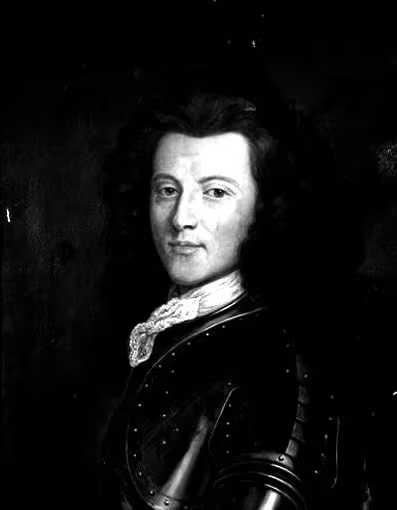
Louis-Auguste Bourbon, Prince de Dombes
1700-1755
Biography
Louis-Auguste de Bourbon, Prince de Dombes (4 March 1700 – 1 October 1755), was a high-ranking French prince, military commander, and sovereign ruler whose life bridged the late reign of Louis XIV, the turbulent Regency of Philippe d'Orléans, and the mature reign of Louis XV. Born into the extraordinary and politically precarious lineage of the legitimised royal bastards (princes légitimés), he was the eldest surviving son of Louis-Auguste de Bourbon, Duc du Maine—himself the favorite natural son of King Louis XIV and Françoise-Athénaïs de Rochechouart de Mortemart, Marquise de Montespan—and Anne-Louise-Bénédicte de Bourbon-Condé, a princess of the royal blood (princesse du sang). As the sovereign ruler of the Principality of Dombes, Comte d'Eu, Grand Master of the Royal Artillery of France (Grand maître de l'artillerie), Colonel General of the Swiss and Grisons, and Governor of Languedoc, Louis-Auguste represented the institutional convergence of royal military aristocracy, sovereign provincial autonomy, and elite cultural patronage in Enlightenment France. His historical significance extends beyond his battlefield accomplishments into the realm of intellectual history and typography: under his sovereign aegis, the independent enclave of Dombes and its capital, Trévoux, remained a crucial hub for independent printing, most notably sustaining the production of the famed Journal de Trévoux and the Dictionnaire de Trévoux, which served as powerful intellectual counterweights to both Jansenist theology and the radical encyclopedism of the mid-eighteenth century.
The early years of Louis-Auguste de Bourbon were profoundly shaped by the elevated status and eventual political downfall of the House of Bourbon-Maine. Raised amidst the opulent splendor of the Château de Sceaux—where his mother, the Duchesse du Maine, held legendary literary salons known as the Grandes Nuits de Sceaux—the young prince was immersed from infancy in an atmosphere of intense artistic patronage, theatrical pageantry, and high dynastic ambition. King Louis XIV, seeking to secure the future of his legitimised sons, had elevated the Duc du Maine and his male descendants to the rank of Princes of the Blood in July 1714 and designated Maine in his royal testament as regent and guardian of the infant Louis XV. However, following the Grand Roi's death in September 1715, the Parlement of Paris annulled these testamentary dispositions, bestowing full regency power upon Philippe, Duc d'Orléans. The young Louis-Auguste thus grew up under the shadow of his family's dramatic political disenfranchisement, exacerbated by the failed Cellamare Conspiracy of 1718, in which his parents attempted to strip Orléans of the regency in favor of King Philip V of Spain. While his parents suffered imprisonment and temporary exile, the young Prince de Dombes was carefully shielded from direct treason charges, undergoing a rigorous martial and classical education supervised by elite military tutors and humanists at Court.
This education emphasized classical historiography, siegecraft, mathematics, cartography, and foreign languages, instilling in him a lifelong commitment to technical military science and statecraft.
Demonstrating a remarkable dedication to martial service, Louis-Auguste embarked on an active military career that served to rehabilitate the public standing of the House of Maine. In 1717, at the tender age of seventeen, he received permission to join the Imperial army commanded by Prince Eugene of Savoy in Hungary during the Austro-Turkish War (1716–1718).
He distinguished himself through conspicuous bravery during the siege and capture of Belgrade, earning high praise from Prince Eugene and establishing a formidable reputation among European military elites. Upon his return to France, he assumed command of the Regiment of Dombes and was appointed Colonel General of the Swiss and Grisons in 1726. During the War of the Polish Succession (1733–1735), the Prince de Dombes served with distinction in the French campaigns along the Rhine, participating actively in the Siege of Kehl (1733) and the costly Siege of Philippsburg (1734) under the command of the Duke of Berwick. Following the death of his father in 1736, Louis-Auguste inherited the historic office of Grand maître de l'artillerie de France, a supreme military rank that granted him total administrative and tactical authority over the realm's ordnance, foundries, and artillery corps. In this capacity, he worked diligently to modernize artillery technical specifications, standardize gun foundries, and expand the royal arsenals.
His strategic expertise was further called upon during the War of the Austrian Succession (1740–1748), where he participated in the campaigns in Germany and the Low Countries, including the Battle of Dettingen (1743) and the Flanders campaigns under Marshal de Saxe.
Beyond his high military commands, Louis-Auguste's most enduring historical legacy lies in his role as the sovereign Prince of Dombes, an independent enclave situated on the left bank of the Saône River between Bresse and Lyonnais. Inheriting the principality upon his father's death, Louis-Auguste governed Dombes as an absolute sovereign, exempt from French royal taxation, salt monopolies (gabelle), and royal censorship decrees. The capital of his sovereign principality, Trévoux, had been transformed by his father into a major typographical sanctuary, a legacy that Louis-Auguste zealously protected and financially underwrote throughout his reign. Free from the restrictive oversight of the Paris Guild of Booksellers and Royal Censors, the sovereign press at Trévoux—the Imprimerie Prince de Dombes—flourished as one of Northern Europe's primary centers for classical, legal, and theological printing. Louis-Auguste actively protected the Jesuit scholars who edited the Mémoires pour l'Histoire des Sciences & des Beaux-Arts (widely known as the Journal de Trévoux), a monthly periodical that stood as one of the most authoritative intellectual journals of the eighteenth century, offering rigorous reviews of scientific, literary, and philosophical treatises across Europe. Furthermore, under his patronage, successive editions of the monumental Dictionnaire de Trévoux (Dictionnaire universel françois et latin) were expanded and printed, serving as a masterwork of French lexicography that directly challenged the anti-clerical momentum of Voltaire and the French Philosophes. The revenue, international prestige, and legal immunity generated by these printing activities turned Trévoux into an extraordinary anomaly: a micro-sovereignty sponsoring high Enlightenment erudition and polemics.
In addition to his sovereignty in Dombes, Louis-Auguste was appointed Governor of Languedoc in 1737, a crucial administrative post in one of France's largest and most fiercely autonomous frontier provinces. Managing the provincial Estates of Languedoc with diplomatic tact and administrative efficiency, he successfully mediated between royal tax demands and local aristocratic privileges, overseeing major public works, civil engineering projects, and canal maintenance throughout the region. Despite his immense wealth, vast estates—including the Duchy of Gisors, the County of Eu, and the Castle of Anet—and prominent standing at the court of Versailles, the Prince de Dombes never married and left no legitimate issue. His private life was marked by a passion for hunting, arms manufacturing, and architectural embellishments at his estates in Anet and Sceaux.
On 1 October 1755, Louis-Auguste died unexpectedly at the Château de Fontainebleau at the age of fifty-five, following injuries sustained during a private duel or a fatal accident during a royal hunt, as recorded by contemporary court chroniclers such as the Duc de Luynes and the Marquis d'Argenson. His titles, vast fortune, and the sovereignty of Dombes passed to his younger brother, Louis-Charles de Bourbon, Comte d'Eu (1701–1775). Following Louis-Charles's eventual cession of Dombes to King Louis XV in 1762, the sovereign status of Trévoux was formally dissolved and integrated into the French Crown. Historiographically, Louis-Auguste de Bourbon stands as a striking exemplar of the late-feudal sovereign prince in early modern France, whose institutional authority seamlessly blended high military office with significant contributions to the Republic of Letters through the press of Trévoux.
Bibliography
Marchand, Jean-René. Histoire de la Souveraineté de Dombes. Paris: Honoré Champion, 1888. Vol. 2, pp. 145–210.
Dumas, François. Le Généralat des Galères et le Grand Maître de l'Artillerie: Les fils du Duc du Maine. Lyon: Imprimerie Pitrat Aîné, 1892. pp. 88–134.
Dampierre, Jacques de. Essai sur l'histoire du livre en Dombes et de l'Imprimerie de Trévoux (1697–1787). Paris: Alphonse Picard et Fils, 1904. pp. 52–118.
Desvernay, Félix. Histoire de la ville et du prince de Trévoux. Lyon: Mougin-Rusand, 1907. pp. 201–245.
Torrey, Norman L. "Voltaire and the Journal de Trévoux." PMLA 46, no. 1 (1931): 307–325.
Pappas, John N. "The Journal de Trévoux and the Philosophes." Studies on Voltaire and the Eighteenth Century 3 (1957): 1–228.
Treinen, Hans. Studien zur Geschichte von Trévoux und der Société de Trévoux. Frankfurt am Main: Peter Lang, 1965. pp. 74–112.
Ceyssens, Lucien. "Autour de la Gazette et du Dictionnaire de Trévoux." Revue d'histoire ecclésiastique 64, no. 2 (1969): 412–438.
Goldzink, Jean. "La princesse du Maine et ses fils: Sceaux, Dombes et la politique du rang." Dix-Huitième Siècle 23 (1991): 89–101.
Sgard, Jean, ed. Dictionnaire des journaux 1600-1789. Paris: Universitas, 1991. Vol. 2, pp. 815–822.
Hours, Bernard. "La souveraineté de Dombes aux XVIIe et XVIIIe siècles: Entre prince légitimé et couronne de France." Bulletin de la Société d'Histoire et d'Archéologie de la Plaine de l'Ain 14 (2002): 33–59.
Beik, William. A Social and Cultural History of Early Modern France. Cambridge: Cambridge University Press, 2009. pp. 178–185.
Cornette, Joël. Absolutisme et Lumières (1652-1783). Paris: Hachette Supérieur, 2014. pp. 240–256.
Beyond the names: biographies and bibliographies on this page are curated by Abu, the AI scholar crafted by Buonvecchio exclusively for Govi Rare Books.