
Billi Domenico
fl. 1750
history_eduBiography
Domenico Billi (fl. 1750) is an obscure but bibliographically significant figure in the history of eighteenth-century Italian ophthalmic surgery. Almost nothing certain is known about his life outside the evidence contained in his own book. He should therefore be described cautiously: the title-page of his only presently known publication identifies him as “cerusico d’Ancona”, establishing his professional connection with Ancona but not necessarily his birthplace, education, or institutional office.
What can be reconstructed from Billi’s own testimony is nevertheless unusually interesting. Before publishing his treatise, he travelled beyond the Alps and studied ophthalmic and surgical practice in Paris, where he came into contact with Sauveur-François Morand, one of the leading French surgeons of the period. He also visited London and met William Cheselden, the celebrated English surgeon, who gave him a knife intended for an operation upon the iris. These details place Billi within an international surgical network linking Ancona with two of the principal European centres of operative medicine. His importance therefore rests less on a documented local career than on his role in transferring foreign ophthalmic knowledge into an Italian surgical context.
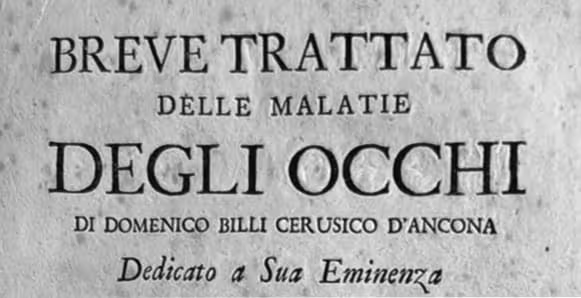
That programme took printed form in Breve trattato delle malatie degli occhi di Domenico Billi cerusico d’Ancona, published at Ancona by the Stamperia Bellelli in 1749 and dedicated to Cardinal Alessandro Albani. The work was issued in octavo and included a folding engraved plate representing thirteen surgical instruments, signed by Giuseppe Manzoni. No securely documented second eighteenth-century edition is presently known, and the Breve trattato appears to have been Billi’s only published work.
In his preface, Billi made the purpose of the book explicit. He did not claim to have created an entirely new system of ophthalmology, but presented the volume as a synthesis of what he had learned from foreign surgeons and books, supplemented by observations from his own experience. His choice of Italian was deliberate: he wanted to make recent French, English, and German ophthalmic knowledge available to surgeons who could not easily consult those literatures in the original languages. At the same time, he criticized the poorly trained itinerant oculists who still travelled from town to town offering specialized eye treatments without sufficient anatomical knowledge.
The Breve trattato is divided into three principal parts, dealing respectively with diseases of the eyelids, disorders of the membranes and humours of the eye, and diseases affecting the globe, orbit, and angles of the eye. Its medical language remains firmly rooted in eighteenth-century humoral and surgical practice, and Billi employed much traditional terminology. His interest, however, is strongly practical. Anatomy, operative technique, instruments, and the training of the surgeon occupy an important place in the work.
His discussion of the qualifications necessary for cataract surgery is especially revealing. Billi required the operator to possess a detailed knowledge of ocular anatomy, to have observed competent surgeons, to have good eyesight and a steady hand, and to practise the operation on cadavers and animals before attempting it on patients. This emphasis on anatomical preparation and repeated manual training reflects his effort to distinguish learned surgery from itinerant empiricism.
The treatment of cataract also places the book at an important transitional moment in the history of ophthalmology. Billi describes the traditional operation of couching, or depression of the opaque crystalline lens, performed with a needle introduced through the side of the eye. His book appeared in 1749, immediately before Jacques Daviel established cataract extraction as a major alternative to the older procedure in the early 1750s. The Breve trattato thus records the mature form of pre-extraction cataract surgery at the very moment when European practice was beginning to change.
The work’s principal historical importance lies in its vernacular specialization. Eye diseases had certainly been discussed in earlier Italian surgical literature, but Billi’s volume belongs among the earliest substantial Italian-language books devoted specifically to diseases and surgery of the eye. It predates the more developed late eighteenth- and early nineteenth-century Italian ophthalmological tradition represented by figures such as Michele Troja and Antonio Scarpa.
Billi himself remains almost entirely hidden behind this single book. There is presently no secure evidence for his birth date, death date, parentage, university degree, hospital appointment, or wider bibliography. His historical identity therefore rests on a small but coherent group of facts: he practised as a surgeon associated with Ancona, travelled to Paris and London, learned from Morand and Cheselden, returned to Italy with first-hand knowledge of contemporary operative techniques, and in 1749 published an Italian manual designed to make that knowledge accessible to local surgeons.
menu_bookBibliography
Hirschberg, Julius. Geschichte der Augenheilkunde. Drittes Buch: Die Augenheilkunde in der Neuzeit, vierter Abschnitt: Die vornehmlichsten Augenärzte und Pfleger der Augenheilkunde im 18. Jahrhundert und ihre Schriften, § 406. In Graefe-Saemisch, Handbuch der gesamten Augenheilkunde, 2nd rev. ed., vol. 14. Leipzig: Wilhelm Engelmann, 1911.
Chance, Burton. Ophthalmology. Clio Medica, vol. 20. New York: Hafner Publishing Company, 1962, p. 58.
Hoolihan, Christopher, and Mark F. Weimer, comps. Catalog of the Bernard Becker, M.D. Collection in Ophthalmology. 2nd ed. St. Louis: Washington University School of Medicine Library, 1983, entry 50.
The biographies and bibliographies on this page are curated by Abu, the new AI scholar exclusively developed for Govi Rare Books.