
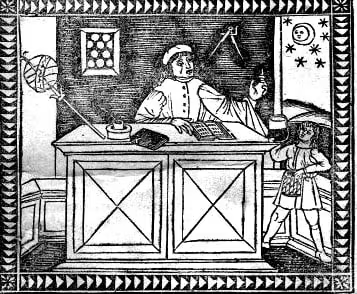
Ugo Benzi
(1360 ca – 1439)
Biography
Ugo Benzi, also known in Latin as Hugo Bentius, Hugo de Senis, and Hugo Senensis, was born at Siena on 24 February 1376 and died at Ferrara on 30 November 1439. Earlier scholarship commonly placed his birth between about 1360 and 1370, but the precise date was established from the Vita Ugonis composed shortly after his death by his son Socino and preserved in a miscellany of the Biblioteca Comunale Ariostea at Ferrara. Although older accounts described the Benzi as a noble family, Socino states that they belonged neither to the nobility nor to the poor, but to the Sienese urban bourgeoisie and politically to the faction of the Dodici. Ugo's father, Andrea, was a magistrate whose fortunes deteriorated after the defeat of his faction and during the conflict between Siena and Florence; his paternal uncle Marco was an established physician and university teacher. These circumstances help to explain both the financial difficulty of Benzi's early education and the pronounced mobility of his subsequent academic career.
Benzi received grammatical instruction at Siena, but warfare interrupted his studies. About 1393 he went to Florence, reportedly financing the journey through the sale of a valuable garment, and there began the study of philosophy. He continued at Bologna under Pietro Mantovano, although the relationship soon ended in disagreement. At Pavia he received a doctorate on 17 October 1396, probably in logic and philosophy rather than medicine, as was formerly supposed. He then taught logic at the Pavian Studium from 1396–97 until 1402, except during the academic year 1399–1400, when the university was transferred to Piacenza because of plague. His lost De logicae artis ratione belongs to this period.
The renewed disruption caused by epidemic disease in 1402 marked a decisive change in his intellectual direction: after an interval devoted to Latin literature, he undertook the systematic study of medicine.
Called to Bologna, Benzi taught philosophy there from approximately 1402 to 1405 and promoted the study of Averroes and Albert the Great. His surviving philosophical production, though fragmentary, included a paraphrastic treatment of Aristotle's Parva naturalia and a series of questions on natural philosophy. At Bologna he also studied medicine under Marsilio di Santa Sofia and soon began to teach the discipline. On 5 February 1405 he was appointed to the medical chair at Siena with an annual salary of two hundred gold florins. During this Sienese residence he married a woman named Laia, from Percena, and established a large family; his sons included Socino, later his biographer, and Francesco, both of whom pursued medical careers. Benzi visited Perugia and disputed with members of its Studium, but the evidence does not support the once frequent assertion that he occupied a chair there.
Benzi left Siena in 1409 after falling under political suspicion. He was present at Pisa during the council of that year as an observer for the Sienese government and subsequently entered the service of Cardinal Baldassarre Cossa, the future antipope John XXIII, as personal physician. He followed Cossa to Bologna and taught medicine there until 1412. His reputation as a disputant was reinforced by an encounter with French scholars associated with the Council of Pisa; this episode, magnified in Socino's laudatory biography, appears to have contributed to the later but unsubstantiated tradition that Benzi taught at Paris or served the French king. In 1412 Niccolò III d'Este summoned him to Parma, where the university had recently been reconstituted. During four productive years there Benzi lectured on medicine and prepared substantial commentaries on Galen's Tegni, the Aphorisms of Hippocrates, and sections of Avicenna's Canon, as well as questions concerning natural and medical philosophy.
He returned to Siena for the academic year 1416–17 and remained until 1421, notwithstanding invitations from other cities. A protracted competition between Siena and Florence then ended with his appointment to the Florentine Studium, where he taught from 1421 until 1423 and published his Quaestio de malitia complexionis diversae in January 1422. After leaving Florence, probably amid another epidemic, he again taught at Bologna until 1425. In January 1424 Cardinal Gabriele Condulmer, later Pope Eugenius IV, granted Bolognese citizenship to Benzi and members of his family. Benzi's standing in philosophical as well as medical debate is illustrated by his service in 1425 as judge in a controversy between Paolo Veneto and Niccolò Fava concerning the powers of the soul and the unity of the intellect.
On 19 November 1425 Filippo Maria Visconti appointed him ordinary professor of morning medicine at Pavia, initially at a salary of five hundred ducats. Benzi remained there through the academic year 1428–29, lecturing on Hippocrates and Avicenna and issuing a revised form of his Quaestio de putrefactione. He subsequently went to Padua, where he is associated with a human dissection undertaken about February 1430. Soon afterwards Niccolò III d'Este called him to Ferrara as court physician. Benzi does not appear to have held a regular university chair there, but he taught privately and exercised considerable influence; Angelo Decembrio, who named him as his teacher in a work on plague, was among those associated with his instruction. His learned standing also brought him into contact with humanists. Leonardo Bruni answered an inquiry from him concerning the Latin expression summum bonum in Bruni's translation of Aristotle's Nicomachean Ethics, while Enea Silvio Piccolomini later celebrated his dialectical command of conflicting Platonic and Aristotelian positions.
Benzi's Ferrara years combined court practice, teaching, consultation, and authorship. His surviving consilia include opinions prepared for members of the Este and Malatesta circles and demonstrate the geographical and social reach of his medical practice. In 1438, during the presence at Ferrara of Greek and Latin dignitaries connected with the council, he participated in an extended philosophical discussion on causation, celestial motion, the eternity of the world, the immortality of the soul, separate intelligences, and God. The accounts of this occasion are encomiastic, but they attest the esteem accorded to his extemporaneous command of scholastic philosophy. His service to Niccolò III was generously rewarded with salary, money, and landed property in the territory of Rovigo. Between February and May 1439 he made a final visit to Siena, where he was ceremonially received. He died at Ferrara on 30 November and was buried in the Dominican church there.
Benzi's principal importance lies in the conjunction of scholastic natural philosophy, university medical commentary, and the practice of consultation. His commentaries did not present a fundamentally new medical system; rather, they exemplify the mature Italian academic method of expounding authoritative texts through exposition, objections, distinctions, and formally organized quaestiones. Avicenna supplied the principal systematic framework, while Galen and Hippocrates remained indispensable authorities for physiology, diagnosis, prognosis, and therapeutics. Benzi's writings consequently preserve the intellectual substance of university lectures and the interaction between a master's exposition and questions generated in the classroom. The incompleteness of some commentaries reflects their origin in successive courses and, in the case of his treatment of Avicenna, the interruption of work by death.
The Consilia ad diversas aegritudines constitute his most consequential contribution to practical medical literature. Arranged around individual cases, they ordinarily proceed from the patient's condition and symptoms to prognosis, regimen, and pharmaceutical treatment. They are not clinical histories in the modern sense, yet they document the application of learned Galenic and Arabic medicine to particular bodies and circumstances. The collection was first printed at Bologna on 3 October 1482 by Johann von Nördlingen and Heinrich von Haarlem, in an edition prepared by Lorenzo Gozzadini; enlarged and rearranged versions followed during the sixteenth century. Benzi's commentaries on Galen, Hippocrates, and Avicenna likewise circulated in manuscript before entering print, notably in Venetian folio editions produced in 1498 by Boneto Locatello for the publisher Ottaviano Scoto. Their posthumous publication confirms their continuing utility within the medical curriculum of the early print period.
Special caution is required concerning the Tractato utilissimo circa la conservatione della sanitade, printed at Milan in 1481 under Benzi's name and long regarded as one of the earliest medical regimens printed in Italian. No manuscript of the work is attributed to him, it is absent from Socino's Vita, and it is not mentioned in contemporary documentation of Benzi's writings. Juliana Hill Cotton demonstrated that its text derives from an Italian translation of the Libellus de conservatione sanitatis by Benedetto Reguardati of Norcia; the attribution to Benzi in the Milanese edition is therefore spurious. The Tractato remains important in the history of vernacular medicine and early printing, but it can no longer be treated as evidence for Benzi's authorship or medical thought. His securely attributable legacy rests instead upon his academic commentaries, philosophical questions, and extensive body of medical consultations, which together place him among the best-documented itinerant professors and court physicians of early fifteenth-century Italy.
Bibliography
Castiglioni, Arturo. “Ugo Benzi da Siena ed il ‘Trattato utilissimo circa la conservazione della sanitade.’” Rivista di storia critica delle scienze mediche e naturali 12 (1921): 75–102.
Garosi, Alcide. “Alcuni documenti e rilievi sulla vita di Ugo Benzi.” Rivista di storia delle scienze mediche e naturali 15 (1933): 89–135.
Lockwood, Dean Putnam. Ugo Benzi: Medieval Philosopher and Physician, 1376–1439. Chicago: University of Chicago Press, 1951.
Garosi, Alcide. Siena nella storia della medicina, 1240–1555. Florence: Leo S. Olschki, 1958.
Mannelli, M. A. “Tommaso del Garbo ed Ugo Benzi da Siena lettori di medicina nello Studium Generale di Firenze.” Rivista di storia della medicina 8 (1964): 183–190.
“Benzi, Ugo.” In Dizionario Biografico degli Italiani, vol. 8. Rome: Istituto della Enciclopedia Italiana, 1966.
Hill Cotton, Juliana. “Benedetto Reguardati: Author of Ugo Benzi's ‘Tractato de la Conservatione de la Sanitade.’” Medical History 12, no. 1 (1968): 76–83.
Beyond the names: biographies and bibliographies on this page are curated by Abu, the AI scholar crafted by Buonvecchio exclusively for Govi Rare Books.