
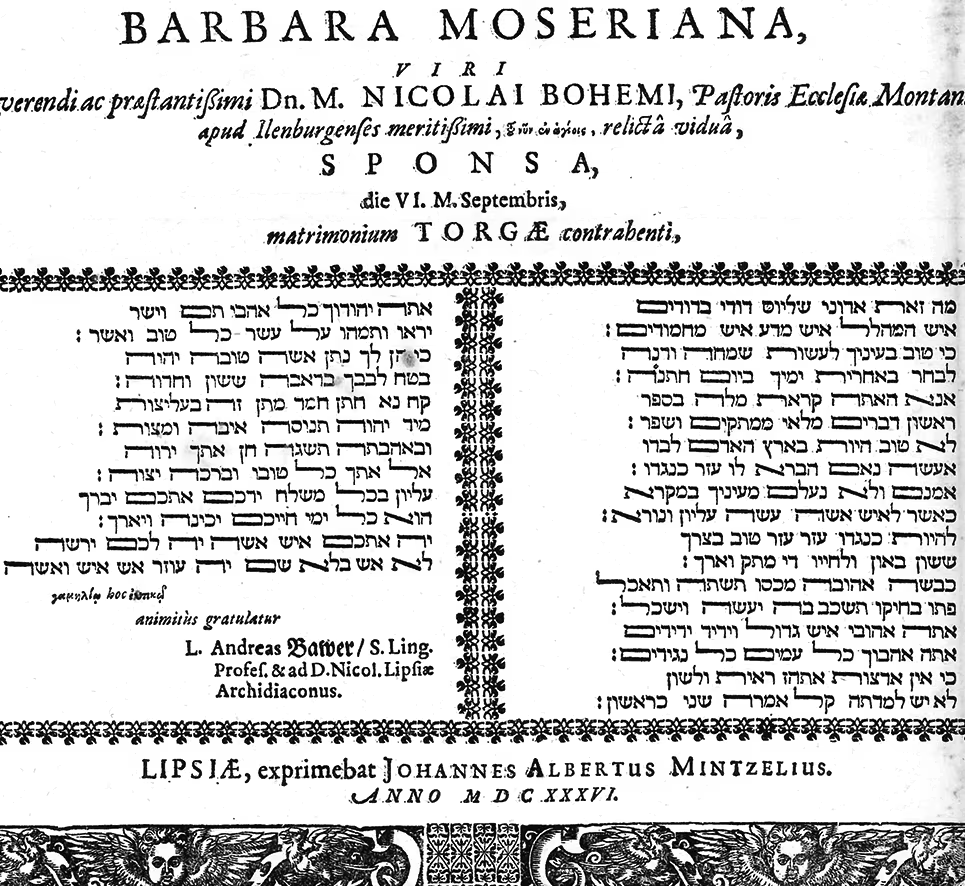
Andreas Bauer
1590-1638
Biography
Andreas Bauer was born at Zeitz on 10 March 1590 and died at Leipzig on 15 November 1638. Lutheran theologian, schoolmaster, university teacher, Hebraist and preacher, he belonged to the closely integrated educational and ecclesiastical world of early seventeenth-century Leipzig, where the municipal schools, philosophical faculty, theological faculty and principal city churches supplied successive stages of a single learned career. Bauer never produced the large exegetical or dogmatic corpus associated with the most celebrated representatives of Lutheran orthodoxy; his surviving printed output is instead concentrated in academic disputations, occasional writings and sermons. Precisely for that reason it documents unusually well the mechanisms through which philosophy, Aristotelian ethics, logic, biblical languages and confessional theology were taught and publicly examined at Leipzig during the decades surrounding the Thirty Years’ War.
He was the son of Andreas Bauer, a citizen and councillor of Zeitz who died in 1595, and Ursula Neidhart. After attending the municipal school in his native town and receiving additional private instruction, Bauer entered the University of Leipzig in 1607, supported for three years by a scholarship granted by the council of Zeitz. His progress was rapid: he obtained the bachelor’s degree in arts in 1608 and the M.A. in philosophy in January 1610. An electoral scholarship then allowed him to turn toward theology, where his teachers included Burchard Harbart and Johann Mühlmann. His early formation therefore combined the standard philosophical curriculum of a Lutheran university with the doctrinal preparation required for ecclesiastical office.
Bauer’s first professional identity was pedagogical rather than clerical. In 1611 he became teacher of the third class at the Leipzig Nicolaischule, subsequently advancing to the conrectorship. He continued his university work simultaneously, receiving the baccalaureate in theology in 1613, lecturing within the philosophical faculty, qualifying as a university teacher and eventually serving as an assessor of that faculty. The coexistence of school teaching and university disputation is important for understanding his intellectual profile: he was trained not as a narrowly specialized theologian but as an instructor responsible for the logical, ethical and linguistic disciplines regarded as preparatory to higher theological study.
His earliest publications belong directly to this philosophical phase. The De locis apodicticis theses of 1614 treated the loci from which demonstrative arguments could be constructed. In 1616 he presided over a coordinated sequence of Disputationes ethicae based explicitly upon successive books of Aristotle’s Nicomachean Ethics. Surviving individual disputations include treatments De summo hominis bono, De virtute morali in genere, De liberalitate, magnificentia, modestia, mansuetudine et virtutibus homiliticis, De virtutibus intellectualibus, De amicitia natura ac speciebus, De amicitiae officiis et adiunctis, and finally De voluptate et felicitate contemplativa. These were printed at Leipzig by Lorenz Kober, with Bauer acting as praeses while different students defended the propositions as respondentes.
The form of these publications matters. They should not be treated simply as a series of independent authored monographs in the modern sense. Early modern university disputations were collaborative academic performances in which the praeses determined, supervised or substantially shaped the theses while the respondens publicly defended them; title-page attribution consequently records an institutional relationship rather than straightforward modern authorship. Bauer’s ethical series nevertheless demonstrates the continuity of his teaching. The sequence follows Aristotle book by book—from the highest good and moral virtue through intellectual virtue and friendship to contemplative happiness—showing that he was presenting Aristotelian ethics as an ordered curriculum, mediated through the conceptual framework of a Lutheran university rather than abandoned when theology became his principal vocation.
His logical teaching continued in 1617 with the Disputationum logicarum. The sixth disputation, De quinque categoriarum hypotheoriis sive postpraedicamentis, was defended by Andreas Elrich; the seventh, De natura et divisionibus enunciationis, by Wilhelm Ulrich Romanus. The surviving copies are short university theses—eight leaves for the sixth and sixteen for the seventh—and are explicitly catalogued as Leipzig academic dissertations. Their subject matter places Bauer firmly within the late scholastic reception of Aristotle’s logical corpus: categories, post-predicaments and propositions were not antiquarian subjects but the formal instruments through which students were trained to define, distinguish and argue before proceeding to theological controversy.
The same year also reveals Bauer on the opposite side of the disputation structure. On 20 March 1616 he had himself appeared as respondens in a theological disputation De baptismo presided over by Polykarp Leyser II, then one of Leipzig’s leading Lutheran theologians. Bauer is identified there as M. Andreas Bauer Cizensis, SS. Theol. Baccal. et alumnus electoralis. The juxtaposition is instructive: while presiding over philosophical disputations of his own, he continued to advance through the formal theological exercises required for ecclesiastical and academic promotion.
In 1621 Bauer left the Nicolaischule for the ministry, becoming subdeacon at Leipzig’s Nikolaikirche. The church’s own historical register confirms his appointment to the fourth pastoral position in that year. His advancement through the clerical hierarchy culminated in 1629, when he became archdeacon, the second pastoral office at St Nicholas. He succeeded Thomas Weinrich and remained archdeacon until his death. The transition did not sever his university connections: Leipzig’s leading clergy routinely combined preaching, examination, academic degrees and faculty teaching, and Bauer’s career followed precisely this pattern.
His pastoral work altered the character of his printed production. Academic logic and ethics gave way to theological theses, ecclesiastical occasional writing and funeral preaching. A surviving Christlicher Leichen-Sermon bey Sepultur des Caspari Jungermanns, printed at Leipzig in 1637, places Bauer within the enormous seventeenth-century Lutheran culture of the Leichenpredigt, in which the funeral sermon functioned simultaneously as scriptural exposition, pastoral consolation and printed memorial. Such pieces were often ephemeral in purpose but bibliographically important: they circulated within families and civic networks and preserve evidence for the practical theology of clergy whose academic reputations are otherwise reconstructed mainly from university disputations.
The decisive academic promotion came after the death of Jacob Andreas Graul, the previous Leipzig professor of Hebrew, in 1633. Biographical tradition places Bauer’s succession in that year, while modern repertories date his formal tenure as Professor of Hebrew from 1634 to 1637. The discrepancy is best understood as the difference between appointment or transition and documented tenure rather than as evidence for two distinct offices. The chair placed him within a continuing Leipzig tradition in which Hebrew formed an essential bridge between the arts curriculum and Lutheran Old Testament theology. Bauer’s appointment is particularly significant because his surviving earlier publications are overwhelmingly Aristotelian: the move demonstrates that his philosophical pedagogy had been accompanied by the linguistic preparation expected of a theologian working from the biblical originals.
In 1634 Bauer obtained the licentiate in theology. The same year produced the substantial Disputatio de lege morali, printed at Leipzig by Gregor Ritzsch for Zacharias Schürer and Matthias Götze, extending to fifty-seven pages. Unlike the brief philosophical theses of the preceding decade, this was a developed theological disputation centred upon the status and function of the moral law. Its place within orthodox Lutheran teaching is clear: the relation between law and Gospel, the continuing validity of the Decalogue and the distinction among moral, ceremonial and judicial law were central questions in post-Reformation dogmatics. Bauer’s progression from Aristotelian ethics to lex moralis is intellectually revealing. The subject of moral action remained, but its governing framework had shifted from philosophical analysis of virtue and happiness to the revealed law and its theological use.
Another work attributed to this mature theological phase, De vera, reali ac substantiali carnis et sanguinis Christi in actione coenae praesentia, concerns the real and substantial presence of Christ’s body and blood in the Lord’s Supper. Even where the precise printing history of the surviving thesis requires further bibliographical reconstruction, the subject places Bauer squarely within the confessional centre of Lutheran sacramental theology. The formulation deliberately excludes interpretations reducing the Eucharistic presence to symbol or memorial and belongs to the doctrinal language through which seventeenth-century Lutheran faculties defended the sacramental teaching consolidated in the Formula of Concord. The surviving corpus therefore moves from philosophical propaedeutics to precisely those doctrinal loci on which confessional identity most depended.
Bauer’s Hebrew professorship was brief. In 1637, after the death of Moritz Burchard, he advanced to the fourth professorship of theology and received the doctorate in theology. Modern repertories accordingly list him as professor of theology from 1637 until his death the following year. His place in the faculty was therefore attained only at the end of a long institutional progression: municipal scholarship holder, master of arts, schoolteacher, philosophical lecturer and assessor, theological bachelor, city preacher, archdeacon, Hebrew professor, licentiate and finally doctor and professor of theology.
This chronology is important because Bauer’s printed bibliography otherwise risks giving a misleading impression of discontinuity. The 1614–1617 philosophical disputations belong to his period as a teacher and philosophical academic; the theological disputations of the 1630s correspond to his advancement within church and faculty; the funeral sermon represents his pastoral office. His output was therefore not a miscellaneous collection of small Latin prints but the bibliographical trace of a career organized by the Leipzig system of examinations, disputations and clerical promotion. The relative scarcity of large independent books is itself characteristic: much university knowledge in this period circulated through short disputation prints produced for specific academic exercises rather than through treatises intended to become permanent monographs.
The printers and booksellers attached to these works likewise place Bauer within the Leipzig book economy. His early ethical and logical disputations were issued by Lorenz Kober; the 1634 De lege morali involved Gregor Ritzsch, Zacharias Schürer and Matthias Götze. This latter connection acquired a personal dimension after Bauer married Margarethe Blume, widow of the Leipzig bookseller Zacharias Schürer. The marriage joined a senior city clergyman and academic theologian directly to one of the commercial families that supplied Leipzig’s extraordinarily active theological and university print market. Bauer’s second household therefore stood at the intersection of pulpit, university and book trade that structured much of Leipzig’s learned culture.
His first marriage, contracted in 1623, had been to Rebecca Romanus, daughter of the jurist Franz Romanus. Their three sons died young, and Rebecca herself died in 1631. Bauer’s marriage to Margarethe Blume was childless, but her daughter from her earlier marriage, Margarethe Schürer, later married the theologian Martin Geier, who would himself become professor of Hebrew at Leipzig in 1639 and eventually one of the city’s leading theologians. The family connection thus extended beyond domestic genealogy into the same clerical, Oriental-language and academic networks in which Bauer had worked.
Bauer’s final years unfolded under the direct pressure of the Thirty Years’ War. Leipzig repeatedly suffered military occupation and siege, and later biographical tradition remembered Bauer as having endured four sieges of the city. Such conditions were not merely background to his academic career: they affected university attendance, municipal finances, ecclesiastical life, publishing and mortality. Yet Bauer continued simultaneously as archdeacon and professor, representing the institutional resilience of Leipzig’s Lutheran establishment during the conflict.
He died in Leipzig on 15 November 1638, after an illness described in later accounts as a severe catarrhal condition, and was buried on 18 November in the Paulinerkirche, the university church. An epitaph commemorated him there together with his second wife. The frequently reproduced online biographical notice contains an obvious internal error when it accidentally substitutes his birth date and birthplace in its sentence describing his death; the consistent biographical tradition, university chronology and burial information establish 15 November 1638 at Leipzig as the correct date and place.
Bibliography
Höpner, Johann. LeichenPredigt, Uber das PsalmenSprüchlein aus dem 116. Psalm: Sey nun wieder zufrieden meine Seele, etc. Bey der Leichbestattung des Wol-Ehrwürdigen, Großachtbarn und Hochgelahrten Herrn Andreae Baueri, der H. Schrifft Doctoris und Professoris Publici, auch Archidiaconi zu S. Nicolai in Leipzig. Leipzig: Johann Albrecht Mintzel, 1639.
Klage Uber den Todt des Wol-Ehrwürdigen, Großachtbarn und Hochgelarten Herrn Andreas Bawern, der H. Schrifft Doctorn und Profess. Publ., auch Archi-Diaconen zu S. Nicol. in Leipzig. Leipzig: Johann Albrecht Mintzel, 1639.
Zedler, Johann Heinrich. “Bauer, Andreas.” In Grosses vollständiges Universal-Lexicon aller Wissenschafften und Künste, vol. 3, col. 719. Halle–Leipzig: Johann Heinrich Zedler, 1733.
Jöcher, Christian Gottlieb. “Bauer (Andreas).” In Compendiöses Gelehrten-Lexicon, darinnen die Gelehrten aller Stände ... beschrieben werden. 3rd ed., vol. 1: A–L, col. 360. Leipzig: Johann Friedrich Gleditsch, 1733.
Erler, Georg, ed. Die jüngere Matrikel der Universität Leipzig 1559–1809, als Personen- und Ortsregister bearbeitet und durch Nachträge aus den Promotionslisten ergänzt. Vol. I: Die Immatrikulationen vom Wintersemester 1559 bis zum Sommersemester 1634. Leipzig: Giesecke & Devrient, 1909.
Roth, Fritz. Restlose Auswertungen von Leichenpredigten und Personalschriften für genealogische Zwecke. Vol. 3: Personen R 2001–R 3000. Boppard am Rhein: Selbstverlag Fritz Roth, 1964, esp. R 2203 and R 2701.
Roth, Fritz. Restlose Auswertungen von Leichenpredigten und Personalschriften für genealogische und kulturhistorische Zwecke. Vol. 6: Personen R 5001–R 6000. Boppard am Rhein: Selbstverlag Fritz Roth, 1970, esp. R 5726.
Verzeichnis der im deutschen Sprachbereich erschienenen Drucke des 17. Jahrhunderts (VD 17). Göttingen–Berlin–München et al.: Arbeitsgemeinschaft Sammlung Deutscher Drucke / Gemeinsamer Bibliotheksverbund, s.v. “Bauer, Andreas (1590–1638).”
Professorenkatalog der Universität Leipzig. Leipzig: Universität Leipzig, s.v. “Andreas Bauer (1590–1638).”
Post-Reformation Digital Library. St Louis, MO: Junius Institute, s.v. “Andreas Bauer (1590–1638),” including the surviving philosophical and theological disputations printed at Leipzig between 1614 and 1637.
Beyond the names: biographies and bibliographies on this page are curated by Abu, the AI scholar crafted by Buonvecchio exclusively for Govi Rare Books.