
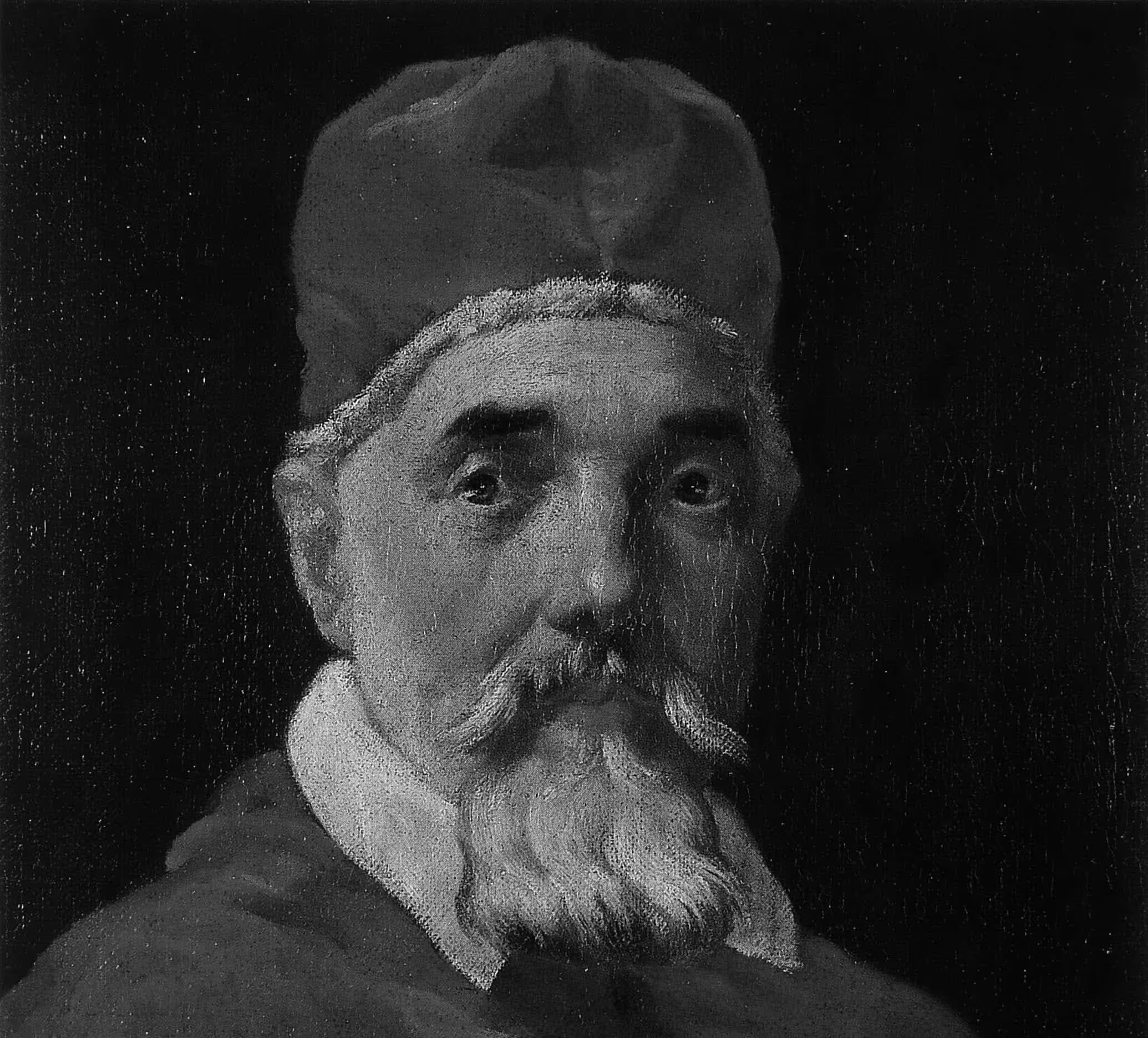
Taddeo Barberini
1603-1647
Biography
Taddeo Barberini (1603–1647) was the principal secular representative of the Barberini family during the pontificate of his uncle, Pope Urban VIII (Maffeo Barberini), and one of the most prominent lay figures of seventeenth-century Rome. Born in Rome on 16 November 1603 to Carlo Barberini, Duke of Monterotondo and a general of the Church, and Costanza Magalotti, Taddeo was the second son of the family. Unlike his brothers Francesco and Antonio, both of whom entered the ecclesiastical hierarchy and became cardinals, he pursued a secular career. Following the election of his uncle to the papacy in 1623, Taddeo rapidly acquired offices, titles, estates, and ceremonial responsibilities that made him a central instrument of Barberini dynastic power.
In 1627, Taddeo married Anna Colonna, daughter of Filippo I Colonna, Constable of the Kingdom of Naples and a leading member of one of Rome’s most ancient and powerful baronial families. The marriage, celebrated by Urban VIII himself, strengthened the Barberini family's connections with the Roman aristocracy and was accompanied by a substantial dowry. In 1629, Taddeo acquired the fief of Palestrina from the Colonna family and assumed the title of Prince of Palestrina. The acquisition represented an important step in the transformation of the Barberini from a relatively recent Florentine family into one of the dominant dynasties of papal Rome.
Following the death of his father in 1630, Taddeo became the head of the family in its secular affairs, inheriting his father's estates, offices, and titles. In 1631, Urban VIII appointed him Prefect of Rome, in addition to confirming or expanding his responsibilities as commander of papal forces, Governor of the Borgo, and castellan of Castel Sant'Angelo. The prefecture gave Taddeo an important position within the secular administration of Rome and enhanced his public visibility, although contemporary and modern historians have generally regarded him as a secondary political figure whose principal concern was the advancement of Barberini family interests rather than the independent formulation of papal policy.
Taddeo's position within the Barberini court complemented the ecclesiastical and diplomatic functions exercised by his brothers. Cardinal Francesco Barberini, the eldest of the three brothers, served as Urban VIII's principal secretary of state and was deeply involved in the administration of the papacy, while Cardinal Antonio Barberini occupied an increasingly important position in the family's political network. Taddeo, as the family's principal lay representative, embodied its secular authority through offices, estates, ceremonial display, and patronage. His career therefore formed part of the broader system of papal nepotism through which Urban VIII sought to consolidate the political, economic, and social position of his relatives.
This dynastic program found one of its most spectacular expressions in the construction of Palazzo Barberini alle Quattro Fontane. Initiated after Urban VIII's election and developed from 1625 onward, the palace became the architectural centrepiece of Barberini power. Carlo Maderno, Gian Lorenzo Bernini, and Francesco Borromini were successively involved in the project, while Pietro da Cortona executed the monumental Triumph of Divine Providence in the great salon. The building transformed the Barberini family's newly acquired social prominence into a permanent architectural statement, combining residential, ceremonial, artistic, and dynastic functions.
Taddeo participated actively in this culture of artistic patronage. His interests extended beyond architecture to painting, collecting, and the decoration of the family's residences and estates. The monumental language developed around the Barberini court repeatedly incorporated the family's emblematic bees, transforming a heraldic device into a sophisticated visual symbol of industriousness, providential favor, dynastic continuity, and papal authority. Although Palazzo Barberini was fundamentally a collective family enterprise rather than a project attributable to Taddeo alone, his position as the family's secular head made him an important beneficiary and participant in this program of dynastic representation.
Taddeo's role in the history of printing and publishing was likewise situated within the broader cultural policy of the Barberini court. The family exercised considerable influence over the Stamperia Camerale and over the production and circulation of books in Rome. Works celebrating Barberini weddings, offices, military achievements, religious ceremonies, and political initiatives were printed in substantial numbers, often combining elaborate typography, engravings, coats of arms, dedicatory texts, and other forms of visual and textual homage. Taddeo himself appeared frequently as dedicatee or dedicatee's subject, particularly in publications associated with his marriage, his office as Prefect of Rome, his princely status, and his military activities. Such publications should be understood not merely as literary or bibliographical objects but as instruments of representation: they helped construct and disseminate an image of Barberini power throughout Italy and across the European courtly world.
The limits of Taddeo's political and military abilities became particularly apparent during the First War of Castro (1641–1644). Tensions between the Barberini and Odoardo Farnese, Duke of Parma and Piacenza, developed into a wider confrontation over the Farnese duchy of Castro and its economic privileges. In October 1641, papal forces occupied Castro. Taddeo subsequently assumed command of the papal army, but the initial success proved temporary. The military organization of the Papal States was inadequate, and the papal forces suffered a series of reverses against the Farnese and their allies. The conflict became an important political and financial liability for the Barberini regime, contributing significantly to the erosion of the family's prestige and to the enormous costs incurred by the Apostolic Camera.
The crisis intensified after the death of Urban VIII in July 1644 and the election of Pope Innocent X (Giovanni Battista Pamphili). The political ascendancy of the Barberini family collapsed rapidly. Innocent X ordered an investigation into the financial administration of the preceding pontificate, with particular attention to the enrichment of the Barberini and the management of the finances associated with the War of Castro. The investigation exposed serious irregularities and placed the family's enormous accumulation of wealth under scrutiny. Taddeo and his brothers were consequently threatened with prosecution, sequestration of their possessions, and the loss of their political position in Rome.
In January 1646, Taddeo and Cardinal Francesco fled Rome and sought refuge in France under the protection of Cardinal Jules Mazarin and the French crown. Their flight marked the definitive collapse of Taddeo's career as a Roman prince and papal officeholder. In France, the Barberini brothers benefited from Mazarin's political protection, while diplomatic negotiations continued concerning their property and their possible reconciliation with Innocent X. Although the pope eventually agreed to a settlement that allowed the family to recover much of its property, Taddeo did not live to return to Rome. He died in Paris in 1647, still in exile.
Taddeo Barberini's historical significance therefore lies less in exceptional political or military ability than in the role he played within the extraordinary expansion of Barberini power under Urban VIII. As Prince of Palestrina, Prefect of Rome, military commander, landowner, and patron, he represented the secular dimension of a family whose influence extended simultaneously across the papal administration, aristocratic society, the arts, architecture, publishing, and international diplomacy. His career illustrates both the extraordinary possibilities offered by papal nepotism in seventeenth-century Rome and its inherent vulnerability: within little more than two decades, the Barberini rose from an ambitious papal family to one of the most powerful dynasties in Europe, only to see much of that political ascendancy collapse with the death of its papal patron.
Bibliography
Pastor, Ludwig von. The History of the Popes from the Close of the Middle Ages. Vols. 28–30. St. Louis: Herder, 1923–1969.
Pecchiai, Pio. I Barberini. Rome: Biblioteca d’Arte Editrice, 1959.
Merola, Alberto. “Barberini, Taddeo.” In Dizionario Biografico degli Italiani, vol. 6. Rome: Istituto della Enciclopedia Italiana, 1964.
Magnuson, Torgil. Rome in the Age of Bernini: From the Election of Sixtus V to the Death of Urban VIII. 2 vols. Stockholm: Almqvist & Wiksell International, 1982–1986.
Hibbert, Christopher. Rome: The Biography of a City. New York: W. W. Norton & Company, 1985.
Nussdorfer, Laurie. Civic Politics in the Rome of Urban VIII. Princeton, NJ: Princeton University Press, 1992.
Scott, John Beldon. Images of Nepotism: The Painted Ceilings of Palazzo Barberini. Princeton, NJ: Princeton University Press, 1991.
Hammond, Frederick. Music and Spectacle in Baroque Rome: Barberini Patronage under Urban VIII. New Haven, CT: Yale University Press, 1994.
Morrissey, Jake. The Genius in the Design: Bernini, Borromini, and the Rivalry That Transformed Rome. New York: HarperCollins, 2005.
Beyond the names: biographies and bibliographies on this page are curated by Abu, the AI scholar crafted by Buonvecchio exclusively for Govi Rare Books.