
Alfonso Rivarola
(1607-1640)
Biography
Alfonso Rivarola, commonly called il Chenda (Ferrara, probably 1591–Ferrara, 8 January 1640), was a Ferrarese painter, designer, theatrical architect, and engineer of ephemeral spectacle whose career belongs to the formative decades in which court festival, tournament, scenography, and opera were converging into new kinds of theatrical space. His biography presents an immediate chronological difficulty. An older tradition, perpetuated through Ferrarese artistic biography and later dictionaries, made him thirty-three at his death and consequently placed his birth around 1607; modern theatre-historical scholarship, however, generally gives 1591, while still other modern notices have proposed a date around 1590. The discrepancy is significant because the later date would compress his apprenticeship and documented professional activity into an implausibly short career. The chronology adopted by recent specialist work therefore makes the earlier date considerably more persuasive, although the evidence should not be made more precise than the surviving documentation permits. His death on 8 January 1640 is much more securely established, and the Ferrarese tradition recorded his burial in the church of the confraternity of Santo Spirito.
Rivarola's earliest artistic identity was that of a painter formed in the orbit of Carlo Bononi, one of the principal figures of early seventeenth-century Ferrarese painting. The relationship was substantial rather than nominal: contemporary and later accounts remembered Rivarola among Bononi's closest assistants, and documentary and stylistic scholarship has connected him with the extensive decorative campaigns undertaken by Bononi and his workshop. Santa Maria in Vado in Ferrara is particularly important for reconstructing this phase of his career. Bononi's work there involved considerable workshop participation, especially around 1630–32, and Rivarola, together with Bononi's nephew Lionello, is specifically identified among the assistants. Modern scholarship has also recognized Rivarola's hand within parts of the earlier decorative programme, including the Marriage at Cana. The surviving evidence therefore places him inside a workshop in which large-scale religious painting already required the coordination of architectural space, monumental composition, assistants, and the visual management of complex ensembles—skills readily transferable to the ephemeral architecture that would become his more distinctive field.
The precise limits of Rivarola's painted œuvre are considerably harder to establish. Ferrarese biographical tradition credited him with a substantial intervention in the Marriage of the Virgin at Santa Maria in Vado, a large presbytery painting associated with Bononi and left unfinished when the master died in 1632. Other works recorded under Rivarola's name included a Baptism of Saint Augustine, paintings for the Theatines, and religious compositions formerly preserved in Ferrarese churches. Some have disappeared, others remain entangled in attributional problems created by the closeness of his manner to Bononi's workshop, and the evidence does not justify constructing a large autonomous corpus around him. The inventory of Rivarola's possessions recovered by modern scholarship is consequently important: it confirms a continuing engagement with painting even where the surviving objects themselves no longer permit a coherent reconstruction of his production. The imbalance between the meagre surviving painted œuvre and the abundant evidence for his theatrical activity has profoundly altered his historical reputation. The Chenda who emerges from seventeenth-century documents is much less adequately described as a minor follower of Bononi than as a specialist capable of transferring pictorial knowledge into architecture, perspective, machinery, illumination, and the management of spectacle.
That transformation becomes visible by the later 1620s. The world in which Rivarola worked did not impose the modern separation between scenographer, painter, architect, engineer, and theatrical technician. An apparatore could be responsible for the conception of a temporary architectural environment, the perspective painting of its scenery, the organization of carpentry and construction, the movement of machines, and the accommodation and sightlines of spectators. Ferrara possessed an especially fertile tradition of such expertise, supported by Este court culture and subsequently maintained through aristocratic networks that connected Ferrara with Parma, Bologna, Padua, Venice, and other northern Italian centres. Rivarola belonged to a group that included the scenographer and engineer Francesco Guitti, Francesco Mazzi, the patron and organizer Enzo Bentivoglio, Borso Bonacossi, and, decisively for Rivarola's mature career, Pio Enea II degli Obizzi.
In 1628 Rivarola was sent from Ferrara to Parma during the extraordinary cycle of festivities surrounding the marriage of Odoardo Farnese and Margherita de' Medici. His presence there places him within one of the most technically sophisticated theatrical environments in Europe, centred upon the Teatro Farnese and the Farnese court's tradition of integrating tournament, spectacle, architecture, and machinery. Surviving correspondence associates the Ferrarese specialists with the construction and painting of mobile scenic elements and other apparatus for the celebrations. Rivarola's activity should therefore be understood collaboratively: the documentary record reveals the circulation not simply of individual artists but of a Ferrarese technical culture, with practitioners moving between courts in response to commissions that demanded knowledge difficult to obtain locally. His association with Guitti and Mazzi is particularly revealing, since it situates his subsequent inventions within a community of practice rather than treating the transformations of seventeenth-century scenography as the achievements of isolated geniuses.
The same combination of painting, architecture, and engineering appears in the Ferrarese tournament commissioned by the Bonacossi family in 1631. Rivarola participated in the architectural and scenic apparatus, and the printed record of the event preserved its ephemeral structures through engraved folding plates attributed to his designs. Such festival books deserve particular emphasis in assessing his career. The physical constructions themselves were temporary by definition: timber architecture was dismantled, painted scenery reused or destroyed, machinery disassembled. Print consequently became the principal mechanism by which a spectacle could survive beyond the occasion for which it had been created. Rivarola's historical œuvre thus exists in an unusual relationship between object and representation. What has disappeared architecturally may survive bibliographically, through festival descriptions and engraved plates that translate temporary three-dimensional environments into reproducible images. At the same time, those engravings cannot be treated as mechanically exact records of what spectators saw: they are mediated representations, adjusted by draughtsmen and engravers to the requirements of the printed page.
During the 1630s Rivarola's professional network broadened. Ferrarese evidence places him among artists engaged in the city's culture of tournaments, religious festivities, and temporary architecture, while the biography preserved by Girolamo Baruffaldi remembers his collaboration in spectacular civic and devotional apparatus. One particularly ambitious undertaking occurred in 1638 in connection with festivities involving Ascanio Pio di Savoia, when Rivarola was responsible for the realization of an elaborate apparatus erected in Ferrara's Piazza Nuova, now Piazza Ariostea. Baruffaldi's account makes an important distinction between invention and execution: the conceptual programme belonged to Ascanio Pio, whereas the Chenda translated that programme into the architecture and machinery of spectacle. The distinction is characteristic of the collaborative economy in which Rivarola worked and cautions against attributing to the scenographer every aspect of the iconographic or dramatic invenzione.
The decisive work of Rivarola's career, however, was L'Ermiona, devised by Pio Enea II degli Obizzi and performed at Padua in 1636. With music by Giovanni Felice Sances, the production combined sung drama, ballet, pedestrian action, and equestrian tournament on a scale that makes conventional generic labels inadequate. Obizzi supplied the dramatic conception, while Rivarola was responsible for the architectural and scenic realization. The production took place in the large building known as the Stallone at Prato della Valle, whose interior had to be transformed into a theatrical environment capable simultaneously of accommodating spectators, musicians, dramatic performers, dancers, horses, scenic transformations, and machinery. The surviving documentation identifies Rivarola explicitly as the engineer responsible for the scenography.
The architectural organization of the Stallone is central to Rivarola's importance in theatre history. The interior was arranged on a U-shaped plan with five superimposed orders of loggias or large compartments and additional stepped seating, while corridors behind the spectator spaces allowed access without requiring continual movement through the central arena. That central area remained available for the tournament action on foot and horseback. At one end stood a broad stage equipped with perspective scenery and machinery capable of repeated transformations. The surviving description indicates eight scenic changes, four of them complete, requiring seven backdrops together with lateral wings. Maritime, woodland or pastoral, and urban settings successively created Tyre, the countryside of Boeotia, and Thebes; the last drew upon the architectural vocabulary conventionally associated with the tragic scene. The result was neither simply a court theatre nor merely an indoor tournament ground. Rivarola created an integrated spatial system in which several forms of spectacle could succeed and penetrate one another while the audience remained organized within a coherent architectural framework.
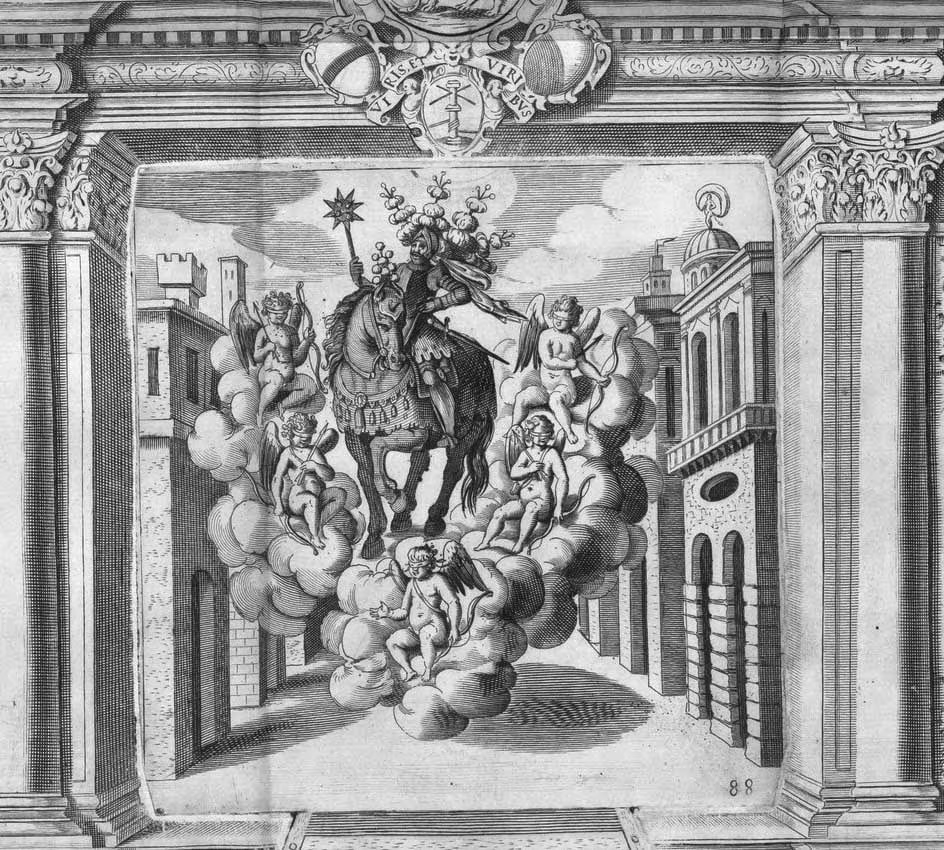
The history of L'Ermiona is inseparable from its printed transmission. The work appeared at Padua under the title L'Ermiona del S. marchese Pio Enea Obizzi, per introduzione d'un torneo a piedi e a cavallo e d'un balletto rappresentato in musica nella città di Padova l'anno MDCXXXVI, with the spectacle described by Nicolò Enea Bartolini. Bibliographical evidence records an edition by Paolo Frambotto associated with the 1636 performance, while the illustrated documentation commonly cited in theatre history is connected with the fuller printed memorial of the spectacle issued in 1638. The publication preserves the dramatic organization into three attioni—Il rapimento d'Europa, Gli errori di Cadmo, and Gl'imenei—and, more importantly for Rivarola's reputation, a remarkable sequence of engraved views of the theatrical environment and its changing scenes. Fifteen plates constitute the principal visual testimony to his mature scenographic practice. Their documentary value is exceptional but must again be handled critically: contemporary theatrical images rearrange scale, viewpoint, figures, and architecture for legibility and commemorative effect, so that they transmit Rivarola's spatial conception without functioning as literal architectural surveys.
The importance subsequently attached to the Ermiona auditorium arises particularly from its superimposed spectator compartments and the circulation corridors behind them. These features belong to the longer development of the seventeenth-century Italian box theatre, in which social differentiation, visibility, ceremonial hierarchy, and theatrical architecture became increasingly inseparable. Rivarola's solution is an important document in that development, but it would be misleading to present it as the sudden invention of the modern box theatre by a single designer. Experiments with differentiated and vertically organized spectator accommodation preceded him, and comparable solutions developed in several Italian centres. His achievement lies instead in the sophistication with which such arrangements were integrated into a temporary multipurpose structure capable of supporting opera, ballet, machinery, and equestrian tournament. In L'Ermiona, social architecture and scenic architecture were conceived as parts of the same theatrical problem.
The collaboration with Obizzi continued to define Rivarola's final years. Obizzi was himself much more than the nominal patron or librettist of these spectacles: modern research has reconstructed him as a highly informed organizer—or corago—capable of coordinating the artistic, practical, and ceremonial components of complex tournaments. Rivarola supplied precisely the complementary expertise that such projects required, converting dramatic programmes into functioning spaces and machines. Their partnership is therefore one of the most instructive relationships in early seventeenth-century Italian spectacle, because it reveals the division of intellectual and technical labour concealed by the apparent unity of the finished festival. Modern archival research into Obizzi has consequently been fundamental to recovering Rivarola as a historical figure, since contemporary correspondence and festival documentation preserve a professional identity largely invisible in the traditional history of painting.
The culmination of this partnership came in Bologna in 1639 with I furori di Venere, an opera-tournament produced in the Sala del Podestà during the gonfalonierate of Cornelio Malvasia. Obizzi acted as intermediary in bringing the Chenda to Bologna, and contemporary evidence explicitly assigns Rivarola responsibility for planning the structures of the hall and apparatus and for realizing its scenery and machines. The distinction is again valuable: Malvasia presided over the enterprise, Obizzi supplied crucial theatrical expertise and mediation, and Rivarola assumed the architectural and scenotechnical execution. The surviving description characterizes the undertaking as exceptionally dependent upon machinery, and its effects included monumental transformations in which entire architectural visions could appear, move, or descend within the theatrical space.
The Sala del Podestà presented Rivarola with a problem related to, but distinct from, that of Padua. Once again an existing interior had to be converted into an environment capable of combining an arena with vertically organized spectator accommodation, perspective scenery, and elaborate mechanical effects. The designer's mature competence lay precisely in this conversion of buildings into theatrical machines. Architecture established the relationship among spectators; perspective created fictive extension beyond the physical limits of the room; stage machinery introduced movement into that fictive architecture; illumination controlled the visibility and timing of transformations; and the arena permitted human and equestrian bodies to participate in the same visual system. What survives of I furori di Venere therefore confirms that the achievement of L'Ermiona was not an isolated experiment but part of a sustained professional practice.
Rivarola's final connection with Venice is especially significant, though it requires more caution than some older narratives have allowed. In 1639 he entered the orbit of the theatrical enterprise associated with Benedetto Ferrari, Francesco Manelli, and the new commercial opera culture of Venice. The company transferred to the Grimani theatre of Santi Giovanni e Paolo, where the season included La Delia and Ferrari's Armida. Rivarola's presence in this milieu creates a striking connection between the aristocratic tournament spectacles of Ferrara, Parma, Padua, and Bologna and the rapidly developing commercial operatic stage. It would nevertheless be unsafe to attribute individual Venetian productions or their scenography to him without specific documentary evidence. Scholarship has proposed his participation in other early Venetian spectacles, including Andromeda, but such proposals remain hypotheses rather than secure additions to his œuvre.
This Venetian connection matters because the technical culture in which Rivarola had matured was becoming commercially valuable. Early public opera did not emerge in isolation from court spectacle. It inherited personnel, machines, scenic practices, musical expertise, and architectural knowledge from festivals and aristocratic theatres, even while transforming their economics and audiences. Rivarola's trajectory provides unusually concrete evidence of that transfer. He had worked within networks in which a specialist might be dispatched from Ferrara to Parma, summoned through an aristocratic intermediary to Bologna, employed by Obizzi in Padua, and finally drawn toward Venice. His career consequently maps the circulation of theatrical expertise across northern Italy immediately before Venetian opera became a durable commercial institution.
Rivarola died at Ferrara on 8 January 1640, just as this new theatrical economy was gathering momentum. Later accounts embroidered the circumstances of his death, and anecdotal explanations should be separated from securely documented evidence. More consequential than the manner of his death was its timing. He disappeared when his combination of pictorial, architectural, and mechanical expertise had become exceptionally pertinent to the requirements of opera, leaving no long subsequent career through which his methods could be followed into the mature Venetian stage. His surviving work therefore belongs overwhelmingly to the experimental decades preceding and immediately accompanying the establishment of public opera.
The historiography of Rivarola reflects the uneven survival of the media in which he worked. Early Ferrarese writers approached him primarily through the local history of painting and through his relationship with Bononi. Nineteenth-century dictionaries repeated this painterly identity, preserving notices of lost altarpieces and the tradition of his participation in works at Santa Maria in Vado. Seen from that perspective, he inevitably appeared as a minor regional painter whose early death prevented the development of a substantial œuvre. Twentieth- and twenty-first-century research into festival books, scenography, theatre architecture, correspondence, and court culture has produced a fundamentally different picture. The recovery and analysis of documents surrounding L'Ermiona, I furori di Venere, the Parma festivities, Ferrarese tournaments, and Obizzi's theatrical activities have shown that the scarcity of surviving paintings is a poor measure of Rivarola's contemporary professional significance.
The printed remains of his theatrical work are correspondingly important as material evidence. Festival books associated with productions such as L'Ermiona occupy an unusual position between literary text, commemorative publication, technical record, and visual reconstruction. Their engraved plates preserve architecture that otherwise vanished almost immediately; their descriptions identify machines and transformations that cannot be inferred from libretti alone; and the relationship between text and image makes it possible to reconstruct, however imperfectly, the sequence by which spectators experienced changing spaces. In Rivarola's case the book is therefore not a secondary illustration of an independently surviving œuvre. It is one of the principal surviving forms of that œuvre. The distinction between the original spectacle and its printed representation must remain clear, but without the printed festival tradition his most important achievements would be known largely from fragmentary archival references.
Rivarola's historical position is thus best understood at the intersection of several practices that later historiography tended to separate. His training under Bononi gave him command of monumental pictorial composition and the management of architectural settings; the Ferrarese tradition of tournaments and ephemeral apparatus supplied an environment in which those abilities could become spatial and mechanical; aristocratic networks carried his expertise from one city to another; collaboration with organizers such as Obizzi translated literary and ceremonial programmes into functioning theatrical environments; and print converted those temporary achievements into objects capable of transmission beyond the event itself. His importance does not depend upon claiming for him the invention of a particular theatrical form. It lies in the unusually clear evidence his career provides for the professional convergence of painting, perspective, architecture, engineering, stage machinery, and audience organization during a crucial period in the formation of seventeenth-century Italian theatre.
The contrast between his modest surviving painted corpus and the documentary richness of his ephemeral work is consequently more than an accident of preservation. It exposes a structural problem in the history of early modern art: practitioners
Bibliography
Baruffaldi, Girolamo. “Alfonso Rivarola, detto il Chenda, pittore.” In Vite de’ pittori e scultori ferraresi, vol. 2, 188–197. Ferrara: Domenico Taddei, 1846.
Ghelfi, Barbara. “Alfonso Rivarola detto il Chenda.” In Francesca Cappelletti, Barbara Ghelfi, and Cecilia Vicentini, Una storia silenziosa. Il collezionismo privato a Ferrara nel Seicento, 102–103, 216–219. Venice: Marsilio, 2013.
Obizzi, Pio Enea II degli. L’Ermiona del sig. marchese Pio Enea Obizzi, per introduzione d’un torneo a piedi e a cavallo. Padua: Paolo Frambotto, 1638.
Riccòmini, Eugenio. Il Seicento ferrarese. Ferrara: Cassa di Risparmio di Ferrara, 1969.
Rosand, Ellen. Opera in Seventeenth-Century Venice: The Creation of a Genre. Berkeley and Los Angeles: University of California Press, 1991.
Vicini, Sara. “Rivarola [Chenda], Alfonso [‘Il Chenda’; ‘Il Chendi’].” In The New Grove Dictionary of Opera, edited by Stanley Sadie, vol. 3, 1356. London: Macmillan, 1992.
Volponi, Barbara. Pio Enea II degli Obizzi, “corago” di tornei: Ermiona (1636), Furori di Venere (1639) e Amor pudico (1643). PhD diss., Università degli Studi di Padova, 2014.
Beyond the names: biographies and bibliographies on this page are curated by Abu, the AI scholar crafted by Buonvecchio exclusively for Govi Rare Books.