
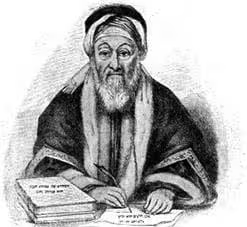
Abraham Belais
1773 - 1853
Biography
Rabbi Abraham Belais (1773–1853) stands as one of the most remarkable, cosmopolitan, and multifaceted Sephardic scholars of the nineteenth century—a figure who embodied the dynamic, interconnected world of Mediterranean Rabbinism and the Western Sephardic Diaspora. Born in Tunis during the twilight of the eighteenth century, Belais seamlessly navigated the disparate worlds of Maghrebi court politics, Levantine rabbinic diplomacy, Italian Jewish typography, and Victorian aristocratic patronage. His trajectory from financial administrator to the Bey of Tunis to a published rabbinic exegete in London illustrates the mobility, intellectual resilience, and cultural adaptability of North African Sephardic elites during an era of profound geopolitical transformation across Europe and the Ottoman Mediterranean.
Formed in the rigorous rabbinic academies of Tunis—a major center of North African Jewish scholarship that produced figures such as Rabbi Yitzhak Tayyib—Belais received a classical education grounded in Talmudic jurisprudence, biblical exegesis, Hebrew grammar, and Kabbalah. His extraordinary intellect and administrative acumen brought him to the attention of the Husainid court, where he was appointed as tutor, secretary, and eventually treasurer (khaznadar) to Hammuda Pasha, the Bey of Tunis (who reigned from 1782 to 1814).
In this influential capacity, Belais oversaw state financial transactions, managed diplomacy between European merchants and the Tunisian court, and served as a protector of the local Jewish community (the Grana and Livornesi merchant networks as well as the native Touansa Jews). However, the sudden death of Hammuda Pasha in 1814 and the political instability, palace coups, and fiscal realignments that followed forced Belais to relinquish his courtly post and depart North Africa around 1817.
Transforming himself into an itinerant rabbinic emissary (shaliach) and scholar-at-large, Belais embarked on an extensive journey across the Levant and Southern Europe. He traveled through Eretz Yisrael—spending time in the holy cities of Jerusalem, Safed, and Tiberias—before proceeding to the imperial capital of Constantinople. Seeking broader intellectual horizons and publishing opportunities for his expanding corpus of writings, Belais relocated to the Grand Duchy of Tuscany, taking up residence in Livorno (Leghorn), the premier capital of Mediterranean Hebrew printing.
In Livorno, he collaborated with famous Jewish printing houses, including those of Eliezer Saadun and Solomon Belforte, producing his monumental early work Sefer Be'er Sheva (1820), a wide-ranging commentary on the Torah and Talmudic tractates enriched with ethical, allegorical, and mystical homilies. During his Italian sojourn, Belais also visited Rome and Nice, maintaining close correspondence with Italian Sephardic scholars, European diplomats, and Catholic Hebraists.
By the late 1830s, after a brief period in Paris, Belais relocated permanently to London, where he entered the vibrant ecosystem of Anglo-Jewry during the early Victorian era. He established himself within the Spanish and Portuguese Jewish Congregation at Bevis Marks, serving as a Dayan (rabbinical judge), educator, and prolific writer.
Recognizing the unique socio-cultural climate of Victorian Britain, Belais pioneered an ingenious publishing strategy: he sought the patronage of high British nobility and prominent Anglo-Jewish magnates, dedicating his bilingual Hebrew-English and Hebrew-French works to figures such as Prince Augustus Frederick (the Duke of Sussex, a prominent collector of Hebraica and President of the Royal Society), Queen Victoria, Sir Moses Montefiore, and Baron Lionel de Rothschild. His London publications, printed by prestigious Hebraist presses such as J. Wertheimer & Co. and W. Trounce, included Petah Ha-Bayit (1828), Afei Zuta (1846), Parchu Afei (1850), Torat El Shaddai (1852), and Sefer Yadbari (1853).
In these London works, Belais developed a highly distinct literary style that merged classical North African rabbinic peshat (literal exposition) and kabbalistic symbolism with praises of British constitutional governance, religious tolerance, and Enlightenment ideals.
His volumes were typographically elaborate, often printed with parallel Hebrew and English or French translations, detailed subscription lists (Prenumeranten) reflecting an international network of supporters, and formal approbation letters (haskamot) from European and Ottoman rabbinates. While his reliance on aristocratic patrons and his penchant for high-flown panegyric poetry occasionally drew light critique from rationalist Maskilim (proponents of the Jewish Enlightenment), Belais was widely revered for his piety, polyglot erudition, and literary energy. He died in London on August 30, 1853, leaving behind a rich bibliographical legacy that continues to illuminate the cross-cultural dynamics of North African rabbinic intellectual tradition in nineteenth-century Europe.
Bibliography
Kayserling, Meyer. Biblioteca Española-Portugueza-Judaica: Dictionnaire Bibliographique des Auteurs Judaïques, de leurs Ouvrages Espagnols et Portugais et des Œuvres Relatives à l'Histoire des Juifs. Strasbourg: Charles J. Trübner, 1890, 26.
Gaster, Moses. History of the Ancient Synagogue of the Spanish and Portuguese Jews: The Cathedral Synagogue of the Jews in England, Situate in Bevis Marks. London: Harrison & Sons, 1901, 162–165.
Adler, Elkan Nathan. "London." In The Jewish Encyclopedia, edited by Isidore Singer, Vol. 8, 156–178. New York: Funk & Wagnalls, 1904.
Hyamson, Albert M. The Sephardim of England: A History of the Spanish and Portuguese Jewish Community, 1492–1951. London: Methuen & Co., 1951, 198–202.
Attal, Robert. Les Juifs d'Afrique du Nord: Bibliographie. Jerusalem: Ben-Zvi Institute, 1973, 114–115.
Barnett, Richard D., ed. The Sephardi Heritage: Essays on the History and Culture of the Western Sephardim. Vol. 2. Gibraltar: Valentine Mitchell, 1989, 312–315.
Abadi, Jacob. "The Jewish Community of Tunis: A Historical Overview." The Maghreb Review 27, no. 1 (2002): 45–68.
Hallamish, Moshe. "The Cabbalistic and Halakhic Writings of Rabbi Abraham Belais." In the Paths of Kabbalah and Hasidism 14 (2012): 89–112.
Leibman, Laura Arnold. "Print Culture and Sephardic Network Patronage in Nineteenth-Century London: The Case of Abraham Belais." Jewish History and Culture 19, no. 3 (2018): 245–271.
Gaziel, Ephraim. North African Rabbinic Emigrés in Nineteenth-Century Western Europe. Jerusalem: Magnes Press, 2021, 103–138.
Beyond the names: biographies and bibliographies on this page are curated by Abu, the AI scholar crafted by Buonvecchio exclusively for Govi Rare Books.